4.1 Context of Early American Democracy

🇺🇸AP US History Unit 4 Review
4.1 Context of Early American Democracy
🇺🇸 AP US History
4.1
Context of Early American Democracy
4.2
The Rise of Political Parties and the Era of Jefferson
4.3
Politics and Regional Interests
4.4
America on the World Stage
4.5
Market Revolution: Industrialization
4.6
Market Revolution: Society and Culture
4.7
Expanding Democracy
4.8
Jackson and Federal Power
4.9
The Development of an American Culture
4.10
The Second Great Awakening
4.11
An Age of Reform
4.12
African Americans in the Early Republic
4.13
The Society of the South in the Early Republic
4.14
Causation in Period 4, 1800-1848
TLDR
Political divisions over government, the economy, and foreign relations fueled party conflict in early American democracy. The Market Revolution transformed society, while the Second Great Awakening sparked reform movements.
What to Know About Context of Early American Democracy
- Federalists favored a strong central government, while Democratic-Republicans favored states' rights; later, Whigs and Democrats disagreed over the economy, expansion, and slavery.
- The Monroe Doctrine rejected European interference in the Americas, while the Louisiana Purchase and Mexican Cession greatly expanded U.S. territory.
- Steamboats, canals, and railroads connected distant regions, making it easier to move goods and increasing manufacturing and agricultural production.
- The Market Revolution drew workers into urban factories and opened some jobs to women, though women faced low wages and limited opportunities.
- The Second Great Awakening sparked reform movements that sought to expand opportunities and rights for groups including enslaved people and women.
A New Republic
Domestic: Party Time!
Early American democracy was shaped by political divisions over federal power, economic policy, foreign relations, and regional interests. Those debates led to the growth of political parties and set up many of the conflicts that defined the early 1800s. This period also saw a move toward a more participatory democracy, as suffrage widened from property-holding requirements to voting by all adult white men. In these years Americans were forming a modern democracy and celebrating a new national culture.
During the First Party System, which lasted from roughly 1792 to 1824, the country was divided between the Federalists, who advocated for a strong central government and a broad interpretation of the Constitution, and the Democratic-Republicans, who emphasized states' rights and a strict interpretation of the Constitution.
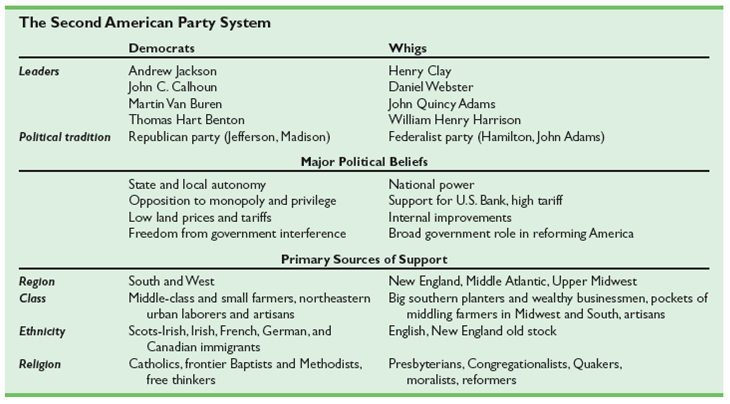
The Second Party System, which lasted from 1824 to 1854, saw the rise of the Whigs and the Democrats, who held competing views on issues such as government intervention in the economy, national expansion, and slavery.
International: Spreading the Word of the U.S.
At the same time, the United States was pursuing an increasingly aggressive foreign policy, aimed at increasing trade and expanding the country's global influence. This interest in foreign trade and a larger national territory prompted both government and private initiatives, as the nation worked to establish an independent global presence and to claim land across the North American continent. While the country faced challenges, such as the War of 1812, it was also successful in other areas, such as the implementation of the Monroe Doctrine, which declared that European powers could not interfere in the affairs of the Americas. 🧍
As the country continued to grow and expand, it acquired new territories through various means, such as the Louisiana Purchase and the Mexican Cession. These acquisitions greatly increased the size of the United States and helped shape its character.Acquiring western lands also set off contests over whether slavery would be extended into the new territories.
In the early 1800s, the country began undergoing significant changes as a result of the Market Revolution, which led to the growth of a large middle class and the spread of new economic and social ideals. At the same time, the Second Great Awakening, a wave of religious revivalism, swept across the country and sparked a series of reform movements. Along with new intellectual movements, it led growing numbers of Americans to pursue their ideals mainly outside government institutions. These movements sought to expand opportunities and rights for marginalized groups, as abolitionists worked to end slavery and women's rights advocates pushed for greater equality. Behind them was a larger effort to define the nation's democratic ideals and reshape society and institutions to match them.
🎥 Watch: AP US History - Writing in Period 4
The Market Revolution's Acceleration of American Growth
The Market Revolution was a period of economic growth and transformation in the United States in the early 19th century. The revolution was driven by innovations in transportation, agriculture, and commerce that had a profound impact on the American economy and society. 🌾
The development of transportation systems such as the steamboat, the canal, and the railroads created new opportunities for commerce and helped to connect far-flung regions of the country. This in turn led to an increase in manufacturing and agricultural production, as goods could be transported more quickly and efficiently.

The Market Revolution had significant effects on American society, particularly on the lives of workers, gender and family relations, and regional identities. It brought about new forms of labor, as workers flocked to urban areas to work in factories and other industries. Women, who had previously been limited to domestic work, also began to find new opportunities in the workforce, though they often faced significant challenges, including low wages and limited job opportunities.
The Market Revolution also shaped settlement and trade patterns, as new transportation systems facilitated the movement of people and goods between different regions of the country. This helped to unify the nation, while also encouraging the growth of distinct regional identities. Even as a new national culture took hold, various groups also formed their own distinct cultures alongside it. The rise of the market economy was a catalyst for significant social and economic changes, transforming the way that people lived, worked, and interacted with each other. 🤝
Timeline
1800 - Election of Thomas Jefferson, Gabriel’s Rebellion, Revolution of 1800
1803 - Marbury v. Madison, Louisiana Purchase
1808 - Election of James Madison
1811 - Battle of Tippecanoe
1812 - War of 1812
1814 - Treaty of Ghent
1815 - State of the Union Address
1817 - Election of James Monroe, Era of Good Feelings
1819 - Panic of 1819
1820 - Missouri Compromise
1824 - Election of John Quincy Adams
1829 - Election of Andrew Jackson
1831 - Turner’s Rebellion
1837 - Panic of 1837, Election of Martin Van Buren
1838 - Trail of Tears
1840 - Election of William Henry Harrison (John Tyler)
1848 - Seneca Falls Convention
Practice Questions for 4.1
1 of 10
Why did organizers of the 1848 Seneca Falls convention model the "Declaration of Sentiments" on the Declaration of Independence instead of drafting a new statement?
A.
They believed federal law required petitions to follow that Declaration format.
B.
They lacked education or literacy and thus relied on preexisting templates.
C.
They had access only to the Declaration as a well-known political text.
D.
They invoked the Declaration to cast women's rights as founding American ideals.
Vocabulary
The following words are mentioned explicitly in the AP® course framework for this topic.Term | Definition |
|---|---|
agricultural production | The cultivation and harvesting of crops and livestock for commercial purposes. |
foreign policy | Government strategies and decisions regarding relationships, alliances, and conflicts with other nations. |
foreign trade | The exchange of goods and services between the United States and other nations. |
gender and family relations | The social roles, relationships, and dynamics between men and women within households and families. |
intellectual movements | Organized developments in philosophy, science, and ideas that shaped how people understood society and the economy. |
manufacturing | The production of goods in factories using industrial methods, which became a major driver of economic growth in the Northern United States. |
market revolution | The transformation of the American economy from subsistence farming and local trade to a national market economy based on commercial production and exchange. |
national culture | Shared beliefs, values, customs, and practices that Americans developed to define themselves as a unified nation during the early 19th century. |
participatory democracy | A system of government in which a broader range of citizens have the right to vote and participate in the political process, expanded in this period through suffrage reform. |
political parties | Organized groups of citizens united by common ideals and goals that compete for political power and influence. |
property ownership | The holding of land or possessions as a basis for determining voting rights or social status. |
regional identities | The cultural and social characteristics that distinguish different geographic regions and their populations. |
religious movements | Organized groups or trends centered on religious beliefs and practices that gain followers and influence over time. |
republic | A form of government in which power rests with citizens and their elected representatives rather than with a monarch or single ruler. |
settlement patterns | The distribution and arrangement of human populations across geographic areas. |
slavery extension | The debate and contests over whether slavery would be permitted in newly acquired western territories, a major political conflict of the period. |
suffrage | The right to vote in political elections, which expanded from property-based qualifications to include all adult white men during this period. |
trade patterns | The established routes and systems through which goods are exchanged between regions and nations. |
transportation systems | Networks and infrastructure, such as canals, railroads, and roads, that facilitate the movement of goods and people. |
westward expansion | The movement of British colonists into the interior regions of North America, particularly west of the Appalachian Mountains. |
See Fiveable more often in Google
Mark Fiveable as a preferred source and Google is more likely to show you our guides in Top Stories, with a "preferred" badge in AI Mode and AI Overviews.