AMSCO 5.6 Failure of Compromise

🇺🇸AP US History Review
AMSCO 5.6 Failure of Compromise
🇺🇸 AP US History
AMSCO 1.2:Native American Societies Before European Contact Notes
AMSCO 2.1 Context: European Colonization of North America Notes
AMSCO 2.2 European Colonization Notes
AMSCO 2.3 The Regions of the British Colonies Notes
AMSCO 2.4 Transatlantic Trade Notes
AMSCO 2.5 Interactions between American Indians and Europeans Notes
AMSCO 2.6 Slavery in the British Colonies Notes
AMSCO 2.7 Colonial Society and Culture Notes
AMSCO 2.8 Comparison in Period 2 (1607-1754) Notes
AMSCO 3.1 Contextualizing Period 3
AMSCO 3.2 The Seven Year's War
AMSCO 3.3 Taxation Without Representation
AMSCO 3.4 Philosophical Foundations of the American Revolution
AMSCO 3.5 The American Revolution
AMSCO 3.6 The Influence of Revolutionary Ideals
AMSCO 3.7 The Articles of Confederation
AMSCO 3.8 The Constitutional Convention and Debates Over Ratification
AMSCO 3.9 The Constitution
AMSCO 3.10 Shaping a New Republic
AMSCO 3.11 Developing an American Identity
AMSCO 3.12 Movements in the Early Republic
AMSCO 3.13 Continuity and Change in Period 3
AMSCO 4.1 Contextualizing Period 4
AMSCO 4.2 The Rise of Political Parties and the Era of Jefferson
AMSCO 4.3 Politics and Regional Interests
AMSCO 4.4 America on the World Stage
AMSCO 4.5 Market Revolution
AMSCO 4.6 Effects of the Market Revolution on Society and Culture
AMSCO 4.7 Expanding Democracy
AMSCO 4.8 Jackson and Federal Power
AMSCO 4.9 The Development of an American Culture
AMSCO 4.10 The Second Great Awakening
AMSCO 4.11 An Age of Reform
AMSCO 4.12 African Americans in the Early Republic
AMSCO 4.13 Southern Society in the Early Republic
AMSCO 4.14 Causation in Period 4
AMSCO 5.1 Contextualizing Period 5
AMSCO 5.2 The Idea of Manfiest Destiny
AMSCO 5.3 Manifest Destiny and the Mexican-American War
AMSCO 5.4 The Compromise of 1850
AMSCO 5.5 Sectional Conflict: Regional Differences
AMSCO 5.6 Failure of Compromise
AMSCO 5.7 Election of 1860 and Secession
AMSCO 5.8 Military Conflict in the Civil War
AMSCO 5.9 Government Policies During the Civil War
AMSCO 5.10 Reconstruction
AMSCO 5.11 Failure of Reconstruction
AMSCO 5.12 Comparion in Period 5
AMSCO 6.1 Contextualizing Period 6
AMSCO 6.2 Westward Expansion: Economic Development
AMSCO 6.3 Westward Expansion: Social and Cultural Development
AMSCO 6.4 The "New South"
AMSCO 6.5 Technological Innovation
AMSCO 6.6 The Rise of Industrial Capitalism
AMSCO 6.7 Labor in the Gilded Age
AMSCO 6.8 Immigration and Migration in the Gilded Age
AMSCO 6.9 Responses to Immigration in the Gilded Age
AMSCO 6.10 Development of the Middle Class
AMSCO 6.11 Reform in the Gilded Age
AMSCO 6.12 Role of Government in the Gilded Age
AMSCO 6.13 Politics in the Gilded Age
AMSCO 6.14 Continuity and Change Period 6
AMSCO 7.1 Contextualizing Period 7
AMSCO 7.2 Imperialism: Debates
AMSCO 7.3 The Spanish-American War and U.S. Foreign Policy to 1917
AMSCO 7.4 The Progressives
AMSCO 7.5 World War I: Military and Diplomacy
AMSCO 7.6 World War I: Home Front
AMSCO 7.7 1920s: Innovations in Communication and Technology
AMSCO 7.8 1920s: Cultural and Political Controversies
AMSCO 7.9 The Great Depression
AMSCO 7.10 The New Deal
AMSCO 7.11 Inerwar Foreign Policy
AMSCO 7.12 World War II Mobilization
AMSCO 7.13 World War II Military
AMSCO 7.14 World War II and Postwar Diplomacy
AMSCO 7.15 Comparison in Period 7
AMSCO 8.1 Contextualizing Period 8
AMSCO 8.2 The Cold War from 1945 to 1980
AMSCO 8.3 The Red Scare
AMSCO 8.4 Economy after 1945
AMSCO 8.5 Culture after 1945
AMSCO 8.6 Early Steps in the Civil Rights Movement, 1945-1960
AMSCO 8.7 America as a World Power
AMSCO 8.8 The Vietnam War
AMSCO 8.9 The Great Society
AMSCO 8.10 The African American Civil Rights Movement in the 1960s
AMSCO 8.11 The Civil Rights Movement Expands
AMSCO 8.12 Youth Culture of the 1960s
AMSCO 8.13 The Environment and Natural Resources from 1968 to 1980
AMSCO 8.14 Society in Transition
AMSCO 8.15 Continuity and Change in Period 8
AMSCO 9.1 Contextualizing Period 9
AMSCO 9.2 Reagan and Conservatism
AMSCO 9.3 The End of the Cold War
AMSCO 9.4 A Changing Economy
AMSCO 9.5 Migration and Immgiration in the 1990s and 2000s
AMSCO 9.6 Challenges of the 21st Century
AMSCO 9.7 Causation in Period 9
AMSCO 1.1 Contextualizing Period 1 Notes
AMSCO 1.3 European Exploration in the Americas Notes
AMSCO 1.4 Columbian Exchange, Spanish Exploration, and Conquest Notes
AMSCO 1.5 Labor, Slavery, and Caste in the Spanish Colonial System Notes
AMSCO 1.6 Cultural Interactions in the Americas Notes
AMSCO 1.7 Causation in Period 1 Notes
Overview
AMSCO Topic 5.6, Failure of Compromise, covers the chain of events from 1852 to 1858 that destroyed every attempt to settle the slavery question peacefully and set the nation on the path to Civil War. Three slavery-related issues divided North and South: the morality of slavery, states' rights (especially the right to protect slavery), and economic differences between the free-labor industrial North and the slave-labor agricultural South. This chapter traces how popular sovereignty failed in Kansas, the Second Party System collapsed, the Supreme Court inflamed the crisis with Dred Scott, and Abraham Lincoln rose to national fame in the Lincoln-Douglas debates.
This chapter picks up where the Compromise of 1850 left off. Every "solution" in 5.6 makes things worse. That's the whole story.
Historians still debate the big question: was the war inevitable, or did blundering politicians and extremism turn a solvable conflict into an unnecessary war? Keep both interpretations in mind. They make great essay material.
Key Takeaways
- In 1852, Whig factions fought over slavery and the party neared a split; Douglas's Kansas-Nebraska Act later let settlers decide on slavery in territories the Missouri Compromise had closed to it.
- Popular sovereignty brought rival governments and violence to Kansas, while Preston Brooks's caning of Charles Sumner exposed the growing divide between North and South.
- After the Whigs broke apart, the Republican Party formed to oppose slavery's expansion; John C. Fremont's strength in free states in 1856 alarmed the South.
- Congress and Kansas voters rejected the proslavery Lecompton Constitution, while Dred Scott barred Congress from excluding slavery from federal territories and put popular sovereignty in doubt.
- In the 1858 Lincoln-Douglas debates, Douglas's Freeport Doctrine angered Southern Democrats; Douglas kept his Senate seat, but Lincoln became a national figure.
National Parties in Crisis: The Election of 1852 and the Kansas-Nebraska Act
The two major parties, the Democrats and the Whigs, grew weak and divided over slavery in the 1850s. The Whigs cracked first.
The Election of 1852
The Whigs nominated Mexican War hero General Winfield Scott and tried to ignore slavery entirely, running on their traditional platform of improving roads and harbors. It didn't work. The party's antislavery and Southern factions fell to fighting, and the party neared a split.
The Democrats nominated Franklin Pierce of New Hampshire as a compromise candidate. He was a Northerner, but Southern Democrats accepted him because he supported the Fugitive Slave Law. Pierce won all but four states in the Electoral College. The Whig Party's days were clearly numbered.
The Kansas-Nebraska Act (1854)
Senator Stephen A. Douglas of Illinois wanted a transcontinental railroad running through the center of the country with a major terminus in Chicago (where, conveniently, he owned real estate). Southerners preferred a southern route, so Douglas cut a deal to win their votes:
- His bill divided the Nebraska Territory into two territories, Kansas and Nebraska
- Settlers in each would decide on slavery by popular sovereignty
- Both territories sat north of the 36°30' line, so the bill opened land to slavery that the Missouri Compromise of 1820 had closed to it
Northern Democrats condemned the bill as a surrender to "slave power," but after three months of bitter debate, Congress passed the Kansas-Nebraska Act of 1854 and Pierce signed it. In effect, it repealed the Missouri Compromise that had kept regional tensions in check for over three decades.
"Bleeding Kansas" and the Sumner-Brooks Incident
After 1854, the conflict between proslavery and antislavery forces turned violent, both in Kansas and on the floor of the U.S. Senate.
Violence in Kansas
Douglas expected antislavery farmers from the Midwest, who made up the majority of settlers, to settle the question peacefully. Instead, both sides rushed to control the territory:
- Slaveholders from neighboring Missouri set up homesteads to win Kansas for the South. Their enemies called them "border ruffians."
- Northern abolitionists and Free-Soilers organized the New England Emigrant Aid Company (1855) to pay transportation costs for antislavery settlers.
- Two rival governments formed: a proslavery legislature in Lecompton and an antislavery legislature in Topeka.
In 1856, proslavery forces attacked the free-soil town of Lawrence, killing two people and destroying homes and businesses. Two days later, abolitionist John Brown and his sons retaliated by attacking a proslavery settlement at Pottawatomie Creek and killing five. The territory earned the name "bleeding Kansas."
The Pierce administration did nothing to keep order or support honest elections in Kansas. Popular sovereignty, the supposedly democratic fix, had produced chaos and bloodshed.
Caning of Senator Sumner (1856)
Massachusetts senator Charles Sumner attacked the Democratic administration in a vitriolic speech, "The Crime Against Kansas," which included personal insults against South Carolina senator Andrew Butler. Butler's nephew, Congressman Preston Brooks, walked into the Senate chamber and beat Sumner over the head repeatedly with a cane. Sumner never fully recovered.
The reaction is the point. The North was outraged and the House voted to censure Brooks, while Southerners applauded him. The same act looked like an atrocity to one section and a defense of honor to the other.
Birth of the Republican Party and the Election of 1856
The Whig Party broke apart completely, and ex-Whigs scattered in three directions:
- Those worried about immigration joined the nativist Know-Nothing Party, which won some local and state elections in the mid-1850s before fading as slavery eclipsed immigration as the central issue
- Ex-Whigs who supported slavery's expansion joined the Democrats, whose core was now the South
- Ex-Whigs who opposed slavery's expansion formed the core of a new party
The Republican Party was founded in Wisconsin in 1854 in direct reaction to the Kansas-Nebraska Act. It combined Free-Soilers with antislavery Whigs and Democrats. Its goal was to stop the spread of slavery into the territories, not to abolish slavery itself. Its first platform called for repealing both the Kansas-Nebraska Act and the Fugitive Slave Law. As Kansas bled, the party grew into the second largest in the country. But it was strictly a Northern, sectional party, and its rise threatened and alienated the South.
The Election of 1856
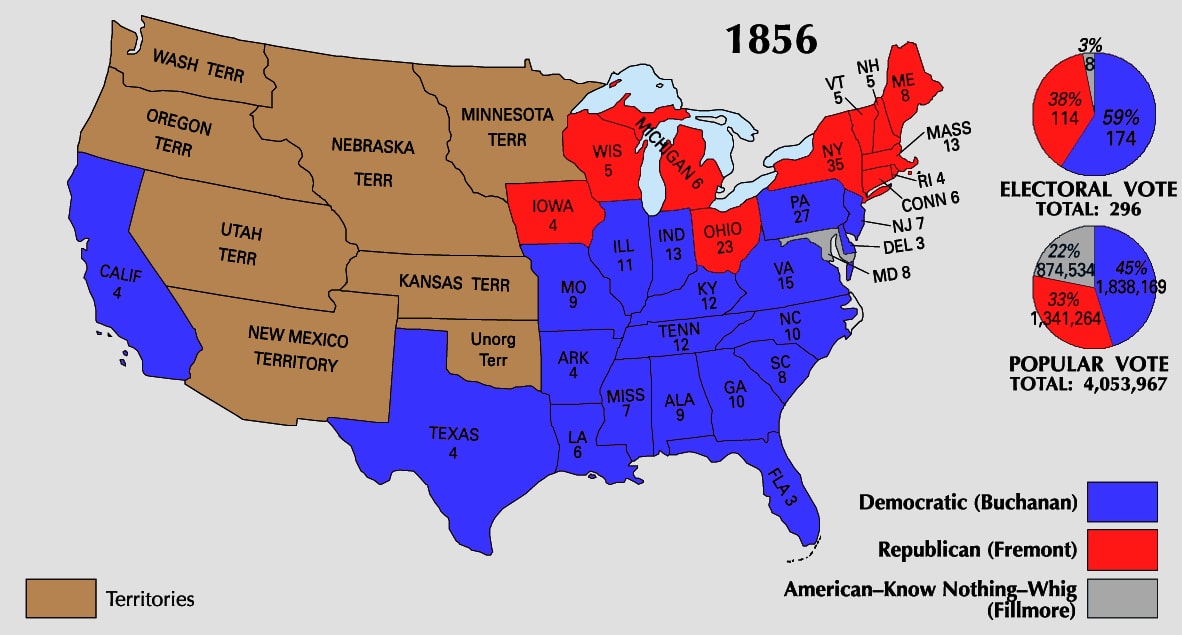
The Republicans' first presidential test came in 1856 with nominee John C. Frémont, the California senator and explorer known as the "Pathfinder." The Republican platform: no expansion of slavery, free homesteads, and a probusiness protective tariff. The Know-Nothings ran former President Millard Fillmore, who took 20 percent of the popular vote.
The Democrats nominated James Buchanan of Pennsylvania, rejecting both Pierce and Douglas because they were too tied to the Kansas-Nebraska mess. Buchanan won, but Frémont carried 11 of the 16 free states. The math was alarming for the South: a purely sectional antislavery party could plausibly win the presidency without a single Southern vote. The election foreshadowed a party that would win all but four presidential elections between 1860 and 1932.
Constitutional Crises Under Buchanan: Lecompton and Dred Scott
Both major positions on slavery in the territories, the Democrats' popular sovereignty and the Republicans' no-expansion stance, took serious blows during Buchanan's administration (1857-1861).
The Lecompton Constitution
In 1857, the proslavery legislature at Lecompton submitted a proslavery state constitution for Kansas. Buchanan knew it lacked majority support but asked Congress to accept it and admit Kansas as a slave state anyway. Congress refused. Many Democrats, including Stephen Douglas, joined Republicans in rejecting it. In 1858, Kansas settlers, most of them antislavery, overwhelmingly voted the document down. Buchanan came out of the episode looking like a weak president doing the South's bidding.
Dred Scott v. Sandford (1857)
Dred Scott was an enslaved man held in Missouri who had lived for two years in the free territory of Wisconsin before returning to Missouri. He sued for his freedom in 1846, arguing that residence on free soil made him free. The Supreme Court, led by Chief Justice Roger Taney, a Southern Democrat, ruled against Scott in March 1857, just two days after Buchanan's inauguration. The majority held:
- Scott had no right to sue in federal court because the Framers did not intend African Americans to be U.S. citizens
- Congress could not deprive any person of property without due process, and since enslaved people were treated as property, Congress could not exclude slavery from any federal territory
- The Missouri Compromise was unconstitutional
In effect, the Court declared every Western territory open to slavery. Southern Democrats were delighted; Republicans denounced the ruling as "the greatest crime in the annals of the republic." The suspicious timing fed Northern fears of a "Slave Power" conspiracy between Buchanan and the Taney Court, pushing thousands of Democrats into the Republican Party. Northern Democrats like Douglas were stuck with an impossible task: defending popular sovereignty without rejecting Dred Scott. If Congress couldn't ban slavery from a territory, how could territorial voters?
The Lincoln-Douglas Debates (1858)
In 1858, Abraham Lincoln, a successful trial lawyer and former one-term Whig congressman, challenged Douglas for his Illinois Senate seat. Douglas (the "Little Giant") was nationally famous as the champion of popular sovereignty; Lincoln was a relative unknown.
Lincoln was not an abolitionist. He was a moderate who opposed the expansion of slavery and framed slavery as a moral issue ("If slavery is not wrong, nothing is wrong"). Accepting the Republican nomination, he delivered his famous house-divided speech: "I believe this government cannot endure, permanently half slave and half free." That line made Southerners see him as a radical.
The two met in seven debates across Illinois. At Freeport, Lincoln challenged Douglas to reconcile popular sovereignty with Dred Scott. Douglas's answer became the Freeport Doctrine: slavery couldn't actually exist anywhere local citizens refused to pass slave codes maintaining it. The answer angered Southern Democrats, who felt Douglas didn't go far enough in backing Dred Scott.
The outcome cut both ways. Douglas kept his Senate seat but alienated Southern Democrats, damaging his 1860 presidential hopes. Lincoln lost the election but emerged as a national figure and a leading contender for the Republican nomination in 1860, which sets up the election of 1860 and secession.
Key Terms to Know
| Term | Why it matters |
|---|---|
| Kansas-Nebraska Act (1854) | Douglas's bill applied popular sovereignty to Kansas and Nebraska, effectively repealing the Missouri Compromise and reigniting sectional conflict. |
| Stephen A. Douglas | Illinois senator who sponsored the Kansas-Nebraska Act and championed popular sovereignty as the path to compromise. |
| Franklin Pierce | Democratic president elected in 1852 who signed the Kansas-Nebraska Act and failed to keep order in Kansas. |
| "Bleeding Kansas" | The violent struggle between proslavery and antislavery settlers that proved popular sovereignty produced bloodshed, not compromise. |
| New England Emigrant Aid Company | Organization founded in 1855 to pay transportation for antislavery settlers moving to Kansas. |
| Pottawatomie Creek | Site where John Brown and his sons killed five proslavery settlers in retaliation for the attack on Lawrence. |
| Sumner-Brooks incident | Preston Brooks's 1856 caning of Senator Charles Sumner showed sectional rage had reached the Senate floor itself. |
| Know-Nothing Party | Nativist, anti-immigrant party that briefly absorbed ex-Whigs before slavery eclipsed immigration as the central issue. |
| Republican Party | Sectional Northern party founded in Wisconsin in 1854 to stop the spread of slavery into the territories. |
| John C. Frémont | First Republican presidential nominee (1856), who carried 11 of 16 free states and alarmed the South. |
| Millard Fillmore | Know-Nothing candidate in 1856 who won 20 percent of the popular vote. |
| James Buchanan | Democratic president (1857-1861) whose support for the Lecompton Constitution and weak leadership deepened the crisis. |
| Lecompton Constitution | Proslavery Kansas constitution that lacked majority support; Congress and Kansas voters rejected it. |
| Dred Scott v. Sandford (1857) | Supreme Court ruling that African Americans were not citizens and Congress could not ban slavery from any territory. |
| Roger Taney | Chief Justice and Southern Democrat who wrote the Dred Scott decision. |
| Lincoln-Douglas debates | Seven 1858 Illinois Senate debates that made Lincoln a national figure. |
| House-divided speech | Lincoln's declaration that the government "cannot endure, permanently half slave and half free." |
| Freeport Doctrine | Douglas's claim that slavery couldn't survive without local slave codes, which alienated Southern Democrats. |
Practice and Next Steps
Pair these notes with the Topic 5.6 Failure of Compromise study guide for the course-aligned version of this material, and browse all chapters on the AMSCO notes page. For context, review AMSCO 5.5 on sectional differences before this chapter.
To check your understanding, work through APUSH guided practice questions, drill definitions in the key terms glossary, or try FRQ practice with instant scoring. Period 5 causation questions (why did compromise fail?) show up constantly on the exam, so practicing with this content pays off.
Frequently Asked Questions
What is AMSCO Topic 5.6 Failure of Compromise about?
AMSCO 5.6 covers the events from 1852 to 1858 that destroyed attempts to settle the slavery question peacefully: the Kansas-Nebraska Act, Bleeding Kansas, the collapse of the Whigs and rise of the Republican Party, the Dred Scott decision, and the Lincoln-Douglas debates. The theme is that every attempted compromise made sectional conflict worse.
Why did the Kansas-Nebraska Act cause so much conflict?
The 1854 act let settlers in Kansas and Nebraska vote on slavery, even though both territories sat north of the 36°30' line where the Missouri Compromise had banned slavery since 1820. It effectively repealed that compromise, so proslavery and antislavery settlers raced into Kansas to control the vote, leading to the violence known as Bleeding Kansas.
What did the Dred Scott decision actually rule?
In Dred Scott v. Sandford (1857), Chief Justice Roger Taney's Court ruled that African Americans were not U.S. citizens and could not sue in federal court, that Congress could not exclude slavery from any federal territory because enslaved people were treated as property, and that the Missouri Compromise was unconstitutional. The ruling opened all Western territories to slavery and pushed thousands of Northern Democrats toward the Republican Party.
Was Lincoln an abolitionist in 1858?
No. Lincoln was a moderate who opposed the expansion of slavery into the territories but did not call for ending slavery where it already existed. He framed slavery as a moral wrong in the Lincoln-Douglas debates, and his house-divided speech made Southerners see him as a radical anyway, but the Republican Party's platform targeted slavery's spread, not its abolition.
How does Failure of Compromise show up on the APUSH exam?
Topic 5.6 is core material for causation questions about the political causes of the Civil War, a favorite for SAQs, LEQs, and DBQs in Period 5. Be ready to explain how the Kansas-Nebraska Act, Dred Scott, and the rise of the sectional Republican Party each undermined compromise. You can practice these skills with APUSH FRQ practice and instant scoring.
See Fiveable more often in Google
Mark Fiveable as a preferred source and Google is more likely to show you our guides in Top Stories, with a "preferred" badge in AI Mode and AI Overviews.