Claims and Evidence in Sources

🇺🇸AP US History Review
Claims and Evidence in Sources
🇺🇸 AP US History
Overview
AP US History Claims and Evidence in Sources is the skill of reading a primary or secondary source and figuring out what argument it makes and how it backs that argument up. You identify the main claim, locate the evidence the author uses, compare arguments across two sources, and explain how a piece of evidence supports, modifies, or refutes the argument.
This is one of the core historical thinking skills, listed in the CED as Skill 3. It applies to both multiple-choice questions and free-response questions, so you will use it on stimulus-based MCQ sets, short-answer questions, and the document-based question.
What Claims and Evidence in Sources Means
A claim is the position an author takes. It is the point they want you to accept.
An argument is the claim plus the reasoning and evidence that support it.
Evidence is the specific information an author uses to make the claim believable. This can be facts, examples, statistics, quotations, events, or details from an image, map, or political cartoon.
Sources come in two types:
- Primary sources were created during the time period under study, like a 1766 act of Parliament or a 1860 party platform.
- Secondary sources were created later by historians analyzing the past, like a 2001 history book about internal improvements.
You analyze both text-based and non-text-based sources, so a chart, photograph, or cartoon counts just as much as a written excerpt.
What This Skill Requires
You need to do four things with a source:
- Find the main claim or argument, even when the author does not state it in a single neat sentence.
- Identify which specific details serve as evidence for that argument.
- Line up two sources and compare what each one argues.
- Explain the relationship between evidence and an argument, including whether outside evidence would strengthen, complicate, or undercut the claim.
The skill is not about whether you agree with the source. It is about accurately reading what the source says and how it tries to convince you.
Subskills You Need
The CED breaks Skill 3 into four parts. All four appear on both MCQ and FRQ.
3.A: Identify and describe a claim or argument
Find the author's main point in a text-based or non-text-based source. Ask yourself: what is this author trying to get me to believe?
3.B: Identify the evidence used to support an argument
Spot the specific details the author uses to back the claim. In a written source these are the facts and examples. In an image these are the visual details that carry the message.
3.C: Compare the arguments or main ideas of two sources
Place two sources side by side and explain how their main ideas agree, disagree, or emphasize different things. This is a comparison of ideas, not just topics.
3.D: Explain how claims or evidence support, modify, or refute an argument
Explain the connection between a piece of evidence and an argument. Sometimes you bring in outside historical knowledge and decide whether it strengthens, complicates, or contradicts the source's claim.
How It Shows Up on the AP Exam
This skill appears across multiple parts of the exam.
- Multiple-choice questions come in sets built around one or more stimuli. Many questions ask you to pin down the claim, find the supporting evidence, or identify what outside development would support an argument in the passage.
- Short-answer questions often hand you a secondary source or a primary source and ask you to describe a claim or compare two historians' arguments.
- The document-based question rests on this skill. You read up to seven documents, identify each argument, and use that evidence to support your own thesis.
Here is the kind of MCQ phrasing tied to Skill 3.D, drawn from a sample question about the Erie Canal in a 2001 history book:
Which of the following developments in the early nineteenth century could best be used as evidence to support the argument in the second paragraph of the excerpt?
The correct answer points to the opposition of some political leaders to providing federal funds for public works, because that outside development matches the source's argument about conflict over internal improvements.
Practical tip: when a question says "could best be used as evidence to support," you are matching outside knowledge to the author's claim, not restating the passage.
Examples Across the Course
These examples come from different units and source types so you can see the skill at work in varied contexts.
Period 3 primary source (Declaratory Act, 1766). The claim is that Parliament has full authority to make laws binding the colonies "in all cases whatsoever." A Skill 3.A question asks you to identify that claim of total parliamentary power.
Period 4 secondary source (a 2001 historian on internal improvements). The argument is that the Erie Canal made New York the best place for commerce and triggered rivalry among seaports. A Skill 3.D question asks what outside development could support the second paragraph's argument about competition over internal improvements.
Period 5 primary source (Republican Party platform, 1860). The claim is that freedom is the normal condition of all US territory. A Skill 3.D question asks what serves as evidence for the line that "our Republican fathers" had abolished slavery in national territory, and the answer points to the Northwest Ordinance.
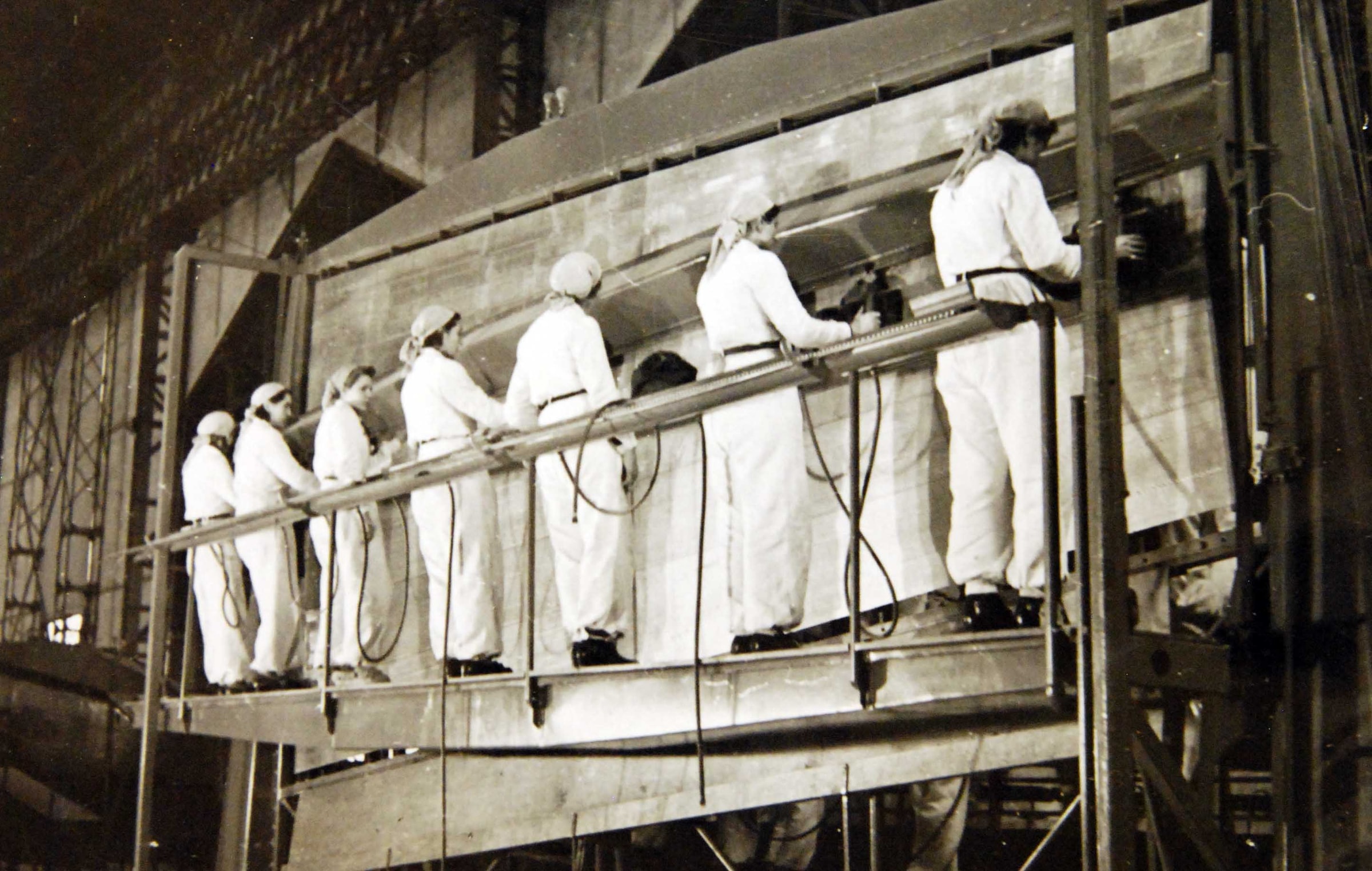
Period 7 non-text source (an image of women in aircraft production in the 1940s). The argument is carried visually. You read details in the photograph to figure out what wartime development it reflects, which is the kind of claim identification Skill 3.A expects from non-text sources.
Two-source comparison (Skill 3.C). Imagine pairing the 1860 Republican platform with a Southern defense of slavery's expansion. You would compare how each source argues about the status of slavery in the territories. The platform claims territory is naturally free, while the opposing source claims slavery may legally extend. The comparison is about the clash of main ideas.
How to Practice Claims and Evidence in Sources
- Read the source attribution first. Knowing the author, date, and source type helps you predict the argument.
- Underline or paraphrase the main claim in one sentence before answering any question.
- For each claim, list the specific evidence the author uses. Separate the claim from the proof.
- For comparison questions, write one sentence for each source's main idea, then state how they relate.
- For 3.D, practice matching outside developments you know to a source's argument and label whether each one supports, complicates, or refutes it.
- Use both text and non-text sources. Pull details out of a chart or cartoon the same way you pull quotations from a passage.
- On the DBQ, sort documents by which side of your thesis they support before you write.
Common Mistakes
- Summarizing instead of identifying the claim. Retelling what the source says is not the same as naming the argument it makes.
- Confusing topic with argument. Two sources can share a topic, like slavery in the territories, while making opposite claims. Comparison is about the claims, not the subject.
- Mixing up claim and evidence. The claim is the position. The evidence is the support. Keep them in separate columns in your head.
- Ignoring non-text sources. Images, maps, and cartoons make arguments too. Read their details.
- Bringing personal opinion into 3.D. The question asks how evidence relates to the source's argument, not whether you think the author is right.
- Skipping the attribution. Missing the author and date makes it harder to spot the argument and easy to misread the purpose.
Quick Review
- Claim = the author's position. Argument = claim plus reasoning and evidence. Evidence = the specific support.
- 3.A: identify and describe the claim in any source, text or non-text.
- 3.B: find the evidence the source uses.
- 3.C: compare the main ideas of two sources.
- 3.D: explain how a claim or evidence supports, modifies, or refutes an argument, often using outside knowledge.
- This skill applies to MCQ, short-answer questions, and the DBQ.
- Always separate the claim from its evidence, and compare ideas rather than topics.
See Fiveable more often in Google
Mark Fiveable as a preferred source and Google is more likely to show you our guides in Top Stories, with a "preferred" badge in AI Mode and AI Overviews.