4.6 Enlightened and Other Approaches to Power

🇪🇺AP European History Unit 4 Review
4.6 Enlightened and Other Approaches to Power
🇪🇺 AP European History
In the 18th century, several rulers in eastern and central Europe practiced enlightened absolutism, applying Enlightenment ideas like legal reform and religious toleration while keeping full control of the state. At the same time, the Peace of Westphalia had reshaped Europe by limiting the Holy Roman Empire's sovereignty, allowing Prussia to rise and pushing the Habsburgs eastward into Austria.
Why This Matters for the AP European History Exam
This topic sits at the intersection of political power and Enlightenment thought, which makes it useful for causation and continuity/change questions. You can use enlightened absolutism to show how new ideas about reason and reform actually played out in government, and you can use Westphalia to explain shifts in the balance of power across central Europe. Rulers like Frederick II and Joseph II are strong evidence when an argument asks how Enlightenment thinking reinforced or challenged existing political order between 1648 and 1815.
This material also connects well to comparison prompts, since enlightened absolutists can be set against earlier absolutist rulers from Unit 3. Watch for how reform from above coexisted with autocratic control, because that tension is exactly what good responses explain.
Key Takeaways
- Enlightened absolutism describes 18th-century rulers in eastern and central Europe who used Enlightenment reforms while keeping power concentrated in the monarch.
- By 1800, most governments in western and central Europe extended toleration to Christian minorities, and some states granted civil equality to Jews.
- The Peace of Westphalia (1648) limited the Holy Roman Empire's sovereignty, which helped Prussia rise and pushed the Habsburgs to shift their empire eastward into Austria.
- Frederick II of Prussia and Joseph II of Austria are the key examples of enlightened monarchs to know for this topic.
- Maria Theresa, Frederick William I, and Frederick II are the Prussian and Habsburg rulers tied to this story of centralization and reform.
- Reform from above often clashed with nobility, clergy, and tradition, so many changes were partial or reversed.
Quick Reference
| Feature | New Monarchs (1450–1648) | Absolutists (1648–1715) | Enlightened Despots (1700s–1815) |
|---|---|---|---|
| Source of Legitimacy | Divine right & traditional monarchy, often with Church approval | Divine Right of Kings; absolute, unchallengeable authority | Utilitarian rule: legitimacy based on service to the people, reform |
| Role of the Church | Reduced Church influence, but often collaborated with it (e.g., Concordats) | Church subordinated to the monarch (e.g., Louis XIV revoking Edict of Nantes) | Church influence reduced; more religious toleration (e.g., Edict of Toleration) |
| Control Over Nobility | Undermined feudal nobles by creating “Nobles of the Robe” | Weakened nobility further; replaced with loyal bureaucrats and militaries | Nobility often retained privileges but were used to implement reforms |
| Economic Approach | Mercantilism began to emerge | Strong state-directed mercantilism (e.g., Colbert in France) | Shift toward laissez-faire and capitalism (e.g., Adam Smith's ideas influence) |
| Relationship with the People | Subjects, not citizens—expected loyalty | Still largely subjects; low political participation | Begins to embrace citizenship rhetoric, legal equality, basic rights |
| View on Reform | Minimal reform—focused on consolidating control | Resisted reform unless it helped centralize authority | Embraced legal, educational, and religious reforms (though selectively) |
| Key Figures | Ferdinand & Isabella, Henry VII, Francis I | Louis XIV, Peter the Great, Charles I | Catherine the Great, Frederick the Great, Joseph II, Napoleon |
What Enlightened Absolutism Actually Means
Enlightened absolutism (sometimes called enlightened despotism) describes monarchs who adopted Enlightenment ideas without giving up authority. They pushed reforms like codified laws, religious toleration, and state-supported education, but they did this from the top down, not through representative government.
The key difference from earlier absolutists is the justification. Older absolutist rulers leaned heavily on divine right. Enlightened absolutists claimed to rule in the interest of the people and the good of the state, using reason and reform as their justification while still holding full control over policy.
A number of states in eastern and central Europe experimented with this approach during the 18th century. Religious change was part of it: by 1800, most governments in western and central Europe had extended toleration to Christian minorities, and some states went further by granting civil equality to Jews.
The Peace of Westphalia and the Rise of Prussia
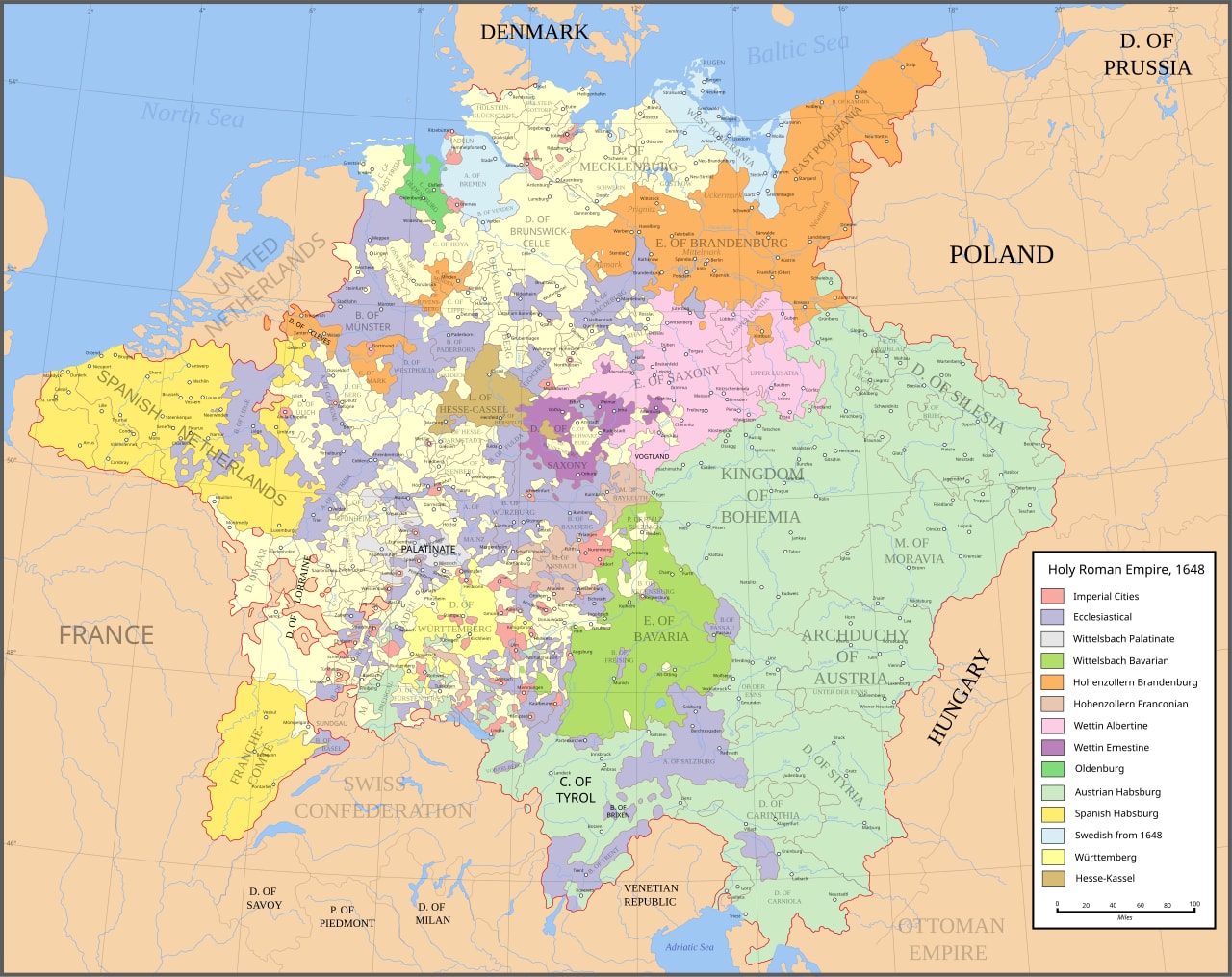
The Peace of Westphalia (1648) ended the Thirty Years' War and limited the sovereignty of the Holy Roman Empire. With the Empire's central authority weakened, individual German states gained more independent control over their own affairs.
Two big results followed:
- Prussia rose to power, building a centralized state with a strong bureaucracy and military.
- The Habsburgs, centered in Austria, shifted their empire eastward.
This matters for the question of a unified Europe. Westphalia made the Holy Roman Empire a much looser collection of states rather than a single unified power, which is a useful point if a prompt asks how political developments challenged or reinforced European unity.
Enlightened Monarchs to Know
These are the rulers the course highlights for this topic. Use them as evidence when explaining how Enlightenment thought shaped political power.
Frederick II "the Great" of Prussia (1740-1786)
Frederick II is the model enlightened monarch for Prussia. He promoted religious toleration, reformed the legal code, and supported arts and philosophy, even corresponding with Voltaire. He called himself "the first servant of the state," but he kept tight control over policy and foreign affairs. His reforms strengthened the Prussian state without weakening the monarch.
Joseph II of Austria (reigned 1765-1790)
Joseph II is often treated as the most aggressive reformer among enlightened monarchs. He issued an Edict of Toleration extending religious freedom to Protestants and Jews, reduced the Catholic Church's power, and pushed reforms in education and serfdom. Many of his changes ran into strong resistance from nobility and clergy, and several were reversed after his death, which shows how reform from above often collided with entrenched social structures.
Maria Theresa of Austria
Maria Theresa is a Habsburg ruler tied to this period of centralization and reform. She strengthened Austria's administration and education while remaining a traditional Catholic monarch. She is useful for showing that reform and traditional monarchy often went together rather than being opposites.
Frederick William I of Prussia (reigned 1713-1740)
Frederick William I focused on building Prussia's army and bureaucracy, earning the nickname the "Soldier King." His work laid the groundwork that Frederick II later built on. He fits the broader story of Prussian centralization more than the Enlightenment reform story, so use him carefully.
How to Use This on the AP European History Exam
Causation
Be ready to explain why rulers adopted Enlightenment reforms. The spread of Enlightenment thought gave monarchs a new way to justify and strengthen central authority. Tie specific reforms (legal codes, toleration, education) back to the goal of a more efficient, loyal, and centralized state.
Continuity and Change
Enlightened absolutists continued the long trend of centralizing power and building bureaucracies, but they changed how rulers justified that power. Show both sides: the continuity of strong monarchy and the change toward reason and reform as justification.
Comparison
Set enlightened absolutists against earlier absolutist rulers from Unit 3. Both concentrated power, but their reasoning and their willingness to reform differed. Frederick II versus an earlier divine-right absolutist is a clean comparison.
Using Sources Effectively
If you get a document tied to a ruler like Frederick II or Joseph II, think about purpose and point of view. A monarch describing himself as a servant of the state is making a political claim, not just stating a fact. Use that gap between rhetoric and reality in your analysis.
Common Trap
Do not treat enlightened absolutism as a move toward democracy. These rulers reformed institutions but kept full control. Reform from above is not the same as shared power.
Common Misconceptions
- Misconception: Enlightened absolutists gave up power.Actually: Enlightened absolutists did not give up power. They used reform to strengthen the monarchy, not to share authority with the people.
- Misconception: Religious toleration meant full equality everywhere.Actually: Religious toleration did not mean full equality everywhere. Toleration was often limited, and civil equality for Jews appeared only in some states by 1800.
- Misconception: The Peace of Westphalia created a unified Germany.Actually: The Peace of Westphalia did not create a unified Germany. It weakened the Holy Roman Empire's central authority, which allowed Prussia and Austria to grow as separate powers.
- Misconception: Enlightened reform was always permanent.Actually: Enlightened reform was not always permanent. Joseph II's reforms show that nobility and clergy could push back and reverse changes after a ruler's death.
- Misconception: Catherine the Great and Napoleon are required names for this topic.Actually: Catherine the Great and Napoleon are common examples of related rulers, but the monarchs the course names specifically for this topic are Frederick II of Prussia and Joseph II of Austria, along with Habsburg and Prussian rulers like Maria Theresa and Frederick William I. Treat broader examples as applications, not as required names for this topic.
Related AP European History Guides
Practice Questions for 4.6
1 of 10
How did Westphalia's recognition of state sovereignty over religion contribute to the fragmentation of unified Christian Europe?
A.
It restored the religious unity of Christian Europe that existed before the Reformation wars.
B.
It allowed rulers to set state religions, ending papal enforcement of uniform Christianity.
C.
It strengthened the papacy by giving the pope enforcement authority over Catholic and Protestant rulers alike.
D.
It imposed Protestant uniformity on states, with Catholic rulers forced to adopt Lutheranism or Calvinism.
Vocabulary
The following words are mentioned explicitly in the AP® course framework for this topic.Term | Definition |
|---|---|
Austria | The central European territory that became the core of Habsburg power after the Peace of Westphalia. |
civil equality | The granting of equal legal rights and status to all citizens regardless of religion or other characteristics. |
enlightened absolutism | A form of government in 18th-century Europe where monarchs maintained absolute power while implementing reforms based on Enlightenment principles. |
Enlightenment thought | Intellectual movement focused on empiricism, skepticism, human reason, and rationalism that challenged prevailing patterns of thought regarding social order, institutions of government, and the role of faith. |
Habsburgs | A European royal dynasty that ruled the Holy Roman Empire and Austria, shifting their power base eastward after 1648. |
Holy Roman Empire | A political entity in Central Europe that existed from 962 to 1806, composed of numerous German and Italian states under an elected emperor. |
Peace of Westphalia | A series of treaties signed in 1648 that ended the Thirty Years' War and established the principle of state sovereignty in Europe. |
Prussia | A German state that rose to major power status in the 17th and 18th centuries, eventually becoming the dominant German power. |
religious toleration | The acceptance of different religious beliefs and practices, allowing individuals freedom of conscience and worship without persecution. |
sovereignty | The power of a state to govern itself and make independent decisions without external interference. |
unified Europe | The concept of European political, religious, or cultural cohesion and integration as a single entity. |
Frequently Asked Questions
What is AP Euro 4.6 about?
AP Euro 4.6 explains how Enlightenment ideas influenced political power from 1648 to 1815. Focus on enlightened absolutism, religious toleration, civil equality in some states, Prussia, the Habsburgs, and the effects of Westphalia.
What is enlightened absolutism?
Enlightened absolutism describes monarchs who adopted some Enlightenment reforms while keeping centralized royal authority. They used reason, legal reform, education, and toleration to strengthen the state rather than create democracy.
Who were the key enlightened monarchs for AP Euro?
The CED names Frederick II of Prussia and Joseph II of Austria as illustrative enlightened monarchs. Maria Theresa, Frederick William I, and Frederick II also matter for the Prussian and Habsburg power shift.
How did religious toleration change by 1800?
By 1800, most governments in western and central Europe had extended toleration to Christian minorities, and some states granted civil equality to Jews. These reforms show Enlightenment influence, though equality remained limited.
How did the Peace of Westphalia affect Prussia and the Habsburgs?
Westphalia limited the sovereignty of the Holy Roman Empire. That helped Prussia rise to power and pushed the Habsburgs, centered in Austria, to shift their empire eastward.
How should I use enlightened absolutism on AP Euro essays?
Use enlightened absolutism for continuity and change. The continuity is centralized monarchy; the change is that rulers justified power through reason, reform, toleration, and service to the state.
See Fiveable more often in Google
Mark Fiveable as a preferred source and Google is more likely to show you our guides in Top Stories, with a "preferred" badge in AI Mode and AI Overviews.