5.6 Napoleon's Rise, Dominance, and Defeat

🇪🇺AP European History Unit 5 Review
5.6 Napoleon's Rise, Dominance, and Defeat
🇪🇺 AP European History
Napoleon Bonaparte rose from a Revolutionary War general to First Consul and then Emperor, building lasting reforms like the Napoleonic Code and a centralized bureaucracy while limiting rights through censorship and secret police. His military success spread French Revolutionary ideals across Europe, but his expanding empire triggered nationalist resistance that helped bring him down, ending with defeat, exile, and the Congress of Vienna's effort to restore balance.
Napoleon AP Euro Summary
For AP Euro 5.6, Napoleon matters because his rule changed European social, economic, and political life while also creating nationalist responses across Europe. He preserved some Revolutionary ideals, especially equality before the law and careers open to talent, but he also curtailed rights through censorship, secret police, and limits on women's legal status.
On the exam, explain both sides of Napoleon's legacy. His reforms spread Revolutionary principles, while his expanding empire and French control of other regions encouraged nationalist resistance in the German states, Spain, and Russia.
Why This Matters for the AP European History Exam
Napoleon sits at the center of a major causation and continuity/change story: how the French Revolution's ideals were both spread and betrayed by one leader. You should be able to explain how his domestic reforms changed European social, economic, and political life, and how his empire provoked nationalist reactions across the continent.
This topic connects backward to the French Revolution and forward to the Congress of Vienna and 19th-century nationalism. That makes it strong evidence for arguments about revolutionary legacies, the tension between reform and repression, and the rise of mass politics. Expect to use Napoleon as evidence in causation, comparison, and change-over-time reasoning.
Key Takeaways
- As First Consul and Emperor, Napoleon delivered lasting domestic reforms while curtailing rights and hiding control behind representative-looking institutions.
- His major reforms included careers open to talent, a centralized bureaucracy, a national education system, the Civil Code (Napoleonic Code), and the Concordat of 1801.
- He limited liberties through censorship, secret police, and rollbacks of women's legal rights.
- New military tactics let him control much of Europe directly or indirectly, spreading Revolutionary ideals like equality before the law and the end of feudal privileges.
- His expanding empire sparked nationalist responses, including German student protests, guerrilla war in Spain, and Russia's scorched-earth policy.
- His defeat led a coalition of European powers to the Congress of Vienna, which aimed to restore balance of power and contain future revolutions.
Napoleon's Rise
From Military Hero to Political Power
Napoleon Bonaparte first gained recognition for his victories in the French Revolutionary Wars and for defending the new republican government against royalist threats. His success and charisma made him a national hero.
Seizing the political vacuum left by the unpopular Directory, Napoleon launched a coup in 1799 (the Coup of 18 Brumaire). This created the Consulate, with Napoleon as First Consul, a position that effectively made him the ruler of France. He later crowned himself Emperor in 1804.
His rise marks a key shift in Revolutionary France, moving from republican ideals toward centralized authoritarian rule behind a facade of popular sovereignty.
Napoleon's Rule: Reform and Repression
Napoleon's government brought order to a fractured France. He kept Revolutionary rhetoric about liberty, but his rule emphasized order, merit, and control. The most testable point here is that he combined enduring reforms with the curtailment of rights.
Enduring Reforms
- Careers open to talent: Government and military positions could be earned by ability rather than birth, a direct break from hereditary privilege.
- Centralized bureaucracy: Napoleon streamlined administration and tied it directly to the national government.
- Education system: He built state secondary schools (lycées) and expanded civil service training.
- Civil Code (Napoleonic Code): A uniform legal code that confirmed equality before the law, protection of property, and the end of feudal privileges. Note that it also rolled back many gains women had made during the Revolution.
- Concordat of 1801: Reconciled France with the Catholic Church while keeping the state in control of religious affairs, strengthening his legitimacy without restoring full papal power.
The Napoleonic Code became a foundational legal model used in many later European and Latin American legal systems. That is an application of his legacy, not a required AP detail.
Curtailment of Rights
Napoleon's reforms came with real limits on freedom:
- Censorship: He controlled newspapers and publishing to silence criticism.
- Secret police: These forces infiltrated opposition groups and arrested dissidents to protect the regime through fear.
- Limitation of women's rights: The Civil Code placed women under male authority and reduced their legal standing.
The key tension to remember: stability and merit-based opportunity came at the cost of civil liberties.
Napoleon's Military Expansion
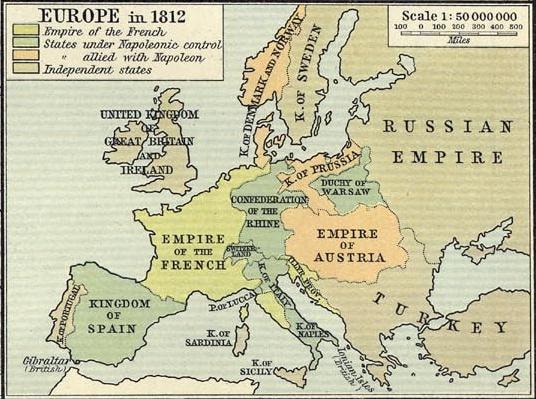
Napoleon's new military tactics let him exert direct or indirect control over much of Europe. He used mass conscription to build huge armies, organized them into flexible corps, and outmaneuvered larger, slower enemies.
Wherever French control spread, so did Revolutionary ideals: abolishing feudal privileges, introducing secular and uniform laws, and redrawing borders. This is the heart of "spreading the ideals of the French Revolution across Europe."
The Continental System
After failing to defeat Britain militarily, Napoleon tried to weaken it economically with the Continental System, a trade embargo meant to cut British commerce off from Europe. It largely backfired: smuggling spread, Britain found other markets, and European economies under French control suffered. Resentment over these economic controls fed resistance, especially in Spain and Russia.
Nationalist Responses to Napoleon
Napoleon's expanding empire created nationalist reactions throughout Europe. By imposing French control and reorganizing territory, he unintentionally awakened national identity in the very places he tried to govern.
Key examples to know:
- Student protests in the German states: Resentment of French control helped stir German national feeling. Note that Germany was not yet a unified country.
- Guerrilla war in Spain: Spanish fighters waged a draining resistance (the Peninsular War) against French occupation.
- Russian scorched-earth policy: During the 1812 invasion, Russians burned crops and supplies as they retreated, denying Napoleon's army food and shelter.
The irony is central: by trying to build a French empire, Napoleon fueled nationalist movements that helped bring it down.
Napoleon's Downfall
Invasion of Russia (1812)
Napoleon invaded Russia with a massive army, but the scorched-earth policy, brutal winter, and supply failures devastated his forces. His Grande Armee was reduced to a fraction of its starting size. This disaster encouraged European powers to unite against him.
Defeat and Exile (1814)
Coalition forces pushed into France, Paris fell, and Napoleon was forced to abdicate. He was exiled to the island of Elba. The monarchy was restored under Louis XVIII.
The Hundred Days and Waterloo (1815)
In March 1815, Napoleon escaped Elba and returned to France in the period known as the Hundred Days. He regained power but was defeated at the Battle of Waterloo in June 1815 by British and Prussian forces under the Duke of Wellington and Gebhard von Blucher. He was exiled a second time to the remote island of Saint Helena, where he died in 1821.
The Aftermath: Congress of Vienna
After Napoleon's defeat by a coalition of European powers, leaders met at the Congress of Vienna (1814-1815) to restore the balance of power and contain the threat of future revolutionary or nationalist upheavals. France was reduced in influence, monarchies were restored, and conservative order replaced revolutionary politics across much of Europe. Still, nationalist and liberal ideas did not disappear; they would resurface throughout the 19th century. (You can go deeper on this in the 5.7 guide.)
Quick Review: Napoleon's Legacy
| Impact Area | Legacy |
|---|---|
| Legal System | Napoleonic Code (Civil Code): equality before the law, property protection, end of feudal privilege |
| Education | State education system (lycees), civil service training |
| Religion | Concordat of 1801: Catholicism tolerated but state-controlled |
| Government | Careers open to talent, centralized bureaucracy, censorship, secret police |
| Military | Mass conscription, corps system, new tactics |
| Nationalism | Provoked responses in the German states, Spain, and Russia |
| Continental System | Failed economic blockade that strained French-controlled Europe |
| Collapse | Russia invasion, coalition response, Waterloo defeat, Saint Helena exile |
How to Use This on the AP European History Exam
MCQ
Source-based multiple-choice questions often pair a document or image with Napoleon's reforms or his fall. Be ready to identify whether a source praises his order and merit-based reforms or criticizes his authoritarian control. Watch for questions that test the contrast between spreading Revolutionary ideals and limiting civil liberties.
Free Response
Napoleon is strong evidence for several reasoning skills:
- Causation: Explain how the Revolution made Napoleon's rise possible, and how his empire caused nationalist reactions.
- Continuity and change: Show what he kept from the Revolution (equality before the law, end of feudal privilege) and what he reversed (women's rights, free press).
- Comparison: Compare his rule to absolute monarchy or to the Revolutionary republic.
When you use Napoleon as evidence, be specific. Name an actual reform (Civil Code, Concordat of 1801, careers open to talent) or a specific nationalist response (guerrilla war in Spain, Russian scorched-earth policy) instead of writing vaguely about "his changes."
Common Trap
Do not argue that Napoleon simply continued the Revolution or simply destroyed it. The accurate answer is both: he preserved certain Revolutionary gains while curtailing rights and centralizing power. Showing that tension earns more credit than a one-sided claim.
Common Misconceptions
- Misconception: Napoleon was only a military leader.Actually: His domestic reforms, especially the Civil Code and centralized administration, had a longer-lasting impact than most of his battles.
- Misconception: He fully carried out Revolutionary ideals.Actually: He spread some of them (legal equality, end of feudal privilege) but also rolled back women's rights, censored the press, and used secret police.
- Misconception: His representative institutions meant real democracy.Actually: They were largely a facade; he held centralized, authoritarian control.
- Misconception: Nationalism helped Napoleon.Actually: It mostly worked against him. His occupation provoked nationalist resistance in places like Spain, the German states, and Russia.
- Misconception: Germany and Italy were unified countries at this time.Actually: They were not. Napoleon reorganized these regions, which helped stir later national movements, but unification came in the late 19th century.
- Misconception: The Continental System crippled Britain.Actually: It mostly hurt French-controlled Europe and fed resistance, while Britain adapted and found new markets.
Related AP European History Guides
Practice Questions for 5.6
1 of 10
The Concordat of 1801 between Napoleon and Pope Pius VII, which restored Catholicism's legal status while maintaining state control over religious appointments, best reflects which of the following developments in Napoleon's approach to governing?
A.
The complete restoration of papal authority and the reversal of all revolutionary religious reforms
B.
The use of compromise with traditional institutions to consolidate power while preserving state supremacy
C.
The elimination of religious practice from French society in accordance with radical revolutionary ideology
D.
The subordination of state authority to papal doctrine and the reestablishment of feudal Church privileges
Vocabulary
The following words are mentioned explicitly in the AP® course framework for this topic.Term | Definition |
|---|---|
careers open to talent | A Napoleonic reform that allowed individuals to advance in government and military positions based on ability rather than noble birth. |
censorship | The suppression or control of information, publications, and speech to limit public expression and dissent. |
centralized bureaucracy | A system of government administration concentrated in a central authority with hierarchical organization and standardized procedures. |
Civil Code | Napoleon's comprehensive legal system that standardized laws across France and influenced legal systems throughout Europe. |
Concordat of 1801 | An agreement between Napoleon and the Pope that restored the Catholic Church in France and regulated its relationship with the state. |
domestic reforms | Internal changes and improvements made to a nation's institutions, laws, and systems of governance. |
educational system | The organized structure and institutions for teaching and learning established under Napoleon's reforms. |
emperor | The supreme ruler of an empire; the title Napoleon assumed in 1804. |
first consul | The chief executive position held by Napoleon in the French government after the coup of 1799, before he became emperor. |
French Revolution ideals | Principles of liberty, equality, and popular sovereignty promoted during the French Revolution that Napoleon spread across Europe. |
guerilla war | A form of irregular warfare conducted by small groups of combatants using tactics such as ambushes and sabotage against a larger, conventional military force. |
limitation of women's rights | Restrictions placed on women's legal status, property ownership, and civil liberties under Napoleonic rule. |
military tactics | Strategic methods and techniques used in warfare and military operations. |
nationalist responses | Political and social movements in which people of a nation or ethnic group resist foreign rule and assert their own national identity and independence. |
representative institutions | Governmental bodies designed to represent the people's interests, though often manipulated or limited in actual power. |
scorched earth policy | A military strategy in which an army destroys resources, infrastructure, and supplies in territory it abandons to prevent the enemy from using them. |
secret police | A covert law enforcement agency used to suppress opposition and maintain state control through surveillance and intimidation. |
Frequently Asked Questions
What should I know about Napoleon for AP Euro?
For AP Euro, know how Napoleon rose to power, reformed France, curtailed rights, spread some Revolutionary ideals, and provoked nationalist responses across Europe. His rule is mainly tested through effects and causation.
What reforms did Napoleon make?
Napoleon expanded careers open to talent, strengthened centralized bureaucracy, built an education system, issued the Civil Code, and reached the Concordat of 1801 with the Catholic Church. These reforms created long-term changes in European political and legal life.
How did Napoleon curtail rights?
Napoleon curtailed rights through censorship, secret police, manipulation of representative institutions, and limits on women's legal rights under the Civil Code. This is why his rule combined reform with authoritarian control.
How did Napoleon spread French Revolutionary ideals?
Napoleon spread ideals such as equality before the law, careers open to talent, and the end of feudal privileges into areas under French influence. At the same time, French control created resentment and nationalist responses.
What nationalist responses did Napoleon create?
The CED examples are student protests in the German states, guerrilla war in Spain, and Russia's scorched-earth policy. These responses show how Napoleon's expanding empire encouraged national resistance.
How did Napoleon fall from power?
Napoleon's failed invasion of Russia weakened his army, encouraged a coalition response, and led to his defeat and exile. After the Hundred Days, he was defeated at Waterloo and exiled to Saint Helena.
See Fiveable more often in Google
Mark Fiveable as a preferred source and Google is more likely to show you our guides in Top Stories, with a "preferred" badge in AI Mode and AI Overviews.