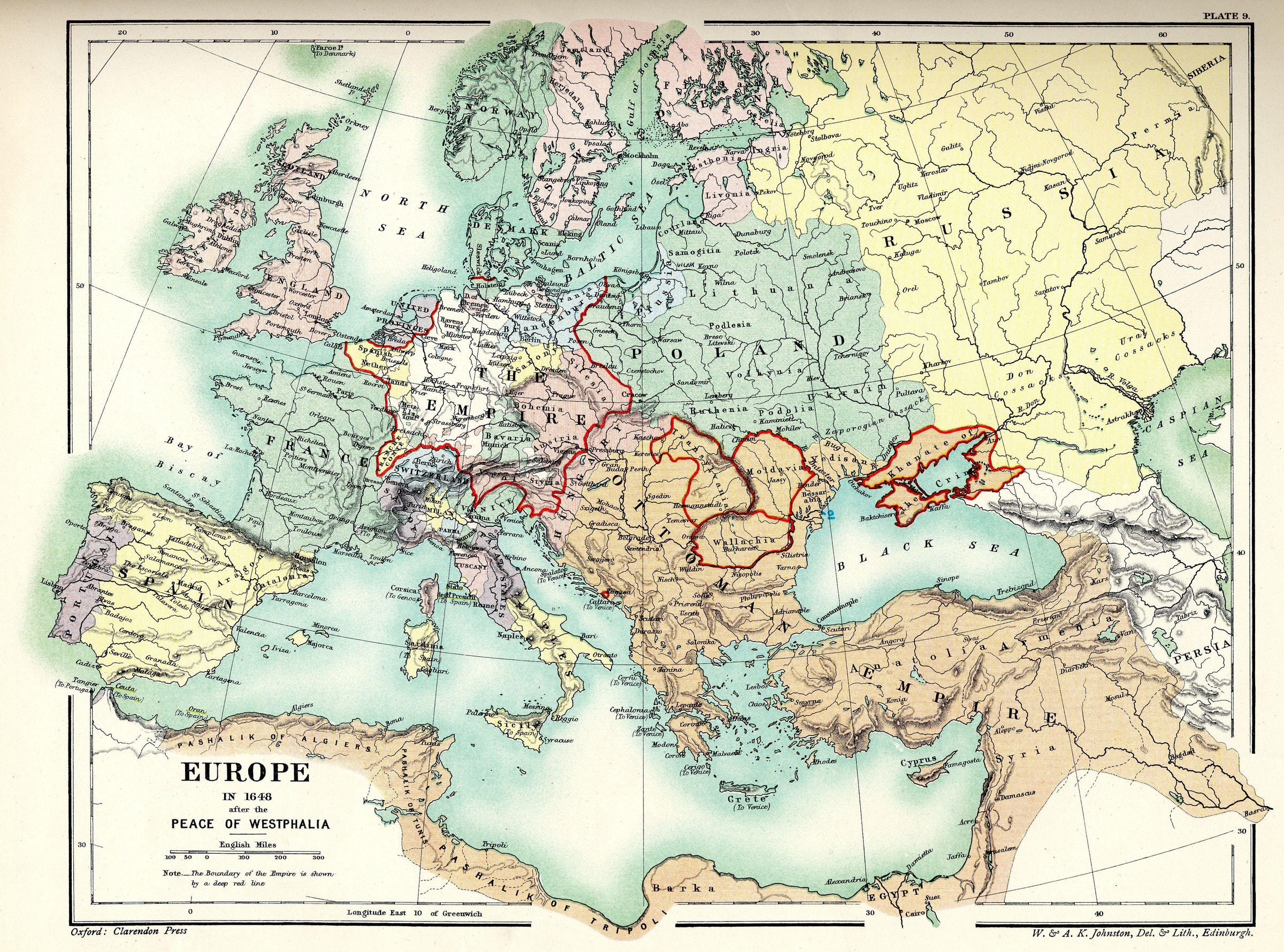
Context: The Rise of Monarchical Sovereignty
Following the Peace of Westphalia (1648), European rulers sought to centralize their authority and consolidate power in response to the chaos of religious wars and internal conflicts. This period marked the rise of absolutist monarchies, where rulers like Louis XIV of France and Peter the Great of Russia established strong, centralized states with near-total control over political, religious, and military affairs.
A key intellectual foundation for this shift was the theory of the Divine Right of Kings, articulated by Bishop Jacques-Bénigne Bossuet. He argued that monarchs ruled by God’s will and were answerable only to Him, legitimizing absolute rule and reducing the influence of competing institutions like the Catholic Church and the nobility.
Additionally, the end of the Thirty Years’ War (1618-1648) had left Europe in disarray. With religious conflict winding down, rulers used the uncertainty of the post-war era to justify the need for stronger, centralized rule. The war had also expanded military power, giving monarchs direct control over standing armies, further increasing their authority. (Ahem! A continuity that continued to build off of the New Monarchs from the renaissance!)

Competing Models of Sovereignty
While many European rulers embraced absolutism, others pursued alternative forms of governance, leading to different distributions of power:
- Absolute Monarchies: Sovereign power was concentrated in the hands of a single ruler.
- Example: Louis XIV of France ("L'État, c'est moi" – "I am the state") embodied absolute rule by centralizing government, controlling the economy, and limiting the nobility’s influence.
- Constitutional Monarchies: Power was shared between the monarch and representative institutions.
- Example: England developed a constitutional system after the Glorious Revolution (1688), limiting royal power through Parliament and establishing a Bill of Rights (1689).
- Decentralized States: Some regions struggled to maintain sovereignty due to linguistic, religious, or cultural divisions.
- Example: The Holy Roman Empire remained fragmented, with its rulers unable to impose centralized control.
Challenges to Sovereignty: Minority Groups & Regional Conflicts
While monarchs aimed for absolute control, various groups and regional movements contested their authority:
- Linguistic and Cultural Minorities:
- Celtic regions (Scotland, Ireland, Brittany) resisted linguistic and cultural assimilation, as their Gaelic traditions differed from dominant national identities.
- Religious Conflicts:
- The Dutch Revolt (1568–1648): Protestant Dutch rebels fought against Habsburg Spain, leading to the formation of the Dutch Republic (modern Netherlands, Belgium, and Luxembourg).
- The Defenestration of Prague (1618): Czech Protestants threw Catholic officials out a window, triggering the Thirty Years’ War and symbolizing resistance to Habsburg rule.
- Jan Hus (1369–1415): A Czech religious reformer who opposed the Catholic Church and became a symbol of national resistance, later executed for heresy.
Comparison of Absolutist and Constitutional Governments in Europe (1648-1815)
| Category | Traditional Absolutist Governments 🇫🇷 🇪🇸 🇷🇺 | Constitutional Governments 🇬🇧 🇳🇱 |
|---|---|---|
| Governance Style | Monarchs held absolute power, often ruling by divine right. | Power was limited by representative institutions (e.g., Parliament, Estates General). |
| Key Examples | France (Louis XIV), Spain (Philip V), Russia (Peter the Great) | England (Parliamentary Monarchy post-Glorious Revolution), Dutch Republic (Oligarchic Republic with Stadtholder) |
| Bureaucratic Control | Monarchs centralized administration, reducing noble power (e.g., Versailles, Table of Ranks in Russia). | Power shared between elected officials and monarchs, leading to more balanced governance. |
| Religious Policies | Monarchs controlled religion (e.g., Louis XIV’s Revocation of Edict of Nantes, Spanish Inquisition). | Greater religious toleration (e.g., English Toleration Act (1689), Dutch religious pluralism). |
| Economic Policies | Mercantilism: State-controlled economies, focusing on bullionism and internal trade (e.g., Colbert in France). | Capitalism & Free Trade: Encouraged private enterprise, joint-stock companies (e.g., Dutch East India Company, British East India Company). |
| Social Control | Suppressed noble autonomy, forcing aristocracy into state service (e.g., Versailles, Russian Table of Ranks). | Nobility remained powerful, often negotiating with the monarchy through representative bodies. |
The Rise of Absolutism and its Justifications
Absolutism was characterized by the concentration of power in a single ruler who controlled all aspects of government. Monarchs justified their rule through:
1. Political Philosophy
Two key thinkers provided intellectual justifications for absolutism:
- Thomas Hobbes (1588–1679):
- In Leviathan (1651), Hobbes argued that without a strong ruler, society would descend into anarchy and chaos.
- To avoid disorder, people must surrender their freedoms to an absolute ruler who ensures stability.
- Bishop Jacques-Bénigne Bossuet (1627–1704):
- ==Developed the Divine Right of Kings, claiming monarchs were chosen by God.==
- Argued that disobedience to the king was disobedience to God.
2. Centralized Administration & Bureaucracy
Absolutist rulers strengthened their power by:
- Building professional bureaucracies staffed by loyal officials rather than nobles.
- Expanding taxation systems to fund standing armies and state projects.
- Controlling the nobility by reducing their political power while granting them court privileges.
3. Military Expansion
- Monarchs reduced reliance on feudal lords for military power, instead forming professional, state-funded armies.
- Military spending increased dramatically, making warfare a tool of state-building.
- Example: Peter the Great modernized Russia’s military, adopting Western tactics and expanding his empire.
Challenges to Absolutism
Despite their efforts, absolute monarchs faced resistance from two primary groups:
1. The Catholic Church
- The Church held significant wealth and influence, which often clashed with royal authority.
- Monarchs sought to limit papal power within their territories.
2. The Nobility
- Nobles historically held local power and resented royal efforts to centralize authority.
- Some rulers co-opted the nobility through court life (e.g., Louis XIV’s Palace of Versailles), while others repressed noble uprisings.
Conclusion: The Shift Toward Centralized States
The period from 1648 to 1815 saw the transition from fragmented, feudal systems to centralized, sovereign states. The decline of papal authority and feudal power allowed monarchs to consolidate control, laying the foundation for modern nation-states.
By the 18th century, absolutist rulers had largely succeeded in creating powerful bureaucracies, standing armies, and centralized economies, but conflicts between monarchs, nobles, and representative institutions continued to shape European governance.
🎥 Watch: AP European History - Age of Absolutism
Vocabulary
The following words are mentioned explicitly in the College Board Course and Exam Description for this topic.
| Term | Definition |
|---|---|
| absolute monarchy | A form of government in which a monarch holds supreme power with minimal constitutional or legal limitations on authority. |
| governmental authority | The power and right of government to make and enforce decisions and laws over a territory and population. |
| minority language groups | Communities within a state that speak languages different from the dominant national language. |
| national identities | The sense of belonging to a nation, shaped by shared history, language, culture, and political institutions. |
| political centralization | The concentration of political power and authority in a central government, a process that occurred unevenly across European states in the 16th and 17th centuries. |
| political institutions | Formal organizations and structures through which political power is exercised and governmental authority is administered. |
| political sovereignty | The supreme power and authority of a state to govern itself and make independent decisions without external interference. |
| regional autonomy | The right of regions or territories to exercise self-governance and control over local affairs with limited interference from central authority. |
| secular systems of law | Legal systems based on civil authority rather than religious doctrine, which played a central role in the development of new political institutions in the early modern period. |
| sovereign state | A political entity with supreme authority over its territory and population, independent from religious or external control, central to early modern European political development. |
Frequently Asked Questions
What is state building and why did it happen from 1648 to 1815?
State building = the process rulers used to create stronger, more centralized governments: clearer sovereign authority, professional armies and bureaucracies, unified legal systems, and new fiscal policies (like mercantilism) that raised revenue. After 1648 (Peace of Westphalia) Europe shifted toward the sovereign state idea, so monarchs (e.g., Louis XIII/Richelieu) and ministers pushed centralization to secure borders, tax bases, and internal order against nobles, regional identities (Catalan revolts, Fronde), and foreign rivals. That competition—between monarchs, nobles, and minority groups—helped produce different outcomes: absolutism in France and Prussia, constitutional limits in Britain. For the AP exam, this fits KC-1.5 and KC-2.1 and is a common contextualization point for short answers and essays (use context to explain how and why political power changed). For a focused review, check the Topic 3.1 study guide (https://library.fiveable.me/ap-european-history/unit-3/state-building-1648-1815/study-guide/Bf7s4Vdb5Yw1duuh0j7h) and practice questions (https://library.fiveable.me/practice/ap-european-history).
What does sovereignty mean and how is it different from just being a king?
Sovereignty means the ultimate legal authority to make and enforce laws inside a territory and to represent that territory in relations with other states—think the right to set taxes, run courts, and decide foreign policy. Being a king is a person who may claim or hold that authority, but kings aren’t automatically sovereign in the modern sense. After 1648 (Peace of Westphalia) “sovereign state” became a key idea: some monarchs achieved centralized, absolutist sovereignty (Louis XIII/Richelieu) while others shared power with nobles, parliaments, or regional identities. So sovereignty = a political-legal condition; “king” = a ruler who may or may not control that condition. For AP Euro, connect this to KC-1.5 (struggle for sovereignty, centralization) and use it for Contextualization or Short-Answer/LEQ evidence (Unit 3 study guide: https://library.fiveable.me/ap-european-history/unit-3/state-building-1648-1815/study-guide/Bf7s4Vdb5Yw1duuh0j7h). For more practice, try Fiveable’s unit resources and 1,000+ problems (https://library.fiveable.me/unit-3, https://library.fiveable.me/practice/ap-european-history).
Why did monarchs and nobles fight so much during this time period?
They clashed because both groups were trying to protect or expand their sources of authority as Europe moved toward the sovereign state. Monarchs (like Louis XIII with Cardinal Richelieu) pushed for centralization and absolutism—streamlining law, tax, standing armies, and royal bureaucracy—while nobles wanted to keep traditional privileges, local autonomy, and influence over taxation and justice (see KC-1.5.III.B). Religious and regional identities made this worse: Protestant vs. Catholic disputes, the Fronde in France, and the Catalan Revolts show nobles using unrest to resist royal centralization. Foreign rivals and balance-of-power politics also incentivized monarchs to weaken powerful nobles so states could mobilize resources more efficiently (KC-2.1.I). For AP essays/DBQs, use this context to explain causes and cite examples (Richelieu, Fronde, Catalonia). Review Topic 3.1 on Fiveable (study guide) and practice questions (https://library.fiveable.me/practice/ap-european-history) to prep for contextualization and evidence use.
How did Louis XIII and Cardinal Richelieu centralize power in France?
Louis XIII and Cardinal Richelieu centralized power by weakening rival power centers and building a stronger royal state. They limited noble influence (curbing private armies and political privileges) and crushed Huguenot political independence—keeping Protestant worship but removing fortified cities like La Rochelle as political threats. Richelieu created a professional royal bureaucracy (intendants) to enforce policy regionally, expanded taxation like the taille to fund a standing army, and used patronage and spies to monitor provincial elites. Politically he followed a raison d’état (state interest): France supported anti-Habsburg powers in the Thirty Years’ War to increase royal security and France’s international position. These moves fit the AP theme of growing absolutism and state centralization (Topic 3.1). For more review, see the Topic 3.1 study guide on Fiveable (https://library.fiveable.me/ap-european-history/unit-3/state-building-1648-1815/study-guide/Bf7s4Vdb5Yw1duuh0j7h) and practice questions (https://library.fiveable.me/practice/ap-european-history).
What was the Fronde and why did it fail to stop French absolutism?
The Fronde (1648–1653) was a series of aristocratic and parliamentary uprisings in France during the minority of Louis XIV, sparked by resistance to royal taxation, centralization under Cardinal Mazarin, and loss of noble privileges. It included the Parlementary Fronde (judicial elites) and the Noble Fronde (high nobles), plus urban unrest in Paris. It failed to stop French absolutism because it was disunited—nobles pursued competing goals, often acted opportunistically, and alienated the broader population by causing disorder. Royal authority regained the initiative by exploiting factionalism, offering concessions selectively, and strengthening the centralized bureaucracy and standing army. The chaos convinced many elites and commoners that a strong, stable monarch was preferable, clearing the way for Louis XIV’s personal rule and greater centralization (KC-1.5; KC-2.1.I). For AP review, connect the Fronde to state-building and absolutism in your LEQ/DBQ context (see the Topic 3.1 study guide on Fiveable: https://library.fiveable.me/ap-european-history/unit-3/state-building-1648-1815/study-guide/Bf7s4Vdb5Yw1duuh0j7h). Practice questions: https://library.fiveable.me/practice/ap-european-history.
I'm confused about the difference between absolute monarchy and other types of government - can someone explain?
Absolute monarchy: a state where the monarch holds most political power centralized in the crown—they make laws, control taxation, bureaucracy, and often a standing army, claiming sovereignty (sometimes via divine right). 17th–18th-century examples: Louis XIII with Cardinal Richelieu’s centralizing policies and the royal reaction to the Fronde show how monarchs curbed noble privileges to build absolutism (CED KC-1.5, KC-2.1.I). Contrast with other forms: - Constitutional monarchy: ruler’s powers limited by law or a parliament (e.g., post-Glorious Revolution England). - Republic/oligarchy: power sits with elected assemblies or elite groups rather than a single sovereign. - Mixed systems: shared authority between monarchs, nobles, and regional bodies (common in the HRE or Spain with regional identities like Catalonia). On the AP: you’ll be asked to explain these differences for contextualization (SAQs/DBQs/LEQs). For review, see the Topic 3.1 study guide (https://library.fiveable.me/ap-european-history/unit-3/state-building-1648-1815/study-guide/Bf7s4Vdb5Yw1duuh0j7h) and practice questions (https://library.fiveable.me/practice/ap-european-history).
Why did minority groups like the Celts and Dutch resist their rulers?
They resisted because state-building threatened their local identities, privileges, and livelihoods. Minority groups like the Celts (in Scotland, Ireland, Brittany) had distinct languages, legal traditions, and local elites; when monarchs tried to centralize law, taxes, or religion (part of building sovereign, modern states), those communities saw their autonomy erased. The Dutch in the Spanish Netherlands resisted for similar reasons but with added religious and economic causes: high taxes, enforcement of Catholic orthodoxy, and mercantilist controls on trade provoked the largely Calvinist, prosperous provinces to assert self-rule (the Eighty Years’ War). In AP terms, these are examples of KC-1.5.III: corporate and minority groups pushing back against absolutist centralization. For exam practice, use the Unit 3 study guide (https://library.fiveable.me/ap-european-history/unit-3/state-building-1648-1815/study-guide/Bf7s4Vdb5Yw1duuh0j7h) and try practice questions (https://library.fiveable.me/practice/ap-european-history) to build contextualization and evidence skills.
What caused the Catalan Revolts in Spain and what were the consequences?
Causes: The Catalan Revolts (1640–1652) grew from Spain’s fiscal and military strain during the Thirty Years’ War and the crown’s push for greater centralization under Philip IV and his minister Olivares. Policies—heavy taxation, forced quartering of Castilian troops in Catalonia, and attempts to override Catalan institutions and privileges—angered nobles, urban elites, and Catalan-speaking communities protecting regional autonomy and legal traditions (KC-1.5.III/B & C). Consequences: Catalonia briefly declared a republic and sought French protection, drawing France into the conflict. The revolts weakened Habsburg Spain, led to harsh repression and curbs on Catalan autonomy, and ended with partial French gains (Roussillon ceded in the 1659 Treaty of the Pyrenees). Long-term, the uprisings show limits to absolutism and how minority regional identity could challenge centralizing monarchies—a clear AP example of monarchs vs. nobles/regions in state building (see the Topic 3.1 study guide: https://library.fiveable.me/ap-european-history/unit-3/state-building-1648-1815/study-guide/Bf7s4Vdb5Yw1duuh0j7h). For practice questions, try Fiveable’s AP practice set (https://library.fiveable.me/practice/ap-european-history).
How do I write a DBQ essay about political centralization in early modern Europe?
Start with a sharp thesis that answers the prompt (e.g., “Political centralization in early modern Europe advanced as monarchs used administrative reform and fiscal/ military capacity to limit noble and regional autonomy”) and a one-paragraph contextualization linking 1648–1815, the Peace of Westphalia, and KC-1.5 (so you show why sovereignty and state-building matter). For the DBQ itself: use at least four documents to support claims, explicitly describe their content, and for two docs explain POV/purpose/situation or audience (sourcing). Bring in at least one specific outside fact (Richelieu’s policies under Louis XIII, the Fronde, Catalan revolts, or Prussian militarization) as extra evidence. Structure paragraphs by sub-claims (fiscal reform, bureaucratic growth, suppression of corporate privileges, linguistic/regional resistance). Finish by showing complexity—e.g., absolutism grew, but resistance and constitutional alternatives persisted. Review Topic 3.1 on Fiveable (https://library.fiveable.me/ap-european-history/unit-3/state-building-1648-1815/study-guide/Bf7s4Vdb5Yw1duuh0j7h) and practice DBQs (https://library.fiveable.me/practice/ap-european-history).
What's the connection between the Peace of Westphalia in 1648 and state building?
The Peace of Westphalia (1648) is a turning point for state building because it helped institutionalize the modern sovereign state. By recognizing rulers’ rights to control religion and law within their territories, Westphalia weakened transnational religious authority (like papal power) and promoted secular systems of law—key ideas in KC-1.5.I. That shift let monarchs (and emerging states) centralize authority, standardize taxation and armies, and claim exclusive sovereignty—setting the scene for both absolutist states (e.g., France under Richelieu/Louis XIII) and competitive state systems in Europe (KC-2.1). Westphalia also formalized the balance-of-power idea: states negotiated and checked one another instead of appealing to a single supranational authority (useful for DBQ/LEQ contextualization on Unit 3 prompts). For a concise AP-style review, see the Topic 3.1 study guide (https://library.fiveable.me/ap-european-history/unit-3/state-building-1648-1815/study-guide/Bf7s4Vdb5Yw1duuh0j7h) and practice problems (https://library.fiveable.me/practice/ap-european-history).
Why did some countries become absolute monarchies while others developed different political systems?
Short answer: different political systems grew from different social, economic, and political contexts. States that faced constant external threats, heavy war costs, or weak regional elites (e.g., France after the Wars of Religion) centralized authority and moved toward absolutism—think Louis XIII and Cardinal Richelieu crushing noble power after the Fronde to build a stronger sovereign state. Other places kept or developed shared governance because strong corporate estates, powerful parliaments, or distinct regional identities limited monarchal centralization (the English Parliament after the Civil War; Catalan resistance in Spain; the fragmented Holy Roman Empire). Religion, finances (tax systems and mercantilism), and war-making capacity all mattered: rulers with reliable revenue and bureaucracy could centralize; where elites or minorities resisted, constitutional or plural systems survived. For more AP-aligned review on state building (keywords like sovereign state, centralization, Richelieu, Fronde), see the Topic 3.1 study guide (https://library.fiveable.me/ap-european-history/unit-3/state-building-1648-1815/study-guide/Bf7s4Vdb5Yw1duuh0j7h). Practice questions: https://library.fiveable.me/practice/ap-european-history.
What were the long-term effects of nobles losing power to monarchs?
When nobles lost power to monarchs, Europe shifted from fragmented, feudal authority toward stronger centralized states—what the CED calls political centralization and the rise of absolutism (think Richelieu/Louis XIII). Long-term effects: stronger bureaucracies and tax systems to fund standing armies and mercantilist policies; reduced noble privileges and regional autonomy; increased state sovereignty under secular law; more opportunities for commoners in bureaucracy and commerce (social mobility); and clearer state borders that fed later nationalism. That consolidation also produced resistance—some places (England, the Dutch Republic) moved toward constitutional limits on monarchy—so outcomes weren’t identical across Europe. For AP essays, use contextualization (1648–1815), specific examples (Richelieu, the Fronde, Catalan revolts), and cause-effect reasoning to support claims. For a focused review, see the Topic 3.1 study guide (https://library.fiveable.me/ap-european-history/unit-3/state-building-1648-1815/study-guide/Bf7s4Vdb5Yw1duuh0j7h) and practice 1,000+ AP-style questions at (https://library.fiveable.me/practice/ap-european-history).
How did language and cultural differences lead to political resistance in places like Scotland and Ireland?
Language and culture became focal points of resistance because state centralization threatened local identities and institutions. In Scotland and Ireland, distinct languages (Scots Gaelic, Irish) and Catholic or Presbyterian religious cultures tied communities to local laws, clans, and corporate bodies. When monarchs or London governments pushed uniform laws, taxation, or Protestant establishment, elites and commoners saw that as an attack on their way of life—so they resisted (e.g., Covenanter opposition in Scotland; Irish Catholic uprisings and the Williamite-era penal laws). Cultural difference made coordination of resistance easier: churches, clans, and vernacular networks spread grievances and justified political claims. For AP essays/DBQs, emphasize KC-1.5.III: how minority identities produced alternative authority and conflicts over sovereignty. Use specific evidence (Penal Laws, Covenants, 1641 revolt) and explain links between language/culture and political aims. For a quick review, check the Topic 3.1 study guide (https://library.fiveable.me/ap-european-history/unit-3/state-building-1648-1815/study-guide/Bf7s4Vdb5Yw1duuh0j7h) and try practice questions (https://library.fiveable.me/practice/ap-european-history).
I missed class - what's the difference between the sovereign state concept and medieval feudalism?
Short version: medieval feudalism was a fragmented, personal system of power based on reciprocal ties between lords and vassals—authority was local, legal rights came from custom and private oaths, and nobles & corporate bodies (towns, estates) held real power. The sovereign state (emerging by 1648) is centralized: a monarch or government claims ultimate, legal authority (sovereignty) over a defined territory, backed by standing armies, uniform law, taxation, and secular institutions. Why it matters for AP Euro (Topic 3.1): the shift from feudal fragmentation to sovereign states explains 17th–18th-century centralization and absolutism (e.g., Richelieu/Louis XIII) and conflicts over noble privileges and regional identities (CED KC-1.5, KC-2.1). For more review, see the Topic 3.1 study guide (https://library.fiveable.me/ap-european-history/unit-3/state-building-1648-1815/study-guide/Bf7s4Vdb5Yw1duuh0j7h) and try practice questions (https://library.fiveable.me/practice/ap-european-history) to prep contextualization and short-answer skills.