8.4 Versailles Conference and Peace Settlement

🇪🇺AP European History Unit 8 Review
8.4 Versailles Conference and Peace Settlement
🇪🇺 AP European History
8.1
Context of 20th Century Global Conflicts
8.2
World War I
8.3
The Russian Revolution and Its Effects
8.4
Versailles Conference and Peace Settlement
8.5
Global Economic Crisis: The Great Depression
8.6
Fascism and Totalitarianism
8.7
Europe During the Interwar Period
8.8
World War II
8.9
The Holocaust
8.10
20th-Century Cultural, Intellectual, and Artistic Developments
8.11
Continuity and Changes in the Age of Global Conflict
The 1919 Paris Peace Conference ended World War I, but the settlement satisfied almost no one. Wilson's idealism clashed with France and Britain's drive to punish Germany, and the resulting Treaty of Versailles, weak League of Nations, and mandate system left political, economic, and diplomatic problems that helped set the stage for World War II.
Why This Matters for the AP European History Exam
This topic is a go-to source of cause-and-effect reasoning for the interwar period. You will use it to explain how and why the peace settlement failed to fix the problems of the early 20th century, which is exactly the kind of causation and continuity/change argument that shows up on the AP European History exam. The settlement connects directly to later topics like the global economic crisis, the rise of fascism, and the road to World War II, so strong evidence here pays off across Unit 8.
When you analyze documents or build an argument, the competing goals of Wilson, Clemenceau, and Lloyd George give you ready-made evidence about idealism versus the desire to punish Germany. You can also use the mandate system to discuss how the war reshaped imperial power and created lasting tension in the Middle East.
Key Takeaways
- The peace negotiators in Paris had conflicting goals: diplomatic idealism versus the desire to punish Germany, which produced a settlement that satisfied few.
- The Treaty of Versailles assigned guilt and demanded reparations from Germany, which weakened the Weimar Republic's ability to build a stable, legitimate government and economy.
- The League of Nations was meant to prevent future wars but was weakened from the start by the absence of major powers, including the U.S., Germany, and the Soviet Union.
- Democratic successor states emerged from former empires (like Poland, Czechoslovakia, Hungary, and Yugoslavia) but later faced serious political, economic, and diplomatic crises.
- The mandate system handed former German and Ottoman lands to France and Britain, shifting the imperial balance of power and creating a strategic interest in the Middle East and its oil.
Context of the Peace Negotiations
The Paris Peace Conference ran from January to June 1919. The victorious powers came in with very different priorities, which shaped every part of the settlement. Wilsonian idealism pushed for lasting peace through diplomacy, self-determination, and collective security. France and Britain, by contrast, wanted to punish Germany and protect their own interests. The final settlement tried to balance these goals and ended up leaving many sides unhappy.
| Country | Objectives and Goals |
|---|---|
| Great Britain | Punish Germany but allow it to recover economically to support European trade and resist communism. Maintain naval supremacy. Expand colonial control at the expense of Germany and the Ottoman Empire. Demand reparations for war damages, especially in Belgium. |
| France | Seek revenge for the Franco-Prussian War and impose harsh penalties on Germany. Recover Alsace and Lorraine. Create a buffer zone in the Rhineland. Support the creation of Poland from German and Russian lands. Take German colonies and gain Ottoman territory. Demand heavy reparations and drastically reduce Germany's military. |
| United States | Advocate for Wilson's Fourteen Points, which called for diplomacy, free trade, and reduced colonial empires. Push for Polish independence and the breakup of the Ottoman Empire. Establish the League of Nations. Promote open diplomacy and fairness rather than harsh punishment of Germany. |
| Italy | Gain the territories promised for switching sides during the war. Seek colonies from the former Ottoman Empire. Expand its influence into Austria-Hungary. |
| Germany | Avoid sole blame for the war. Prevent crippling reparations. Maintain relations with Russia. Avoid territorial losses and keep its sovereignty. |
The clash between Wilsonian idealism and postwar realities ran through both the winning and the defeated states. That tension is the core of this topic, and it explains why the settlement struggled to deliver a stable peace.
The Treaty of Versailles (1919)
The Treaty of Versailles formally ended World War I, but its terms helped create long-lasting political and economic instability.
Provisions of the Treaty
- War guilt and reparations: The settlement assigned guilt to Germany and required heavy reparations. These provisions hindered the Weimar Republic's ability to build a stable and legitimate political and economic system. The economic strain fed into the hyperinflation that destabilized Germany in the early 1920s.
- Territorial losses: Germany lost significant territory, including Alsace and Lorraine, which returned to France. Its overseas colonies were redistributed to the victorious powers.
- Military restrictions: Germany's military was sharply limited. (Specific caps such as army size and bans on certain weapons are commonly cited examples of how strict these limits were.)
The League of Nations
One of Wilson's central goals was the League of Nations, an international organization meant to prevent future wars. It was weakened from the outset:
- Absence of major powers: The United States did not join, despite Wilson's leadership in creating it, and Germany and the Soviet Union were also left out at the start. Without these major powers, the League lacked the influence and force to back up its decisions.
- Limited enforcement: With no real enforcement power and key nations missing, the League struggled to address later conflicts and political crises.
The Mandate System and the Redrawing of Empires
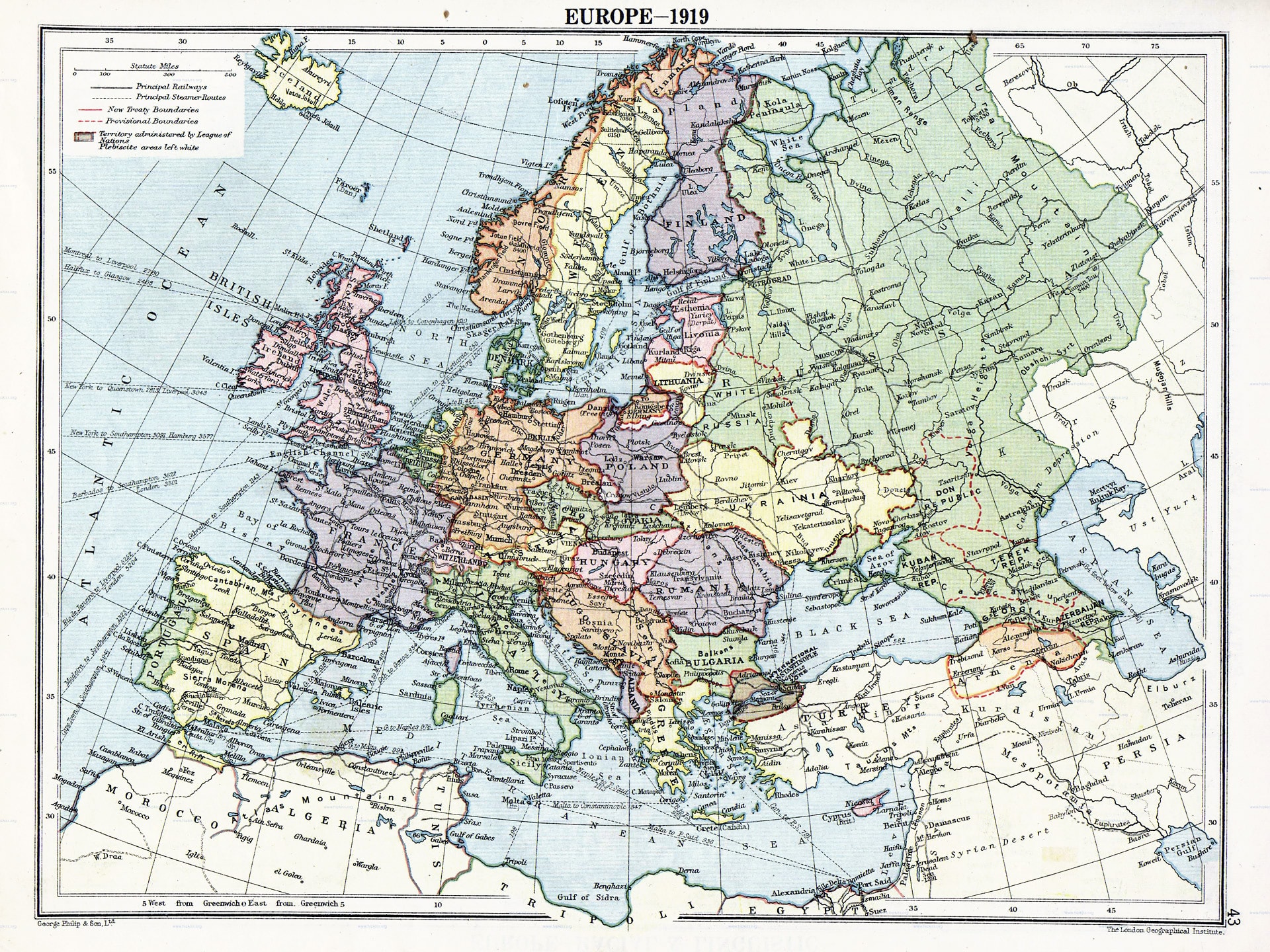
The settlement redistributed former German and Ottoman territories through the mandate system, which placed these areas under French and British control. This altered the imperial balance of power and created a strategic interest in the Middle East, especially its oil.
- Mandates to France and Britain: Former Ottoman territories in the Middle East, such as Lebanon and Syria, Iraq, and Palestine, were placed under French and British control as mandates.
- New states in Europe: Democratic successor states emerged from the former empires, including Poland, Czechoslovakia, Hungary, and Yugoslavia. The treatment of ethnic minorities within these new states created tensions that lasted for decades.
Why the Settlement Failed to Resolve the Challenges
The treaty ended the war on paper, but it did not solve the deeper political, economic, and diplomatic problems of the early 20th century.
- Punitive terms bred resentment: The assignment of guilt and the reparations burden left lasting bitterness in Germany. Economic difficulties, including hyperinflation and unemployment, created openings for extremism.
- Idealism versus reality: Wilson's ideals of self-determination, free trade, and open diplomacy clashed with the victorious powers' drive to secure their own interests. The settlement could not produce a just and durable peace.
- Fragile successor states: The new democratic states carved from Austria-Hungary and the Ottoman Empire often had unstable political systems. They struggled with economic and social crises and were vulnerable to communism and fascism.
- A weak League: The League of Nations lacked military force and key members, which limited its ability to manage tensions and prevent future conflict.
Long-term Effects
- The instability that followed Versailles connects directly to later Unit 8 topics. As an application of this, the economic hardship and political weakness in Germany helped open the door for Adolf Hitler and the Nazi Party.
- The mandate system redrew borders in the Middle East. The creation of new, often artificial borders contributed to long-standing tensions in the region.
How to Use This on the AP European History Exam
Causation
Practice explaining how and why the settlement failed. Strong responses link specific provisions (war guilt, reparations, the weak League) to specific effects (Weimar instability, openings for extremism). Avoid vague claims like "the treaty was too harsh" without naming a provision and a result.
Using Sources Effectively
If you get a document tied to 1919, identify whose goals it reflects. A French source likely emphasizes punishing Germany and security; an American source likely reflects Wilsonian idealism and the League. Use the point of view to explain why the negotiators reached a compromise that satisfied few.
Continuity and Change
Use this topic to trace how the war reshaped European borders and empires. The mandate system and the new successor states show how empires broke apart and how imperial power shifted toward France and Britain.
Common Trap
Do not treat the Treaty of Versailles as the single cause of World War II. It is one important factor among several, including the Great Depression, the appeal of fascism, and the failure of appeasement. Frame it as a contributing cause, not the whole story.
Common Misconceptions
- Misconception: The treaty alone caused World War II.Actually: It contributed to instability, but the global economic crisis, the rise of fascism, and failed appeasement also played major roles.
- Misconception: The League of Nations failed only because the U.S. stayed out.Actually: U.S. nonparticipation mattered, but Germany and the Soviet Union were also absent at the start, and the League had no real enforcement power.
- Misconception: Self-determination was applied fairly to everyone.Actually: New successor states still contained ethnic minorities, and the treatment of those groups created lasting tensions.
- Misconception: The mandate system was just a minor colonial detail.Actually: It shifted the imperial balance of power and created a strategic interest in the Middle East and its oil that shaped later conflicts.
- Misconception: All the Allies wanted the same thing.Actually: Wilson, Clemenceau, and Lloyd George had conflicting goals, which is why the final settlement satisfied few.
Related AP European History Guides
Practice Questions for 8.4
1 of 10
In 1925, the League of Nations distributed an official promotional poster across Britain and France depicting the organization as an unbreakable shield protecting the globe from the weapons of war. A historian analyzing the diplomatic realities of the 1920s should consider that this source's public audience likely caused it to:
A.
exaggerate the institution's collective security power despite the competing nationalist interests of member states.
B.
exaggerate the institution's collective security power despite the absence of the United States and Soviet Union.
C.
downplay the institution's collective security power despite the absence of the United States and Soviet Union.
D.
exaggerate the institution's collective security power despite the reluctance of Britain and France to enforce League sanctions.
Vocabulary
The following words are mentioned explicitly in the AP® course framework for this topic.Term | Definition |
|---|---|
democratic successor states | New independent nations created from the collapse of the Austro-Hungarian and Ottoman empires after World War I, including Poland, Czechoslovakia, Hungary, and Yugoslavia. |
imperial balance of power | The distribution of colonial territories and strategic influence among European imperial powers, altered by the mandate system following World War I. |
League of Nations | An international organization created after World War I to maintain peace and resolve disputes between nations, weakened by the absence of major powers including the United States, Germany, and the Soviet Union. |
mandate system | A system established by the League of Nations to administer former German and Ottoman territories as mandates held by victorious powers, particularly France and Great Britain. |
reparations | Compensation payments imposed on defeated nations, particularly Germany, as punishment for war damages and losses. |
Versailles settlement | The peace agreement ending World War I that imposed war guilt and reparations on Germany, creating political and economic instability in the postwar period. |
Weimar Republic | The democratic German government established after World War I that struggled to achieve political and economic stability due to the harsh terms of the Versailles settlement. |
Wilsonian idealism | President Woodrow Wilson's vision for international peace based on democratic principles, national self-determination, and collective security through the League of Nations. |
Frequently Asked Questions
What was the Versailles Conference?
The Versailles Conference was part of the 1919 Paris Peace Conference after World War I. The victorious powers negotiated peace terms, redrew borders, debated self-determination, and created the League of Nations.
What were the main terms of the Treaty of Versailles?
The treaty assigned war guilt to Germany, required reparations, limited Germany's military, redistributed German colonies, returned Alsace-Lorraine to France, and supported the creation of new states in Europe.
Why did the Versailles settlement satisfy few people?
The settlement tried to balance Wilsonian idealism with France and Britain's desire for security, reparations, and imperial gains. The result left Germany resentful, many national groups dissatisfied, and the League of Nations weak.
How did the League of Nations become weak from the start?
The League lacked strong enforcement power and began without several major powers, including the United States, Germany, and the Soviet Union. That limited its ability to manage later international crises.
How did Versailles affect the Weimar Republic?
War guilt, reparations, military limits, and territorial losses weakened the Weimar Republic's legitimacy and economy. These problems contributed to political instability in interwar Germany.
How should I use Versailles on the AP Euro exam?
Use Versailles as evidence for causation in the interwar period, but do not treat it as the only cause of World War II. Link specific provisions to instability, resentment, or diplomatic weakness.
See Fiveable more often in Google
Mark Fiveable as a preferred source and Google is more likely to show you our guides in Top Stories, with a "preferred" badge in AI Mode and AI Overviews.