

The Atlantic Ocean connected Europe, Africa, and the Americas in a complex network of trade and exchange. This transatlantic system moved goods, people, ideas, and diseases, reshaping societies on both sides of the ocean.
The Atlantic Economy
The Atlantic economy developed as European powers established colonies and trading posts around the Atlantic basin. Colonial economies focused on acquiring, producing, and exporting commodities highly valued in Europe.
- Goods Exchange: Raw materials, foodstuffs, and manufactured products moved between continents
- Labor Movement: Enslaved Africans forcibly transported to the Americas to work on plantations
- New Markets: European manufactured goods found new markets in the Americas and Africa
Main Trade Routes:
- Europe to Americas: Manufactured goods, textiles, tools, weapons
- Americas to Europe: Tobacco, sugar, cotton, furs, timber, fish
- Africa to Americas: Enslaved people, gold, ivory
- Americas to Africa: Rum, manufactured goods

Triangular Trade System
The triangular trade connected three regions in an interdependent economic relationship. Rather than a simple triangle, this system involved multiple overlapping trade routes that linked different parts of the Atlantic world.
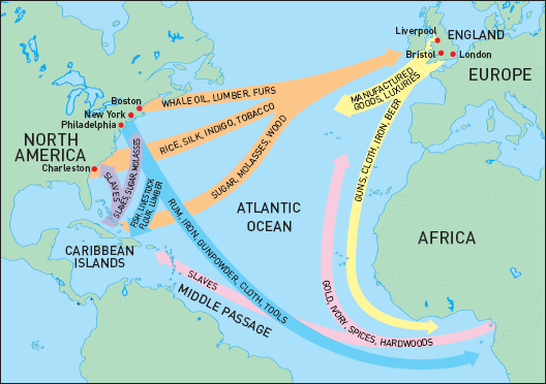
The North American Colonies produced and sent lumber, ship parts, iron products, furs, and tobacco to Europe. The West Indies exchanged sugar and molasses for New England rum, colonial food, and timber. Europe supplied America and Africa with finished goods like cloth, iron tools, tea, and furniture, while Africa became the source of enslaved labor for American plantations.
Mercantilism and Imperial Control
Mercantilism was the economic theory guiding European colonial policies. European powers believed wealth (gold and silver) equaled power, and countries should export more than they import to accumulate wealth. Under this system, colonies existed to benefit the mother country, not themselves.
British Control Mechanisms:
- Navigation Acts (beginning 1650): Required colonial goods to be shipped on English vessels and many products to be sent only to England
- Trade Restrictions: Colonists prohibited from manufacturing certain goods that competed with British industries
- "Salutary Neglect": Period when Britain loosely enforced trade regulations (ended after 1763)
The British policy had mixed effects on colonists. Those who produced shipping parts and tobacco had guaranteed British customers. However, most colonists resented mercantilism because it restricted their economic freedom to produce what they wanted and sell to markets of their choosing.
Impact on Native Americans
European trade dramatically transformed Native American societies, bringing both new opportunities and devastating consequences.
- Increased Flow of Goods: European tools, weapons, cloth, and alcohol entered Native communities
- Cultural Changes: New technologies and goods altered traditional practices and created dependencies
- Economic Shifts: Traditional economies adapted to European trade demands (especially fur trade)
- Epidemic Diseases: Trade connections spread devastating European diseases
- Demographic Collapse: Some regions lost 50-90% of Native population due to disease
Enslaved Africans in the Atlantic Economy
The transatlantic slave trade became a central component of the Atlantic economy. Approximately 12 million Africans were forcibly transported to the Americas where their labor produced valuable commodities like sugar, tobacco, rice, and indigo that fueled European wealth.
- Different colonial regions used enslaved labor in varying degrees
- West Indies and Southern colonies had large enslaved populations
- Middle colonies held significant minorities of enslaved people
- New England farms used relatively few enslaved laborers
Colonial-Imperial Tensions
The British attempt to incorporate colonies into a structured imperial system created growing tensions. As colonial economies developed, conflicts emerged between imperial expectations and colonial ambitions.
- British enforcement of trade regulations often met with colonial resistance
- Smuggling became common as colonists sought to bypass restrictions
- Conflicts with Native Americans over land and resources complicated imperial control
- By mid-18th century, colonies had developed expectations of economic autonomy
- The end of "salutary neglect" after 1763 would intensify these tensions
Vocabulary
The following words are mentioned explicitly in the AP® course framework for this topic.Term | Definition |
|---|---|
Atlantic economy | An interconnected economic system in which goods, enslaved Africans, and American Indians were exchanged between Europe, Africa, and the Americas. |
colonial economies | Economic systems in European colonies focused on acquiring, producing, and exporting valuable commodities and exploiting labor sources. |
commodities | Raw materials or goods produced in the colonies that were valued in Europe and exported for profit. |
demographic shifts | Significant changes in the size, composition, and distribution of American Indian populations caused by disease and other factors. |
epidemic diseases | Infectious diseases introduced by Europeans to American Indian populations, causing widespread death and demographic collapse. |
mercantilism | An economic policy pursued by European nations, including Britain, to accumulate wealth and power through controlling trade and acquiring colonies. |
sources of labor | The enslaved Africans and American Indians exploited by European colonizers to produce commodities and generate wealth. |
trade networks | Established routes and connections through which goods and people were exchanged across the Atlantic between continents. |
transatlantic trade | The exchange of goods, people, and resources between Europe, Africa, and the Americas through extensive trade networks. |
Frequently Asked Questions
What is transatlantic trade and when did it happen?
Transatlantic trade was the network of exchange between Europe, Africa, and the Americas from the 1500s through the 1700s—and especially important for British North America between 1607–1754 (Unit 2). It included the Triangular Trade: European goods to Africa, enslaved Africans across the Middle Passage to the Americas, and colonial commodities (tobacco, sugar, furs) sent back to Europe. Driven by mercantilism and laws like the Navigation Acts, it created plantation economies, slave codes, and the African diaspora while reshaping Native American communities through trade and disease (Columbian Exchange, smallpox). For the AP exam this ties to Learning Objective D: explain causes and effects over time. Review the Topic 2.4 study guide for focused notes (/apush/unit-2/transatlantic-trade/study-guide/UcqUNsSk8bGifGh838TY) and practice application with questions at (/practice/ap-us-history).
What was the Atlantic economy and how did it work?
The Atlantic economy was the web of trade linking Europe, Africa, and the Americas from the 1500s–1700s. European markets wanted sugar, tobacco, rice, and furs from the colonies; colonies produced these plantation and regional commodities using coerced labor. Ships ran a “triangular trade”: manufactured goods left Europe for Africa, enslaved Africans were shipped across the Middle Passage to the Americas, and colonial cash crops and raw materials returned to Europe. Mercantilist policies (Navigation Acts, Molasses Act) tried to funnel colonial wealth to the mother country, while salutary neglect often meant weak enforcement. This system fueled the African Diaspora, reshaped Native American economies and demographics via trade and disease, and tied colonial economies into global markets (see CED KC-2.1.III.A, KC-2.1.III.B). Review the Topic 2.4 study guide for details (/apush/unit-2/transatlantic-trade/study-guide/UcqUNsSk8bGifGh838TY) and practice questions (/practice/ap-us-history).
Why did Europeans start trading across the Atlantic Ocean in the first place?
Europeans began trading across the Atlantic mainly for profit and resources. After 1492, the Columbian Exchange opened access to valuable New World commodities—tobacco, sugar, and later rice and indigo—that were in high demand in Europe. Mercantilist thinking pushed European states to acquire colonies that produced exportable goods and provided raw materials, while colonies needed finished European manufactures, creating regular Atlantic trade networks (triangular trade). Labor shortages in plantation economies led Europeans to import enslaved Africans via the Middle Passage, which became central to the Atlantic slave trade. Trade with Native peoples (fur trade, foodstuffs) and competition among European powers also drove expansion, and disease-driven demographic shifts reshaped which labor and trading systems developed. For AP review, use the Topic 2.4 study guide (/apush/unit-2/transatlantic-trade/study-guide/UcqUNsSk8bGifGh838TY) and practice questions (/practice/ap-us-history) to tie these causes to CED keywords like mercantilism, plantation economy, and Columbian Exchange.
How did the triangular trade system actually work between Europe, Africa, and the Americas?
Triangular trade was a three-leg Atlantic circuit: merchants from Europe sailed to West Africa carrying manufactured goods (textiles, firearms, rum) to exchange for enslaved Africans; captains then endured the Middle Passage, transporting enslaved people to the Americas where they were sold into plantation economies that produced sugar, tobacco, rice, and molasses; finally ships loaded those raw commodities and colonial goods and returned to Europe. That cycle powered mercantilism—colonies supplied raw materials and bought finished goods—while Navigation Acts tried to lock trade into imperial channels. Effects: massive demographic change (the African diaspora), brutal labor systems and slave codes, economic growth in sugar and tobacco colonies, and cultural/ecological exchange from the Columbian Exchange. For AP exam prep, this fits CED Topic 2.4 Learning Objective D (explain causes/effects) and shows up on SAQs/DBQs—practice applying causation and continuity/change. Review the Topic 2.4 study guide (/apush/unit-2/transatlantic-trade/study-guide/UcqUNsSk8bGifGh838TY) and try practice problems (/practice/ap-us-history).
What's the difference between transatlantic trade and regular European trade?
Transatlantic trade connected Europe, Africa, and the Americas in a triangular system—goods, enslaved Africans (Middle Passage), and raw colonial commodities (tobacco, sugar, molasses) moved across the Atlantic—while “regular” European trade mostly meant commerce inside Europe or between European ports. Key differences: scale and human impact (the Atlantic system included the Atlantic Slave Trade and slave codes), products (plantation-produced cash crops for European markets), and economic goals (mercantilist policies like the Navigation Acts funneled colonial wealth to the metropole). Transatlantic trade also triggered the Columbian Exchange (diseases, crops, livestock) and reshaped American Indian economies and demographics. For the AP exam, you should be able to explain causes/effects over time (CED Learning Objective D) and use examples like Chesapeake tobacco, sugar colonies, Molasses Act, and salutary neglect. Review the Topic 2.4 study guide (/apush/unit-2/transatlantic-trade/study-guide/UcqUNsSk8bGifGh838TY) and practice questions (/practice/ap-us-history).
Why did Europeans focus so much on getting commodities from the Americas instead of just trading with other European countries?
Because the Americas offered goods Europe either didn’t have or couldn’t get cheaply at scale—tobacco, sugar, cotton, timber, and precious metals—colonists and merchants could make huge profits by extracting and exporting those commodities to European markets. Under mercantilism European states wanted bullion, raw materials, and favorable trade balances, so colonies were valuable sources of wealth and captive markets (see Navigation Acts, Molasses Act). The Atlantic economy linked those commodities to enslaved labor and the Triangular Trade: Europe supplied manufactured goods, Africa supplied enslaved people, and the Americas supplied cash crops (KC-2.1.III.A). Trading only within Europe couldn’t supply new land, labor, or the huge quantities of tropical staples that fed European consumers and manufacturers. For AP review, focus on mercantilism, plantation economies, the Columbian Exchange, and the Navigation Acts (Topic 2.4 study guide: /apush/unit-2/transatlantic-trade/study-guide/UcqUNsSk8bGifGh838TY; unit overview: /apush/unit-2). Practice related multiple-choice and SAQ skills at (/practice/ap-us-history).
How did transatlantic trade affect Native American communities and their economies?
Transatlantic trade reshaped Native American communities economically and demographically. Trade brought European goods (metal tools, firearms, textiles) and new markets (especially the fur trade), which linked many tribes into an Atlantic economy and made some groups wealthier and more powerful. But it also created dependency on European goods, shifted gendered labor (e.g., men focused more on trapping), and intensified intertribal competition for furs and access to trade routes. Crucially, contact spread epidemic diseases (smallpox, measles) that caused catastrophic population loss and social disruption, weakening communities and their ability to resist land loss and colonial pressure. Over time these forces—economic integration, population decline, and growing colonial demand for land and labor—undermined Indigenous autonomy and transformed local economies. For the AP exam, be ready to explain these causes and effects over time (CED Topic 2.4, Learning Objective D). Review the Topic 2.4 study guide (/apush/unit-2/transatlantic-trade/study-guide/UcqUNsSk8bGifGh838TY) and practice questions (/practice/ap-us-history).
What were the main effects of epidemic diseases that came with European trade on Native populations?
Epidemic diseases from European contact (especially smallpox) caused catastrophic demographic decline among Native peoples—sometimes wiping out 50–90% of local populations. That loss produced radical demographic shifts (CED: Columbian Exchange, smallpox epidemics): communities fractured, political and kinship networks collapsed, and cultural knowledge and labor systems were severely reduced. Fewer people meant Native societies struggled to defend territory, negotiate trade, or maintain economic systems (like the fur trade), which made them more vulnerable to European encroachment and changing Atlantic economies. For the AP exam, link this to KC-2.1.III.B (trade spreading goods and diseases) and explain cause → effect: disease → population decline → social/political disruption → loss of land and autonomy. Review Topic 2.4 on Fiveable for a quick refresher (/apush/unit-2/transatlantic-trade/study-guide/UcqUNsSk8bGifGh838TY) and try practice questions (/practice/ap-us-history) to prepare.
I'm confused about mercantilism - how does it connect to transatlantic trade?
Mercantilism was the economic idea that a nation’s power came from accumulating wealth (gold/silver) by having a favorable balance of trade. That directly shaped transatlantic trade: Britain treated the Atlantic as a closed system where colonies supplied raw materials (tobacco, sugar, lumber) and purchased British manufactured goods. The result: a triangular trade network—European goods to Africa, enslaved Africans to the Americas (Middle Passage), colonial commodities back to Europe—and a plantation economy in places like the Chesapeake and Caribbean. Laws like the Navigation Acts enforced mercantilist goals by restricting colonial trade to benefit Britain, though salutary neglect meant enforcement was often weak until later. For APUSH, this links to KC-2.1 and KC-2.2 (Atlantic economy, slave trade, imperial policy) and is fair game for short-answer or LEQ prompts asking you to explain causes/effects (see Topic 2.4 study guide: /apush/unit-2/transatlantic-trade/study-guide/UcqUNsSk8bGifGh838TY). For extra practice, try the AP questions at /practice/ap-us-history.
What caused the British government to try controlling colonial trade more strictly?
Mostly two things pushed Britain to tighten control: mercantilist goals and money. Under mercantilism Britain wanted colonies to supply raw materials and buy British goods, so controlling colonial trade (Navigation Acts, Molasses Act) protected British markets and shipping. After the costly Seven Years’ War (French & Indian War) Britain also faced huge debt and felt the colonies should help pay—so Parliament moved from salutary neglect to stricter enforcement and new revenue measures. Wars and expanding imperial competition made Britain more worried about smuggling and foreign rivals, so enforcement increased after about 1763. Understanding these causes (mercantilism, postwar debt, enforcement of trade laws) ties directly to Topic 2.4 and KC-2.1/2.2 in the CED—good stuff to explain on short-answer or multiple-choice items. Review the Topic 2.4 study guide for key docs and examples (/apush/unit-2/transatlantic-trade/study-guide/UcqUNsSk8bGifGh838TY) and try practice questions (/practice/ap-us-history).
How do I write a DBQ essay about the economic effects of transatlantic trade?
Start with a clear thesis that answers the DBQ prompt: e.g., “Transatlantic trade reshaped colonial economies by creating plantation export economies, increasing African slavery via the Middle Passage, and linking colonies to British mercantilist policy.” In your intro also contextualize briefly (Columbian Exchange, rise of Atlantic economy, mercantilism). During the 15-minute reading, group the 7 documents into 3–4 analytical categories (economic effects: plantation/tobacco/sugar, labor: slave trade and slave codes, imperial regulation: Navigation Acts/Salutary Neglect). Use at least four documents to support your argument, cite specific content, and for two documents explain POV/purpose (who produced it and why). Add one outside fact (e.g., Chesapeake tobacco monoculture or Molasses Act) as required evidence beyond the docs. Close by showing complexity (continuity/change or differing regional impacts). For topic review check the Transatlantic Trade study guide (/apush/unit-2/transatlantic-trade/study-guide/UcqUNsSk8bGifGh838TY), unit overview (/apush/unit-2), and practice questions (/practice/ap-us-history).
Did transatlantic trade actually benefit the American colonies or just Europe?
Short answer: it benefited both—but in very different ways. European merchants, manufacturers, and governments gained the most direct wealth: finished goods, specie, and imperial power (mercantilism, Navigation Acts). Colonies profited too—planters in Chesapeake and the Caribbean made big profits from tobacco and sugar, port cities (Boston, New York) grew, and colonists got access to new goods via the Columbian Exchange and Atlantic economy. Big caveats: much colonial wealth depended on enslaved labor and the Atlantic Slave Trade (Middle Passage, slave codes), which caused enormous human suffering and long-term social costs. Also, salutary neglect let colonial elites benefit unevenly while imperial policies limited colonial manufacturing. For AP exam prep, tie causes/effects to KC-2.1 and KC-2.2 (triangular trade, plantation economy) in essays/short answers. For a focused review, see the Topic 2.4 study guide (/apush/unit-2/transatlantic-trade/study-guide/UcqUNsSk8bGifGh838TY) and practice questions (/practice/ap-us-history).
What were the long-term consequences of the Atlantic slave trade on African societies?
Long-term consequences of the Atlantic slave trade on African societies included major demographic, political, economic, and cultural changes. Massive population loss (especially young men and women) and gender imbalances reduced labor for local economies and slowed population growth. Increased internal warfare and state centralization occurred as some polities raided neighbors or strengthened militaries to capture slaves, while others collapsed or were depopulated. Economically, many regions shifted toward participation in the slave trade—becoming dependent on European goods (guns, cloth) and cash-crop exchange—undermining diverse subsistence production and long-term development. Culturally, the trade produced the African diaspora and disrupted social structures, traditions, and family systems. These developments tie directly to KC-2.1.III.A (creation of an Atlantic economy) and help explain continuity and change for Topic 2.4. For targeted review, see the Topic 2.4 study guide (/apush/unit-2/transatlantic-trade/study-guide/UcqUNsSk8bGifGh838TY), the Unit 2 overview (/apush/unit-2), and practice questions (/practice/ap-us-history) to prep for DBQs/SAQs that ask you to explain causes and effects.
Why did conflicts keep happening between colonists and the British over trade policies?
Conflicts kept happening because British trade policies clashed with colonial economic interests and political expectations. Under mercantilism (Navigation Acts, Molasses Act), Parliament insisted colonies supply raw materials and buy British goods, which limited colonial markets and profits. For decades Britain practiced salutary neglect—colonists grew used to self-rule and local assemblies controlling trade and taxes. After the French and Indian War Britain tried stricter enforcement and new revenue measures to pay war debts, provoking resistance (smuggling, protests, boycotts) because colonists saw taxation without colonial consent as illegitimate (a big AP theme for Unit 2/Topic 2.4). Erratic enforcement and competing goals—imperial revenue vs. colonial autonomy—made conflict continual. For more detail and exam-aligned review see the Topic 2.4 study guide (/apush/unit-2/transatlantic-trade/study-guide/UcqUNsSk8bGifGh838TY) and practice questions (/practice/ap-us-history).