22.4 Roosevelt’s “Big Stick” Foreign Policy

🗽US History Unit 22 Review
22.4 Roosevelt’s “Big Stick” Foreign Policy
🗽 US History
Roosevelt's "Big Stick" Foreign Policy
Theodore Roosevelt's "Big Stick" diplomacy shaped America's rise as a global power. He combined diplomatic persuasion with the threat of military force, expanding U.S. influence in Latin America and beyond. This approach led to increased interventions and the assertion of American interests on the world stage, from the construction of the Panama Canal to mediation of the Russo-Japanese War.

Top images from around the web for Roosevelt's "big stick" diplomacy
Theodore Roosevelt’s ‘Big Stick’ Foreign Policy View original
Is this image relevant?
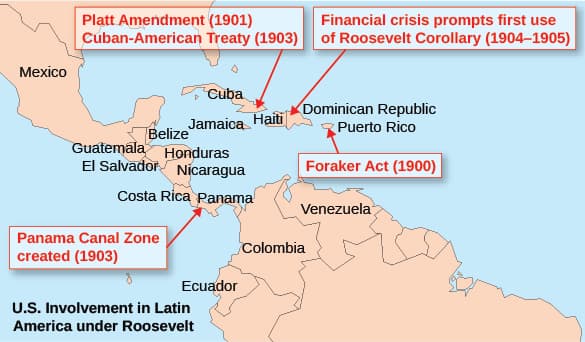
Roosevelt’s “Big Stick” Foreign Policy · US History View original
Is this image relevant?
Roosevelt’s “Big Stick” Foreign Policy | United States History II View original
Is this image relevant?
Theodore Roosevelt’s ‘Big Stick’ Foreign Policy View original
Is this image relevant?
Roosevelt’s “Big Stick” Foreign Policy · US History View original
Is this image relevant?
Roosevelt's "Big Stick" Diplomacy
The phrase comes from an African proverb Roosevelt liked to quote: "Speak softly and carry a big stick; you will go far." The idea was straightforward: negotiate peacefully, but keep a strong military ready so other nations take you seriously.
- Roosevelt used this approach to expand U.S. power projection across the Western Hemisphere and beyond
- American involvement in Latin America and the Caribbean grew significantly, often to protect U.S. economic interests in places like Cuba and the Dominican Republic
- Gunboat diplomacy became a common tactic, with the U.S. Navy's visible presence reinforcing American demands during negotiations
A major extension of this philosophy was the Roosevelt Corollary to the Monroe Doctrine (1904). The original Monroe Doctrine (1823) warned European nations not to colonize or interfere in the Western Hemisphere. Roosevelt's Corollary went further: it claimed the U.S. had the right to intervene in Latin American countries to maintain stability and prevent European powers from using debt collection or instability as an excuse to step back into the region. In practice, this meant the U.S. could and did send troops into Caribbean and Central American nations, acting as a self-appointed "international police power."

Construction of the Panama Canal
The U.S. wanted a canal across the Isthmus of Panama to allow ships to move between the Atlantic and Pacific Oceans without sailing all the way around South America. This mattered for both trade efficiency and naval strategy, since the Navy could shift fleets between oceans far more quickly.
Here's how it unfolded:
- The U.S. approached Colombia (which controlled Panama at the time) with a proposal to build and control a canal zone
- Colombia's senate rejected the deal, wanting better terms
- Roosevelt supported Panamanian rebels who were already seeking independence from Colombia
- After a quick and successful rebellion in November 1903, the U.S. immediately recognized Panama as an independent nation
- The new Panamanian government signed the Hay-Bunau-Varilla Treaty, granting the U.S. control over a 10-mile-wide Canal Zone
- Construction began in 1904 and was completed in 1914
Building the canal was a massive engineering and public health challenge. Tropical diseases like malaria and yellow fever had devastated earlier French construction efforts. American engineers and doctors, particularly Dr. William Gorgas, tackled mosquito-borne illness through drainage and sanitation programs, making construction possible.
The Panama Canal demonstrated both U.S. technological capability and Roosevelt's willingness to use diplomatic pressure and military support to achieve strategic goals. It also highlighted how central the Caribbean and Latin America had become to U.S. interests, from trade routes to naval bases.

U.S. Mediation in the Russo-Japanese War
The Russo-Japanese War (1904–1905) broke out over competing claims to Manchuria and Korea. Japan won a series of surprising military victories, but both sides suffered heavy casualties and financial strain.
Roosevelt offered to mediate, and in 1905 he hosted the Portsmouth Peace Conference in Portsmouth, New Hampshire. He navigated the negotiations carefully, balancing the interests of both powers.
The Treaty of Portsmouth ended the war on these terms:
- Japan gained control over Korea and leased territories in southern Manchuria
- Russia agreed to evacuate Manchuria and recognize Japan's interests in Korea
- Neither side paid a war indemnity, which frustrated Japan
This was a landmark moment for U.S. diplomacy. It established the United States as a power capable of resolving major international conflicts, not just regional ones. Roosevelt won the Nobel Peace Prize in 1906 for his role, the first American president to receive the honor.
The war's outcome also marked Japan's emergence as a major power in East Asia, challenging the dominance that European nations like Britain and France had long held in the region. This shift in the balance of power set the stage for rising tensions that would eventually contribute to conflicts decades later.
Global Power Projection and Economic Influence
Roosevelt took other steps to project American power worldwide. In 1907–1909, he sent the Great White Fleet, a squadron of 16 battleships, on a 14-month voyage around the globe. The tour was a clear signal to other nations that the U.S. Navy could operate anywhere in the world.
Roosevelt also promoted economic tools to extend American influence. While Dollar Diplomacy is more closely associated with his successor, William Howard Taft, Roosevelt laid the groundwork by encouraging American investment abroad and using economic leverage to counterbalance European spheres of influence in Latin America and East Asia. The goal was to protect U.S. business interests while reducing the need for direct military intervention.
See Fiveable more often in Google
Mark Fiveable as a preferred source and Google is more likely to show you our guides in Top Stories, with a "preferred" badge in AI Mode and AI Overviews.