28.5 The African American Struggle for Civil Rights

🗽US History Unit 28 Review
28.5 The African American Struggle for Civil Rights
🗽 US History
Post-World War II Civil Rights Movement
The African American struggle for civil rights between 1945 and 1960 laid the groundwork for one of the most transformative periods in American history. During these years, activists used legal challenges, nonviolent protest, and political organizing to dismantle the system of racial segregation that had defined the South since Reconstruction. Understanding this period means understanding how ordinary people built a movement that forced the federal government to act.

Top images from around the web for Civil rights under Truman and Eisenhower
File:Little Rock Nine protest.jpg - Wikipedia, the free encyclopedia View original
Is this image relevant?
File:Little Rock Desegregation 1957.jpg - Wikipedia, the free encyclopedia View original
Is this image relevant?
Civil rights movement - Wikipedia View original
Is this image relevant?
File:Little Rock Nine protest.jpg - Wikipedia, the free encyclopedia View original
Is this image relevant?
File:Little Rock Desegregation 1957.jpg - Wikipedia, the free encyclopedia View original
Is this image relevant?
Civil Rights Under Truman and Eisenhower
President Harry Truman (1945–1953) took some of the earliest executive actions on civil rights in the postwar era. In 1946, he established the President's Committee on Civil Rights to investigate the state of racial discrimination in the country. The committee's 1947 report, To Secure These Rights, recommended anti-lynching laws, voting rights protections, and a permanent Fair Employment Practices Committee (FEPC) to prevent racial discrimination in hiring. Most of these recommendations stalled in Congress because Southern Democrats blocked them.
Truman's most significant civil rights achievement was Executive Order 9981 (1948), which desegregated the U.S. armed forces by banning racial discrimination in the military. This was a major step, though full implementation took several years.
President Dwight D. Eisenhower (1953–1961) was more cautious on civil rights but still signed important legislation:
- Civil Rights Act of 1957: The first federal civil rights law since Reconstruction, focused on protecting voting rights. It created the Civil Rights Commission to investigate civil rights violations and established the Civil Rights Division within the Department of Justice.
- Civil Rights Act of 1960: Expanded the enforcement powers of the Civil Rights Commission and gave federal courts more authority to protect voting rights.
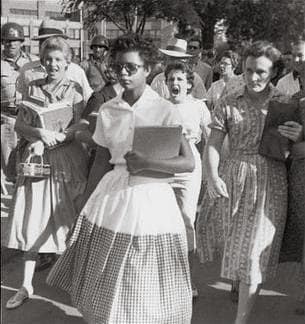
- Little Rock Crisis (1957): When Arkansas Governor Orval Faubus used the National Guard to block nine Black students from entering Little Rock Central High School, Eisenhower sent federal troops (the 101st Airborne Division) to enforce desegregation. This marked a significant moment of federal intervention on behalf of civil rights.
African American Activism Strategies, 1945–1960
Legal Challenges to Segregation
The NAACP Legal Defense and Educational Fund, led by attorney Thurgood Marshall, pursued a deliberate strategy of challenging segregation through the courts. Rather than attacking Jim Crow all at once, Marshall and his team built a series of cases arguing that "separate" facilities were never truly "equal."
This strategy culminated in Brown v. Board of Education (1954), in which the Supreme Court unanimously ruled that segregation in public schools was unconstitutional. The decision overturned the "separate but equal" doctrine established in Plessy v. Ferguson (1896). Brown didn't end school segregation overnight, but it gave the movement a powerful legal foundation.
Nonviolent Direct Action
Nonviolent protest became the movement's most visible strategy during this period. The key idea behind civil disobedience was that activists would deliberately, peacefully break unjust laws to expose their immorality and force a response.
- Montgomery Bus Boycott (1955–1956): After Rosa Parks was arrested for refusing to give up her bus seat to a white passenger, the Black community organized a boycott of Montgomery's bus system. Led by a young minister named Martin Luther King Jr. and the Montgomery Improvement Association, the boycott lasted 381 days. It ended when the Supreme Court ruled Montgomery's bus segregation unconstitutional. The boycott also launched King as a national civil rights leader.
- Greensboro Sit-Ins (1960): On February 1, 1960, four Black college students sat down at a whites-only Woolworth's lunch counter in Greensboro, North Carolina, and refused to leave when denied service. Within weeks, sit-ins spread to dozens of Southern cities, drawing thousands of young people into the movement.
Political Activism and Voter Registration
Alongside protests, activists worked to build Black political power through voter registration, particularly in the Deep South where intimidation and discriminatory practices kept most Black citizens from voting. Organizations like the Student Nonviolent Coordinating Committee (SNCC) played a central role in these efforts.

White Southern Responses to Civil Rights
Massive Resistance
Many white Southerners did not accept desegregation quietly. After the Brown decision, a strategy known as "massive resistance" spread across the South:
- The Southern Manifesto (1956): 101 members of Congress from Southern states signed this document denouncing the Brown decision and pledging to use "all lawful means" to resist school desegregation.
- Interposition and nullification: Some states claimed the right to override federal court rulings, echoing arguments from before the Civil War.
- School closures: Rather than integrate, some localities shut down their public schools entirely. Prince Edward County, Virginia, closed its schools for five years (1959–1964).
- White Citizens' Councils formed across the South to oppose civil rights through economic pressure, such as firing activists or denying them loans and credit.
Violence and Intimidation
The Ku Klux Klan and other white supremacist groups used terror to suppress the movement:
- Emmett Till (1955): A 14-year-old from Chicago was brutally murdered in Mississippi after allegedly whistling at a white woman. His mother's decision to hold an open-casket funeral shocked the nation and galvanized support for civil rights.
- 16th Street Baptist Church bombing (1963): A Klan bombing in Birmingham, Alabama, killed four young girls, drawing national outrage.
Gradual Acceptance
Not all white Southerners resisted. In some urban areas, particularly cities like Atlanta, business leaders pushed for compliance with desegregation orders to avoid the economic damage and negative publicity that violent resistance brought.
Demographic and Social Changes
The Great Migration reshaped the context of the civil rights struggle. Millions of African Americans moved from the rural South to cities in the North and West throughout the early and mid-twentieth century. This migration increased Black political power in Northern cities, where African Americans could vote more freely and elect representatives who supported civil rights legislation.
However, de facto segregation persisted in the North even without formal Jim Crow laws. Black families faced discrimination in housing (through practices like redlining and restrictive covenants), education (through segregated neighborhood schools), and employment. These patterns meant that the civil rights struggle extended well beyond the South.

Civil Rights Legislation and Landmark Events of the 1960s
While this unit focuses on 1945–1960, the activism of that period directly produced the landmark legislation and events of the early-to-mid 1960s. You should understand how they connect.
Major Legislation
- Civil Rights Act of 1964: Signed by President Lyndon B. Johnson, this law prohibited discrimination based on race, color, religion, sex, or national origin. It outlawed segregation in public accommodations (restaurants, hotels, theaters) and banned employment discrimination.
- Voting Rights Act of 1965: Banned literacy tests and other discriminatory voting practices. It authorized federal oversight of voter registration in areas with a history of discrimination, dramatically increasing Black voter registration across the South.
- Fair Housing Act of 1968: Prohibited discrimination in the sale, rental, and financing of housing based on race, religion, national origin, or sex.
Key Events
March on Washington for Jobs and Freedom (1963)
Over 250,000 people gathered at the Lincoln Memorial in one of the largest demonstrations in American history. It was organized by a coalition known as the "Big Six" civil rights leaders: Martin Luther King Jr. (SCLC), Roy Wilkins (NAACP), Whitney Young (National Urban League), A. Philip Randolph (Brotherhood of Sleeping Car Porters), John Lewis (SNCC), and James Farmer (CORE). King delivered his famous "I Have a Dream" speech, and the march helped build public and congressional support for the Civil Rights Act of 1964.
Selma to Montgomery Marches (1965)
Organized by the SCLC and SNCC to demand voting rights, these marches became a turning point after "Bloody Sunday" (March 7, 1965), when state troopers and sheriff's deputies attacked peaceful marchers with tear gas and clubs on the Edmund Pettus Bridge in Selma, Alabama. Television coverage of the violence shocked the nation and built momentum for the Voting Rights Act of 1965.
Evolving Strategies and Ideologies
By the mid-1960s, some activists grew frustrated with the pace of change and the limits of nonviolent protest. The Black Power movement emphasized racial pride, economic self-sufficiency, and community control. Malcolm X advocated for Black nationalism and self-defense, offering a sharp contrast to King's nonviolent philosophy. These differing approaches reflected real debates within the movement about the best path toward equality.
See Fiveable more often in Google
Mark Fiveable as a preferred source and Google is more likely to show you our guides in Top Stories, with a "preferred" badge in AI Mode and AI Overviews.