31.4 Bill Clinton and the New Economy

🗽US History Unit 31 Review
31.4 Bill Clinton and the New Economy
🗽 US History
The Clinton Administration and the New Economy
The Clinton presidency (1993–2001) represented a deliberate pivot toward centrist politics at a time when both parties were polarized. Clinton's "Third Way" approach borrowed from both liberal and conservative playbooks, and his two terms coincided with one of the longest economic expansions in American history. Understanding this era means grappling with how politics, technology, and globalization intersected to reshape the country.

Top images from around the web for Economic policies of Clinton era
Clinton's Surpluses Were Due to the Stock Bubble | Beat the Press | CEPR View original
Is this image relevant?
Presidency of Bill Clinton - Wikipedia View original
Is this image relevant?
United States federal budget - Wikipedia View original
Is this image relevant?
Clinton's Surpluses Were Due to the Stock Bubble | Beat the Press | CEPR View original
Is this image relevant?
Presidency of Bill Clinton - Wikipedia View original
Is this image relevant?
Third Way Politics
Clinton campaigned as a "New Democrat," distancing himself from the liberal wing of his party. His Third Way philosophy combined traditionally conservative priorities like deficit reduction, free trade, and welfare reform with liberal commitments to public investment, education, and social safety nets.
The strategy was politically effective: it pulled moderate voters away from Republicans while keeping the Democratic base largely intact. Critics on the left argued Clinton conceded too much to conservative ideas, while critics on the right saw his centrism as superficial. Either way, the Third Way defined Democratic politics through the 1990s and influenced the party for years afterward.

Economic Policies of the Clinton Era
Deficit Reduction
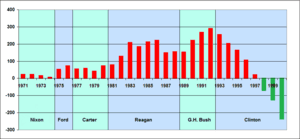
When Clinton took office, the federal budget deficit stood at roughly $290 billion. The Omnibus Budget Reconciliation Act of 1993 attacked this problem from both sides: it raised income taxes on the wealthiest Americans and cut government spending. The bill passed without a single Republican vote in either chamber.
The results were dramatic. By 2000, the deficit had not only disappeared but had flipped into a surplus of $236 billion. This was the first budget surplus since 1969, and it fueled debates over whether to pay down the national debt, cut taxes, or expand programs.
NAFTA
The North American Free Trade Agreement, signed in 1993, created a free-trade zone between the United States, Canada, and Mexico by phasing out most tariffs and trade barriers between the three countries. Clinton argued NAFTA would boost economic growth and create jobs through expanded trade.
NAFTA was genuinely controversial, and the opposition crossed party lines. Labor unions and many Democrats warned it would push manufacturing jobs to Mexico, where wages were lower. Supporters countered that cheaper imports and new export markets would benefit the overall economy. In practice, both sides had a point: trade volume surged, but certain manufacturing communities, particularly in the Midwest, did lose jobs.
Welfare Reform
The Personal Responsibility and Work Opportunity Reconciliation Act of 1996 overhauled the federal welfare system. Its key changes included:
- Replacing the old open-ended federal welfare program (AFDC) with Temporary Assistance for Needy Families (TANF), which came with time limits and work requirements
- Capping benefits at five years over a recipient's lifetime
- Shifting much of the responsibility for designing and administering welfare programs from the federal government to the states
Welfare caseloads dropped sharply in the years that followed, though whether that reflected genuine self-sufficiency or simply people losing access to benefits remained hotly debated.

The New Economy and Economic Prosperity
The 1990s saw the rise of what commentators called the "New Economy", built on information technology, the internet, and deepening globalization.
The Tech Boom
The rapid growth of the internet transformed how businesses operated and how consumers spent money. The dot-com boom sent venture capital flooding into tech startups, many of which had little revenue but sky-high stock valuations. Companies like Amazon, eBay, and Yahoo became household names almost overnight. The NASDAQ composite index, heavy with tech stocks, rose roughly 400% between 1995 and its peak in March 2000.
Globalization
Global markets became increasingly interconnected during this period. Multinational corporations expanded supply chains across borders, and cross-border investment accelerated. Clinton's trade policies actively encouraged this trend, pushing to lower barriers and integrate more countries into the global trading system.
The Numbers
The economic expansion of the 1990s was remarkable by almost any measure:
- Unemployment fell to around 4% by 2000, the lowest in three decades
- The economy grew for 116 consecutive months, the longest peacetime expansion on record at that time
- The stock market soared, and rising consumer confidence drove spending
The prosperity was real, but it wasn't evenly distributed. Wage growth was strongest at the top, and the dot-com bubble would burst in 2000–2001, wiping out trillions in stock value and exposing how much of the boom had been built on speculation.
Clinton's Foreign Affairs Approach
Clinton's foreign policy operated in the post–Cold War moment, when the U.S. was the world's sole superpower but lacked a clear organizing framework for when and how to intervene abroad.
Interventionism
- Somalia (1993): U.S. troops participated in a UN peacekeeping mission to address a humanitarian crisis. The mission turned deadly during the Battle of Mogadishu ("Black Hawk Down"), killing 18 American soldiers and prompting a U.S. withdrawal. The experience made the administration cautious about future interventions.
- Bosnia (1995): Clinton authorized NATO airstrikes against Bosnian Serbs to stop ethnic cleansing during the Bosnian War. The strikes helped bring the warring parties to the negotiating table, leading to the Dayton Accords.
- Iraq (1998): The U.S. launched airstrikes (Operation Desert Fox) against Iraq after Saddam Hussein's government refused to cooperate with UN weapons inspectors.
Peacemaking Efforts
- Oslo Accords (1993): Clinton helped broker this agreement between Israel and the Palestine Liberation Organization (PLO), which established limited Palestinian self-governance in parts of the West Bank and Gaza Strip. The accords were a landmark moment, though a final peace agreement remained elusive.
- Good Friday Agreement (1998): Clinton played a significant supporting role in negotiations that ended decades of sectarian conflict in Northern Ireland by establishing a power-sharing government between unionists and nationalists.
Counterterrorism
Terrorism emerged as a growing threat during the 1990s, though it had not yet become the dominant focus of U.S. policy:
- The 1993 World Trade Center bombing killed six people and injured over a thousand, offering an early warning of the threat from radical Islamist groups
- The 1998 U.S. embassy bombings in Kenya and Tanzania, carried out by al-Qaeda, killed over 200 people. Clinton responded with cruise missile strikes against al-Qaeda targets in Afghanistan and a pharmaceutical factory in Sudan
- These events foreshadowed the September 11 attacks, and critics later argued the Clinton administration did not do enough to neutralize al-Qaeda
Trade and Globalization
- Supported China's entry into the World Trade Organization (completed in 2001), normalizing trade relations and integrating China more fully into the global economy
- Normalized trade relations with Vietnam in 2000, ending the longstanding trade embargo
The 2000 Election Controversy
The 2000 presidential election between Vice President Al Gore and Texas Governor George W. Bush became one of the most contested in American history.
The Vote
Gore won the national popular vote by about 540,000 votes (48.4% to 47.9%), but the Electoral College outcome came down to a single state: Florida.
The Florida Recount
- Initial returns showed Bush ahead in Florida by fewer than 2,000 votes out of roughly 6 million cast, triggering an automatic machine recount under state law.
- The machine recount narrowed Bush's lead to just 537 votes.
- Disputes erupted over undervotes (ballots where no presidential vote registered, often due to incompletely punched "hanging chads") and overvotes (ballots with multiple selections). Problems were concentrated in Miami-Dade, Broward, and Palm Beach counties.
- Gore's campaign requested manual recounts in select counties to try to capture voter intent from ambiguous ballots.
Bush v. Gore
The case reached the U.S. Supreme Court, which ruled 5–4 in Bush v. Gore that the manual recount violated the Equal Protection Clause of the Fourteenth Amendment because different counties were using different standards to evaluate ballots. The Court halted the recount, effectively awarding Florida's 25 electoral votes to Bush. Final Electoral College tally: Bush 271, Gore 266.
Aftermath
The election exposed serious problems with American voting infrastructure. Congress responded with the Help America Vote Act of 2002, which provided federal funding to replace outdated punch-card and lever voting machines and created the Election Assistance Commission to set standards for election administration. The controversy also intensified debates about the Electoral College system itself.
See Fiveable more often in Google
Mark Fiveable as a preferred source and Google is more likely to show you our guides in Top Stories, with a "preferred" badge in AI Mode and AI Overviews.