21.4 Progressivism in the White House

🗽US History Unit 21 Review
21.4 Progressivism in the White House
🗽 US History
Progressive Presidents and Their Agendas
Three presidents shaped the Progressive Era from the White House: Theodore Roosevelt, William Howard Taft, and Woodrow Wilson. Each brought a different approach, but all three expanded federal power to regulate business, protect workers, and address the problems created by rapid industrialization. Together, their presidencies transformed what Americans expected the federal government to do.

Top images from around the web for Square Deal vs Taft's progressivism
Progressivism in the White House – US History II View original
Is this image relevant?
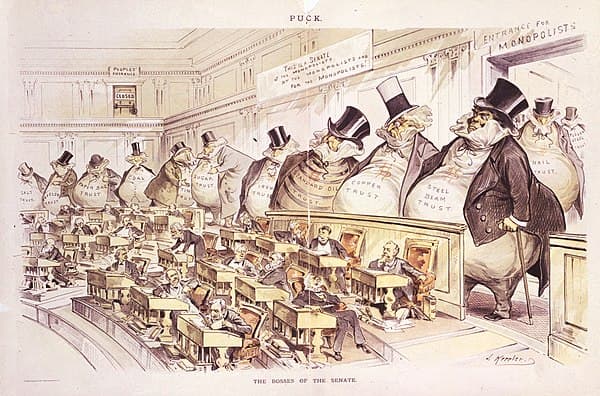
Progressivism in the United States - Wikipedia View original
Is this image relevant?
Progressivism in the White House | United States History II: Since 1865 View original
Is this image relevant?
Progressivism in the White House – US History II View original
Is this image relevant?
Progressivism in the United States - Wikipedia View original
Is this image relevant?
Square Deal vs. Taft's Progressivism
Theodore Roosevelt's "Square Deal" was built on the idea that government should be a fair referee between big business, labor, and consumers. Roosevelt didn't want to destroy corporations; he wanted to control the ones that abused their power.
- Trust-busting: Roosevelt's administration filed suit against 44 corporate monopolies. The most famous case targeted the Northern Securities Company, a massive railroad trust. The Supreme Court ordered it dissolved in 1904, sending a clear signal that the federal government would enforce antitrust law.
- Railroad regulation: The Hepburn Act (1906) gave the Interstate Commerce Commission real power to set maximum railroad shipping rates, which had previously been left entirely to the railroads themselves.
- Conservation: Roosevelt was the most conservation-minded president up to that point. He established 150 national forests, 51 federal bird reserves, and 5 national parks (including Yosemite and Crater Lake). He also created the U.S. Forest Service to manage public lands, setting a precedent for federal environmental protection.
- Consumer protection: After Upton Sinclair's The Jungle exposed horrifying conditions in meatpacking plants, Roosevelt pushed Congress to pass the Pure Food and Drug Act and the Meat Inspection Act (both 1906). These laws required accurate labeling and federal inspection of food products.
William Howard Taft is often seen as the less exciting Progressive president, but his record on trust-busting actually exceeded Roosevelt's. The tension between the two men had more to do with style and political alliances than with policy goals.
- Taft's administration broke up 90 trusts, including the landmark case against Standard Oil Company (1911), using the Sherman Antitrust Act.
- The Payne-Aldrich Tariff Act (1909) was supposed to lower tariffs significantly, but Congress watered it down. Taft signed it anyway, angering Progressive reformers who felt he'd caved to conservative Republicans.
- He supported the 16th Amendment (ratified 1913), which authorized a federal income tax. This gave the government a major new revenue source that didn't depend on tariffs.
- He established the U.S. Postal Savings System, giving ordinary citizens a safe place to deposit money at a time when bank failures were common.

Wilson's New Freedom Legislation
Woodrow Wilson campaigned on a platform called the "New Freedom," which focused on breaking up monopolies, lowering tariffs, and reforming the banking system. Once in office, he worked closely with Congress to pass a wave of legislation.
- Underwood-Simmons Tariff Act (1913): Significantly reduced import tariffs for the first time in decades, lowering prices on consumer goods and encouraging international trade. The lost tariff revenue was offset by the new federal income tax.
- Federal Reserve Act (1913): Created the Federal Reserve System, a central banking system that could regulate the money supply and stabilize the economy. This was arguably the most lasting reform of the entire Progressive Era; the Fed still operates today.
- Clayton Antitrust Act (1914): Strengthened antitrust enforcement by spelling out specific illegal business practices (like price-fixing). Crucially, it exempted labor unions from being treated as illegal trusts, which had been a major problem under the Sherman Act.
- Federal Trade Commission Act (1914): Established the FTC as a new federal agency with the power to investigate and prohibit unfair business practices, such as false advertising and deceptive trade.
- Keating-Owen Child Labor Act (1916): Prohibited the interstate sale of products made by child labor. This was a landmark effort, though the Supreme Court struck it down in Hammer v. Dagenhart (1918), ruling that Congress had overstepped its commerce power.
- Adamson Act (1916): Established an 8-hour workday for interstate railroad workers, with overtime pay for additional hours. This was the first federal law regulating work hours in private industry.

Progressive Expansion of Federal Power
The Progressive presidents collectively reshaped the role of the federal government. Here's how that expansion played out across several areas:
Increased executive authority: Roosevelt embraced what he called the "stewardship theory" of the presidency, arguing that the president could do anything not explicitly forbidden by the Constitution. Wilson took a different approach, using his influence to personally guide legislation through Congress. Both models expanded presidential power well beyond what the 19th century had established.
Trust-busting and regulation: All three presidents used antitrust law to break up monopolies and promote competition. They also created new federal agencies (the FTC, the FDA's precursor) that gave the government permanent oversight of business practices, rather than relying on one-time lawsuits.
Conservation and environmental protection: Roosevelt's conservation legacy was enormous, and the creation of the National Park Service (1916, under Wilson) institutionalized federal management of public lands. These efforts established the principle that natural resources belonged to the public, not just to private industry.
Social welfare and labor reforms: Laws like the Adamson Act and the Keating-Owen Act represented early steps toward federal protection of workers. While some of these laws were limited or struck down, they set precedents that later generations built on with programs like Social Security (1935) and the Fair Labor Standards Act (1938).
Progressivism and Social Reform
Understanding the broader Progressive movement helps you see why these presidents acted as they did. Several key concepts drove the era:
- Muckraking refers to investigative journalism that exposed corruption and social problems. Writers like Upton Sinclair, Ida Tarbell, and Lincoln Steffens shaped public opinion and created political pressure for reform. Tarbell's exposé of Standard Oil, for example, directly fueled the push for antitrust action.
- The regulatory state describes the expansion of government agencies and oversight that Progressive legislation created. Before this era, the federal government had very little direct involvement in regulating business. Afterward, agencies like the FTC and the Federal Reserve became permanent features of American governance.
- Social reform efforts targeted poverty, unsafe working conditions, and political corruption. Progressives believed that government had a responsibility to address the problems caused by industrialization and urbanization, rather than leaving everything to the free market.
See Fiveable more often in Google
Mark Fiveable as a preferred source and Google is more likely to show you our guides in Top Stories, with a "preferred" badge in AI Mode and AI Overviews.