5.1 Confronting the National Debt: The Aftermath of the French and Indian War

🗽US History Unit 5 Review
5.1 Confronting the National Debt: The Aftermath of the French and Indian War
🗽 US History
The Aftermath of the French and Indian War

Top images from around the web for British colonies after French-Indian War
File:British colonies 1763-76 shepherd1923.PNG - Wikimedia Commons View original
Is this image relevant?
Wars for Empire | US History I View original
Is this image relevant?
Royal Proclamation of 1763 - Wikipedia View original
Is this image relevant?
File:British colonies 1763-76 shepherd1923.PNG - Wikimedia Commons View original
Is this image relevant?
Wars for Empire | US History I View original
Is this image relevant?
British Colonies After the French and Indian War
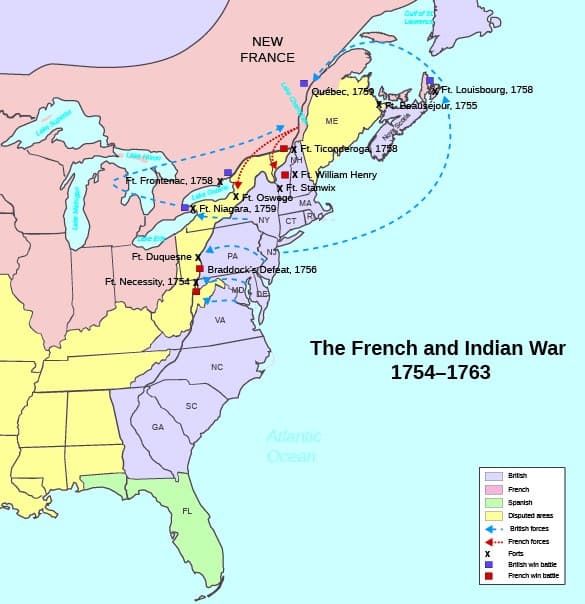
Britain's victory in 1763 didn't just end a war. It reshaped the entire map of North America. France ceded its vast holdings (New France and Louisiana) to Britain and Spain, giving Britain control of all lands east of the Mississippi River.
Colonists celebrated at first. The French threat was gone, and a huge stretch of new territory seemed open for settlement. But that celebration didn't last long. Britain now had to govern and defend an empire that had roughly doubled in size, and the bill for doing so would land squarely on the colonies.

Britain's Post-War Financial Crisis
The French and Indian War nearly doubled Britain's national debt, from about £75 million in 1756 to £133 million by 1763. To put that in perspective, just paying the interest on that debt consumed a large portion of Britain's annual revenue.
On top of the debt, Britain faced ongoing costs:
- A standing army of roughly 10,000 troops stationed in North America to defend the new frontier
- A massive navy to protect trade routes across the Atlantic, Caribbean, and Indian Ocean
- Administrative costs of governing territories that now stretched from Canada to Florida
King George III and Parliament concluded that the colonists, who had directly benefited from the war, should help pay for their own defense. This logic seemed perfectly reasonable in London. In the colonies, it would prove explosive.

Parliament's Strategies for Addressing the Debt
Parliament responded to the crisis with a wave of new taxes, trade regulations, and territorial restrictions. Each was designed to either raise revenue or cut costs, but together they created the impression of a government tightening its grip on colonial life.
Direct Taxes on the Colonies
- Sugar Act (1764) actually lowered the duty on imported molasses (from 6 pence to 3 pence per gallon), but it dramatically increased enforcement. Before 1764, smuggling was rampant and customs officials rarely collected the old tax. The Sugar Act changed that by deploying naval patrols and establishing new admiralty courts to prosecute smugglers without juries.
- Stamp Act (1765) required colonists to purchase special stamps for legal documents, newspapers, playing cards, and other printed materials. This was the first direct tax Parliament had ever imposed on the colonies (as opposed to trade duties), which made it especially controversial.
Trade and Currency Restrictions
- The Currency Act (1764) banned colonies from issuing their own paper money. Colonial currency had often lost value, which hurt British merchants who received it as payment. But for colonists already short on hard currency, this restriction squeezed their local economies.
- The Proclamation of 1763 drew a line along the Appalachian Mountains and forbade colonial settlement west of it. Parliament wanted to avoid expensive frontier wars with Native Americans. Colonists, many of whom had fought in the war partly to access the Ohio River Valley, saw this as a betrayal.
These measures built on existing mercantilist policies like the Navigation Acts, which had long required colonies to trade primarily with Britain. The difference now was enforcement. Parliament was no longer willing to look the other way.
Proclamation Line vs. Sugar Act
These two policies illustrate the two different ways Parliament tried to manage its post-war problems:
Proclamation of 1763 aimed to reduce costs by preventing frontier conflicts with Native Americans. It restricted westward settlement beyond the Appalachians. Colonists resented losing access to lands they felt they had fought to win.
Sugar Act (1764) aimed to raise revenue by cracking down on smuggling rather than simply raising tax rates. Colonists protested the stricter enforcement and the use of admiralty courts (which had no juries), arguing these measures violated their traditional rights as English subjects.
Both policies shared a common thread: decisions made in London, without colonial input, that directly limited colonial economic opportunity and self-governance.
Colonial Resistance and the Representation Debate
The core colonial objection came down to a single principle: "No taxation without representation." Colonists had no elected members in Parliament, so they argued that Parliament had no right to tax them directly. Only their own colonial legislatures, where they were represented, could levy taxes.
British officials countered with the theory of virtual representation. Under this idea, every member of Parliament represented all British subjects everywhere, not just the voters in their own district. Most people living in Britain couldn't vote either, they pointed out, yet Parliament still legislated on their behalf.
Colonists found this argument unconvincing. An ocean separated them from Parliament, and members of Parliament had no firsthand knowledge of colonial conditions. The Board of Trade, which advised Parliament on colonial policy, consistently recommended measures that prioritized British economic interests over colonial concerns, reinforcing the colonists' sense that no one in London was looking out for them.
This gap between British and colonial views of representation would only widen as Parliament continued passing new measures in the years ahead.
See Fiveable more often in Google
Mark Fiveable as a preferred source and Google is more likely to show you our guides in Top Stories, with a "preferred" badge in AI Mode and AI Overviews.