25.1 The Stock Market Crash of 1929

🗽US History Unit 25 Review
25.1 The Stock Market Crash of 1929
🗽 US History
Factors and Vulnerabilities Leading to the 1929 Stock Market Crash
The 1929 stock market crash didn't happen out of nowhere. It was the result of deep structural problems in the American economy that had been building throughout the 1920s. Rampant speculation, overproduction, and extreme wealth inequality all combined to create conditions where a major collapse was almost inevitable. Once the crash hit, it set off a chain reaction of bank failures, mass unemployment, and widespread poverty that would define the next decade.
The damage cut across every level of society. Wealthy investors lost fortunes overnight, middle-class families watched their savings vanish, and working-class Americans faced unemployment and homelessness on a massive scale. Understanding what caused the crash means looking at both the immediate triggers and the longer-term vulnerabilities that made the economy so fragile.

Top images from around the web for Factors behind 1929 market crash
Krach de 1929 - Vikidia, l’encyclopédie des 8-13 ans View original
Is this image relevant?
The Stock Market Crash of 1929 | United States History: Reconstruction to the Present View original
Is this image relevant?
File:1929 wall street crash graph.svg - Wikipedia View original
Is this image relevant?
Krach de 1929 - Vikidia, l’encyclopédie des 8-13 ans View original
Is this image relevant?
The Stock Market Crash of 1929 | United States History: Reconstruction to the Present View original
Is this image relevant?
Factors Behind the 1929 Market Crash
Rampant speculation and excessive borrowing drove stock prices far beyond what companies were actually worth. Investors bought stocks on margin, meaning they only put down 10–20% of the purchase price and borrowed the rest from brokers. The plan was to sell at a profit and repay the loan, but this only works when prices keep rising. A widespread belief took hold that the market would go up forever, drawing in everyone from professional traders to ordinary Americans with no investing experience. When prices finally turned, margin buyers couldn't repay their loans, and the selling snowballed.
Overproduction and underconsumption created a dangerous gap between supply and demand. Factories churned out goods at record rates during the 1920s, but wages for most workers stayed flat. Industries like automobile manufacturing (Ford's Model T being a prime example) ramped up production, yet a large share of Americans simply couldn't afford to buy what was being produced. Unsold inventory piled up, and companies eventually had to cut production and lay off workers.
Unequal distribution of wealth meant the economy was standing on a narrow base. The top 1% of the population controlled roughly 40% of the nation's wealth, while about 80% of Americans had no savings at all. This concentration meant that consumer spending depended heavily on credit rather than real income, and most families had zero cushion when the economy turned.
A weak banking system and easy credit amplified all of these problems. Banks invested depositors' money directly in the stock market and made loans to speculators without adequate risk assessment. There was little federal regulation of banking practices during this period. When stock prices collapsed, banks that had overextended themselves failed, taking their depositors' money with them. (The Glass-Steagall Act of 1933 was later passed specifically to address these failures by separating commercial and investment banking.)

Economic Vulnerabilities of 1920s America
Overreliance on consumer credit was a ticking time bomb. Installment buying plans let Americans purchase cars, appliances, and furniture on credit, which boosted spending in the short term but left households loaded with debt. When the economy contracted, consumers couldn't keep up with payments, leading to widespread defaults and a credit crunch that deepened the downturn.
The agricultural sector was already in crisis. Farmers had been struggling throughout the 1920s as new technology increased crop yields while global competition pushed prices down. Many farmers carried heavy debts from land purchases and equipment upgrades made during the wartime boom. The crash made their situation far worse, and the Dust Bowl of the early 1930s would later compound the devastation in rural areas.
International economic instability made recovery harder. European nations were still burdened by World War I debts and political turmoil. The Smoot-Hawley Tariff of 1930 raised import duties to record levels, which prompted retaliatory tariffs from trading partners and caused international trade to collapse. This turned what might have been an American recession into a global depression.
The federal government largely stood on the sidelines. The prevailing laissez-faire philosophy of the 1920s meant minimal regulation of financial markets and no real safety net for ordinary Americans. When the crisis hit, the Hoover administration was slow to intervene. The Federal Reserve also failed to act decisively, tightening the money supply at exactly the wrong time instead of providing liquidity to struggling banks. The resulting shantytowns that sprang up across the country became known as "Hoovervilles," a bitter reflection of public anger at the government's inadequate response.

Market Dynamics and Economic Consequences
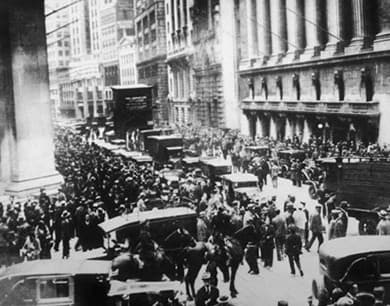
The prolonged bull market of the 1920s created an unsustainable bubble. Stock prices had roughly quadrupled between 1924 and 1929, far outpacing actual corporate earnings. When confidence finally cracked in late October 1929, the result was a devastating bear market marked by panic selling. On Black Thursday (October 24) and Black Tuesday (October 29), massive sell-offs wiped out billions of dollars in value.
The crash didn't cause the Great Depression by itself, but it was the spark that ignited all the underlying problems. As stock values collapsed, banks failed, credit dried up, businesses closed, and unemployment spiraled upward. The depression that followed would last roughly a decade and reshape the role of the federal government in American economic life.
Impact of the 1929 Crash on American Society
Social Impact of the 1929 Crash
The crash's effects reached every corner of American society, though not everyone suffered equally.
Investors and the wealthy saw fortunes disappear almost overnight. On Black Tuesday alone, the market lost about 230 billion in today's dollars). Some prominent financiers faced total ruin, forced to sell homes, businesses, and personal assets. The psychological shock was enormous for a class that had felt invincible during the boom years.
Middle-class and white-collar workers lost their savings when banks failed, since there was no federal deposit insurance at the time. As businesses cut costs or shut down entirely, office workers and professionals faced layoffs and pay cuts. Many families that had considered themselves financially secure found themselves standing in soup kitchen lines.
Working-class Americans and the poor bore the heaviest burden. Unemployment reached approximately 25% by 1933, and in some industrial cities it was even higher. Homelessness surged, and bread lines stretched for blocks in major cities. Families who had been living paycheck to paycheck had nothing to fall back on.
Farmers and rural communities, already weakened by a decade of low prices and debt, were pushed to the breaking point. Foreclosures swept through farming regions as families lost land that had been in their possession for generations. Many displaced farm families, sometimes called "Okies" regardless of their actual home state, migrated westward in search of work, particularly to California.
Minorities and marginalized groups suffered disproportionately. African Americans, recent immigrants, and women were typically the first to be fired under "last hired, first fired" practices. They also faced discrimination in accessing the limited relief programs that did exist. The economic crisis intensified racial tensions across the country, as competition for scarce jobs and resources grew fiercer.
See Fiveable more often in Google
Mark Fiveable as a preferred source and Google is more likely to show you our guides in Top Stories, with a "preferred" badge in AI Mode and AI Overviews.