5.2 The Stamp Act and the Sons and Daughters of Liberty

🗽US History Unit 5 Review
5.2 The Stamp Act and the Sons and Daughters of Liberty
🗽 US History
The Stamp Act and Colonial Resistance
The Stamp Act of 1765 sparked widespread colonial resistance and marked a turning point in British-American relations. Colonists viewed the tax as a violation of their rights, leading to protests, boycotts, and the formation of resistance groups like the Sons and Daughters of Liberty. The act's repeal in 1766 was a victory for the colonists, but Parliament immediately reasserted its authority through the Declaratory Act, setting the stage for future conflicts.

Top images from around the web for Purpose and impact of Stamp Act
The Stamp Act and the Sons and Daughters of Liberty | United States History I View original
Is this image relevant?
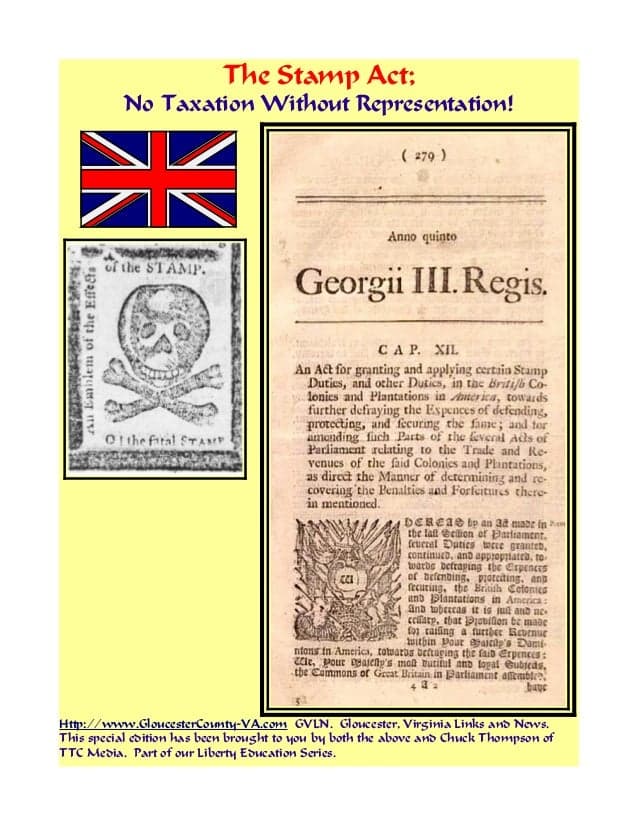
The Stamp Act - No Taxation Without Representation View original
Is this image relevant?
Stamp Act 1765 - Wikipedia View original
Is this image relevant?
The Stamp Act and the Sons and Daughters of Liberty | United States History I View original
Is this image relevant?
The Stamp Act - No Taxation Without Representation View original
Is this image relevant?
Purpose and Impact of the Stamp Act
After the Seven Years' War (French and Indian War), Britain faced massive war debt and the ongoing cost of stationing troops in the colonies. The Stamp Act of 1765 was Parliament's attempt to make the colonists help cover those expenses. It required colonists to pay a tax on a wide range of printed materials, including newspapers, legal documents, and even playing cards. A physical stamp on the paper proved the tax had been paid.
What made this tax so explosive wasn't just the cost. Colonists saw it as a direct violation of their rights as Englishmen. The core argument: they had no elected representatives in Parliament, so Parliament had no right to tax them. This principle of "no taxation without representation" became the rallying cry of colonial opposition.
The Stamp Act triggered organized resistance across the colonies:
- Stamp Act Congress convened in New York in October 1765, bringing together delegates from nine colonies to coordinate a unified response.
- Colonists organized boycotts of British goods (called non-importation agreements) to put economic pressure on Parliament.
- Public protests spread through colonial cities, with crowds burning effigies of stamp distributors and destroying stamped paper.

Effectiveness of Colonial Responses
Colonial resistance worked on multiple fronts, and the combination proved powerful enough to force Parliament's hand.
Economic pressure was arguably the most effective tactic. Colonists refused to purchase British imports, causing a sharp decline in trade. British merchants, watching their profits shrink, lobbied Parliament hard for repeal.
Direct action and intimidation also played a major role. Protesters targeted stamp distributors specifically, threatening and harassing them until many resigned their positions. Without anyone willing to distribute the stamps, the act became nearly impossible to enforce.
Political coordination through the Stamp Act Congress gave the resistance a unified voice. The Congress issued a "Declaration of Rights and Grievances" that made two key claims:
- Only colonial legislatures had the right to tax the colonists.
- Parliament should repeal the Stamp Act.
The Congress also petitioned both the King and Parliament directly. This was significant because it showed the colonies could act together across regional lines.
Under combined pressure from colonial boycotts and British merchants, Parliament repealed the Stamp Act in March 1766. But the victory came with a catch: Parliament simultaneously passed the Declaratory Act, asserting its right to legislate for the colonies "in all cases whatsoever." The colonists had won the battle over the Stamp Act, but Parliament refused to concede the larger principle.

Sons vs. Daughters of Liberty Tactics
Two resistance groups illustrate how different segments of colonial society contributed to the opposition movement.
The Sons of Liberty were a loosely organized network of male patriots who favored public, often confrontational tactics. They organized street demonstrations, enforced boycotts, and used intimidation against British officials and loyalists. Their methods could turn violent: tarring and feathering was a real threat aimed at stamp distributors and other enforcers of British policy. Prominent members included Samuel Adams, John Hancock, and Paul Revere. The Sons of Liberty would remain active through later crises, including the Boston Tea Party in 1773.
The Daughters of Liberty took a different but equally important approach, focusing on economic resistance. They organized spinning bees, public gatherings where women produced homespun cloth as a substitute for British textiles. By making their own goods and boycotting British tea and other imports, they turned everyday household decisions into political acts. They also raised funds for the patriot cause by selling homespun products.
Key comparison: The Sons of Liberty relied on public demonstrations, direct action, and intimidation. The Daughters of Liberty relied on economic resistance through boycotts and domestic manufacturing. Both were essential to making colonial opposition effective.
Together, these groups helped transform scattered local grievances into a broad, coordinated resistance movement that cut across class and gender lines.
Colonial Response and Imperial Reform
The Stamp Act crisis revealed a fundamental disagreement between Britain and the colonies over governance. Colonists asserted their right to colonial self-government, particularly on the question of taxation. Their resistance tactics, from boycotts to civil disobedience, established a playbook that would be used again in response to future British policies like the Townshend Acts.
Perhaps most importantly, the crisis fostered a growing sense of colonial unity. Before 1765, the colonies had rarely cooperated on political matters. The Stamp Act Congress and the coordinated boycotts showed that the colonies could act together against perceived British overreach, laying groundwork for the broader resistance that would eventually lead to revolution.
See Fiveable more often in Google
Mark Fiveable as a preferred source and Google is more likely to show you our guides in Top Stories, with a "preferred" badge in AI Mode and AI Overviews.