20.4 Social and Labor Unrest in the 1890s

🗽US History Unit 20 Review
20.4 Social and Labor Unrest in the 1890s
🗽 US History
Economic and Political Turmoil in the 1890s
The 1890s were one of the most volatile decades in American political and economic life. A devastating depression, a realigning presidential election, and a wave of labor strikes all collided within a few years, exposing deep fractures between workers, farmers, and the industrial elite. Understanding how these events connected is key to grasping why the Gilded Age eventually gave way to the Progressive Era.

Top images from around the web for Impact of 1893 Depression on Populism
Farmers Revolt in the Populist Era | United States History II View original
Is this image relevant?
Panic of 1893 - Wikipedia View original
Is this image relevant?
Panic of 1893 - Wikipedia View original
Is this image relevant?
Farmers Revolt in the Populist Era | United States History II View original
Is this image relevant?
Panic of 1893 - Wikipedia View original
Is this image relevant?
Impact of the 1893 Depression on Populism
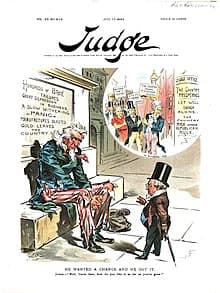
The Depression of 1893 was the worst economic crisis the country had faced up to that point. It lasted roughly four years and had several overlapping causes:
- Overexpansion of the railroad industry, which created a speculative bubble that burst when major railroads went bankrupt
- Declining European demand for American agricultural products like wheat and cotton, which crushed farm prices
- Shrinking U.S. gold reserves, which shook confidence in the nation's financial stability and triggered bank failures
The human cost was staggering. An estimated 3 million workers lost their jobs, roughly 20% of the workforce at the depression's peak. Poverty, homelessness, and food insecurity spread through industrial cities and farming communities alike.
This suffering fueled the Populist Party (also called the People's Party), which had been building support among farmers since the early 1890s. The depression pushed the party's message to a wider audience. Populists advocated for:
- A graduated income tax so the wealthy paid a larger share
- Government ownership of railroads and telegraph lines to break corporate monopolies on transportation and communication
- Free coinage of silver to inflate the money supply, making it easier for debt-burdened farmers to pay back loans
By the 1894 midterm elections, the Populist Party had won several congressional seats and gained control of state legislatures in places like Kansas and North Carolina. The party's rise signaled that millions of Americans felt the existing two-party system wasn't addressing their needs.

The 1896 Presidential Election
The 1896 election is one of the most important in U.S. history because it realigned American politics for a generation. The two candidates offered sharply different visions for the country's economic future.
William McKinley (Republican) supported the gold standard, arguing it provided financial stability, and backed high protective tariffs to shield American manufacturing from foreign competition. His campaign was heavily funded by industrialists like Mark Hanna, who raised an unprecedented amount of money from business interests.
William Jennings Bryan (Democratic and Populist nominee) championed free coinage of silver and a progressive income tax. At just 36 years old, Bryan electrified the Democratic National Convention with his famous "Cross of Gold" speech, in which he declared, "You shall not crucify mankind upon a cross of gold." The speech framed the election as a battle between ordinary farmers and workers on one side and Eastern financial elites on the other.
The two campaigns looked completely different in style:
- Bryan embarked on a grueling nationwide speaking tour, traveling over 18,000 miles and delivering hundreds of speeches directly to voters.
- McKinley ran a "front porch" campaign from his home in Canton, Ohio, where delegations of supporters came to him. Behind the scenes, his campaign used its massive funding advantage to flood the country with pamphlets, posters, and surrogate speakers.
McKinley won decisively, 271 electoral votes to Bryan's 176. He carried the industrial Northeast and Midwest, while Bryan dominated the South and rural West. The result was widely seen as an endorsement of the gold standard and a rejection of the Populist agenda. More broadly, it launched a period of Republican dominance in national politics that lasted until the Great Depression reshuffled the parties in the 1930s.

Causes and Consequences of 1890s Labor Strikes
Labor unrest in the 1890s didn't come out of nowhere. Workers faced brutal conditions throughout the Gilded Age:
- Workdays of 12 to 16 hours were common in factories and mines
- Wages were low and frequently cut during economic downturns
- There were almost no legal protections for workers or unions
- Wealth was concentrating at the top while workers struggled to survive
These conditions produced several major confrontations between labor and capital.
The Homestead Strike (1892) erupted at Andrew Carnegie's steel plant in Homestead, Pennsylvania, when the company tried to break the union and cut wages. Management hired Pinkerton detectives as a private security force. When the Pinkertons arrived by barge, a violent battle broke out with striking workers, leaving several dead on both sides. The state militia eventually restored order, and the union was crushed. The strike dealt a serious blow to organized labor in the steel industry for decades.
The Pullman Strike (1894) became the most significant labor conflict of the decade. Here's how it unfolded:
- Workers at the Pullman Palace Car Company near Chicago had their wages cut, but the company refused to lower rents in the company-owned town where employees were required to live.
- Workers went on strike, and the American Railway Union (ARU), led by Eugene V. Debs, supported them by refusing to handle any train with a Pullman car attached.
- The boycott effectively shut down much of the nation's rail traffic, disrupting mail delivery and interstate commerce.
- President Grover Cleveland obtained a federal court injunction against the strike and sent federal troops to Chicago to enforce it, citing the disruption of mail service.
- Violence broke out, several workers were killed, and Debs was arrested and imprisoned for violating the injunction.
The strike failed, but it had lasting consequences. It demonstrated that the federal government would intervene on the side of business during labor disputes. It also radicalized Debs, who later became the most prominent socialist in American politics.
The Coeur d'Alene conflicts (1892–1899) were a series of violent clashes between silver miners and mine owners in Idaho, involving dynamite, martial law, and federal troops. These disputes showed that labor violence wasn't limited to Eastern industrial cities.
The consequences of this wave of labor unrest rippled forward:
- Public awareness of workers' suffering grew, even though public opinion was often divided
- The labor movement continued to organize, with unions like the American Federation of Labor (AFL) gaining members by focusing on skilled workers and practical demands like higher wages and shorter hours
- Working conditions and wages improved gradually, though progress was slow and uneven
- The unresolved tensions between labor and management set the stage for continued conflicts in the early 20th century, including the Coal Strike of 1902 and the Lawrence Textile Strike of 1912
Industrial and Social Landscape
Rapid industrialization had concentrated enormous economic power in the hands of a few large corporations and monopolies. Companies like Carnegie Steel and Standard Oil dominated entire industries, and their owners wielded political influence to match their wealth.
Labor unions emerged as the primary vehicle for workers to push back, using collective bargaining to negotiate for better pay and conditions. But unions faced fierce resistance. Companies regularly used strike-breaking tactics such as hiring replacement workers (called "scabs"), employing private security forces like the Pinkertons, and pressuring courts to issue injunctions against strikes.
Social reformers, many of them journalists and clergy, began drawing public attention to the human costs of unchecked industrialization. Their efforts in the 1890s planted seeds that would grow into the broader Progressive movement of the early 1900s.
See Fiveable more often in Google
Mark Fiveable as a preferred source and Google is more likely to show you our guides in Top Stories, with a "preferred" badge in AI Mode and AI Overviews.