23.1 American Isolationism and the European Origins of War

🗽US History Unit 23 Review
23.1 American Isolationism and the European Origins of War
🗽 US History
American Isolationism and World War I
World War I tested America's long-standing commitment to staying out of European affairs. Economic ties with the Allies, German submarine warfare, and British naval blockades all challenged President Wilson's efforts to keep the U.S. neutral. Understanding how and why the U.S. eventually entered the war is key to grasping how America's global role fundamentally shifted in the early twentieth century.

Top images from around the web for Wilson's foreign policy and neutrality challenges
United States in World War I - Wikipedia View original
Is this image relevant?
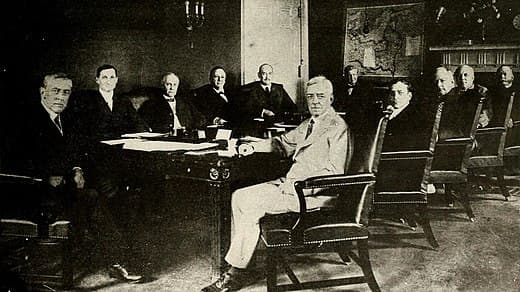
Woodrow Wilson - Wikipedia View original
Is this image relevant?
Who Makes U.S. Foreign Policy? | Boundless Political Science View original
Is this image relevant?
United States in World War I - Wikipedia View original
Is this image relevant?
Woodrow Wilson - Wikipedia View original
Is this image relevant?
Wilson's Foreign Policy and Neutrality Challenges
Woodrow Wilson came into office championing moral diplomacy, the idea that the U.S. should promote democracy and ethical conduct abroad rather than pursue raw economic or territorial gain. When war broke out in Europe in 1914, Wilson declared American neutrality and urged citizens to remain "impartial in thought as well as in action."
That neutrality proved difficult to maintain for several reasons:
- Economic ties with Allied nations. U.S. banks extended large loans to Britain and France to support their war efforts, and American trade with the Allies surged, especially in war materials, food, and manufactured goods. By 1917, U.S. trade with the Allies was worth roughly 1 million with Germany. This financial entanglement meant that an Allied defeat would have been an economic disaster for the U.S.
- German submarine warfare. Germany declared the waters around Britain a war zone and used U-boats to sink merchant ships entering the area. The most infamous incident was the sinking of the British passenger liner Lusitania in May 1915, which killed 1,198 people, including 128 Americans. These attacks enraged the American public and put enormous pressure on Wilson's neutrality stance.
- British naval blockade. Britain blockaded German ports to cut off supplies, which also strangled U.S. trade with Germany. While this angered American merchants, the economic damage was far smaller than what would result from losing Allied trade, so the blockade generated less public outcry than German submarine attacks did.

Factors in the U.S. Declaration of War
By early 1917, several developments pushed the U.S. past the breaking point:
-
Unrestricted submarine warfare resumes. In January 1917, Germany announced it would sink any ship in the war zone, neutral or not. German leaders knew this risked drawing the U.S. into the war, but they gambled they could starve Britain into surrender before American forces could make a difference. U.S. merchant ships were sunk almost immediately, killing American sailors.
-
The Zimmermann Telegram. In January 1917, German Foreign Minister Arthur Zimmermann sent a coded telegram to Mexico proposing a military alliance against the United States. In return, Germany promised to help Mexico recover territories lost in the Mexican-American War: Texas, New Mexico, and Arizona. British intelligence intercepted and decoded the telegram, then shared it with the U.S. government. When it was published in American newspapers in March 1917, public outrage was enormous.
-
The Russian Revolution. In March 1917, the Tsarist autocracy in Russia was overthrown and replaced by a provisional government that appeared more democratic. This mattered because it removed an awkward contradiction: Wilson could now frame the war as a struggle of democracies against autocracies without having to explain why the U.S. was allied with the repressive Russian Tsar.
-
Wilson's idealism. Wilson came to believe the U.S. had a moral obligation to help make the world "safe for democracy." He saw the war not just as a military conflict but as a chance to reshape the international order. This vision eventually took concrete form in his Fourteen Points, a blueprint for postwar peace that included open diplomacy, freedom of the seas, arms reduction, and the creation of a League of Nations.
On April 2, 1917, Wilson asked Congress for a declaration of war. Congress approved it on April 6.

Influences on America's Path to War
Beyond the immediate triggers, deeper forces shaped the country's drift toward intervention:
- Economic interests. American businesses had poured investments into Allied countries. The U.S. economy was increasingly tied to Allied success through trade, loans, and war production. A Central Powers victory could have meant massive financial losses for American banks and industries.
- Ethnic and cultural divisions. Americans of British, French, and Italian descent often sympathized with the Allies. Meanwhile, German Americans (a large and politically active group) and Irish Americans (who resented British rule in Ireland) tended to oppose intervention. These divisions made the neutrality debate deeply personal for many communities.
- Cumulative impact of German actions. The sinking of the Lusitania, the resumption of unrestricted submarine warfare, and the Zimmermann Telegram formed a pattern that increasingly looked like deliberate aggression against the United States. Each incident built on the last, eroding public patience and strengthening the case for war.
European Origins of War
The war itself grew out of long-building tensions in Europe, often summarized with the acronym M.A.I.N.:
- Militarism. European powers had been engaged in a massive arms race for decades. Germany and Britain competed over naval supremacy, and standing armies across the continent grew to unprecedented sizes. This buildup created an atmosphere of suspicion and made leaders quicker to choose military solutions.
- Alliances. A web of mutual defense treaties divided Europe into two opposing camps: the Triple Alliance (Germany, Austria-Hungary, Italy) and the Triple Entente (France, Russia, Britain). These alliances meant that a conflict between two nations could rapidly pull in the rest of the continent, which is exactly what happened after the assassination of Archduke Franz Ferdinand of Austria-Hungary in June 1914.
- Imperialism. European powers competed fiercely for colonies and resources in Africa, Asia, and the Pacific. These rivalries bred resentment and distrust, particularly between Britain, France, and Germany.
- Nationalism. Intense national pride and the desire for self-determination fueled conflicts, especially in the Balkans, where ethnic groups under Austro-Hungarian and Ottoman rule sought independence. The assassination of Franz Ferdinand by a Serbian nationalist was the spark that ignited the war.
Post-War Developments
- Treaty of Versailles (1919). The peace agreement that formally ended the war imposed harsh terms on Germany, including massive reparations, territorial losses, and a "war guilt" clause that placed full blame for the conflict on Germany. Many historians argue these punitive terms planted the seeds for future instability in Europe.
- League of Nations. Wilson's proposed international organization was designed to resolve disputes peacefully and prevent future wars. It was written into the Treaty of Versailles, but the U.S. Senate ultimately refused to ratify the treaty, largely due to concerns that League membership would commit the U.S. to foreign entanglements. The League went forward without American participation, significantly weakening its effectiveness.
See Fiveable more often in Google
Mark Fiveable as a preferred source and Google is more likely to show you our guides in Top Stories, with a "preferred" badge in AI Mode and AI Overviews.