10.3 The Nullification Crisis and the Bank War

🗽US History Unit 10 Review
10.3 The Nullification Crisis and the Bank War
🗽 US History
The Nullification Crisis
The Nullification Crisis of 1832–1833 was one of the first major showdowns between federal and state authority. South Carolina's refusal to enforce a federal tariff pushed the country to the brink of armed conflict and forced President Jackson to take a firm stand on the Union's survival. The arguments made here resurfaced directly in the lead-up to the Civil War.

Top images from around the web for Causes and consequences of Nullification Crisis
Foreign Affairs | US History II (American Yawp) View original
Is this image relevant?
Tariffs - home View original
Is this image relevant?
The Nullification Crisis and the Bank War · US History View original
Is this image relevant?
Foreign Affairs | US History II (American Yawp) View original
Is this image relevant?
Tariffs - home View original
Is this image relevant?
Causes and Consequences of the Nullification Crisis
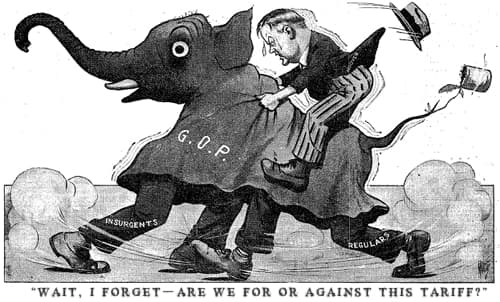
The Tariff of Abominations (1828) imposed high protective tariff rates designed to shield Northern manufacturing from foreign competition. Southern states, whose economies depended on exporting cotton and tobacco, saw the tariff as a direct attack on their livelihoods. They paid higher prices for imported goods while gaining nothing from the protections. South Carolina became the center of opposition.
The Doctrine of Nullification was the intellectual backbone of South Carolina's resistance. Vice President John C. Calhoun argued that individual states had the right to declare federal laws unconstitutional and refuse to enforce them within their borders. Calhoun drew on the Virginia and Kentucky Resolutions (1798), written by Jefferson and Madison in response to the Alien and Sedition Acts, which had similarly argued that states could resist federal overreach. The doctrine directly challenged the idea that the federal government held supreme authority over the states.
The Tariff of 1832 lowered rates somewhat but kept the protectionist structure intact. South Carolina found this insufficient. In response, a special state convention passed an Ordinance of Nullification, declaring both the 1828 and 1832 tariffs null and void within the state. South Carolina also threatened secession and began raising militia forces to back up its position.
The resolution came through two simultaneous measures:
- The Compromise Tariff of 1833, negotiated by Henry Clay, gradually reduced tariff rates over a ten-year period. This gave South Carolina enough of a concession to step back from the brink.
- The Force Bill (1833) authorized President Jackson to use military force to collect tariffs in South Carolina if necessary. Jackson made clear he would not tolerate secession, reportedly saying he would hang Calhoun if the state followed through.
South Carolina accepted the compromise tariff and rescinded its nullification ordinance, though it symbolically nullified the Force Bill on its way out.
The lasting impact was significant. The crisis affirmed that the federal government would use force to preserve the Union, but it also showed that Southern states were willing to push confrontations to the edge over economic and political grievances. The underlying tensions between slave states and free states, and between federal power and states' rights, only deepened in the decades that followed, foreshadowing secession and the Civil War.

The Bank War
Jackson's war against the Second Bank of the United States was the defining economic battle of his presidency. It revealed his willingness to use executive power aggressively and reshaped American politics by helping create the two-party system that dominated the antebellum era.

Effects of Jackson's Bank War
The Second Bank of the United States, chartered in 1816, functioned as the country's central bank. It regulated currency, extended loans, and managed government funds. Its president, Nicholas Biddle, wielded enormous financial influence. Jackson viewed the Bank as a corrupt monopoly that served wealthy elites and foreign investors at the expense of ordinary Americans.
Jackson's opposition was both constitutional and populist. He argued the Bank concentrated too much power in a single private institution and that it was not authorized by the Constitution. More broadly, he framed the fight as the common man versus the privileged few.
The veto of the Bank recharter (1832) was a turning point. When Henry Clay pushed a recharter bill through Congress (partly as an election-year challenge to Jackson), Jackson vetoed it with a message that went far beyond legal arguments. He appealed directly to popular resentment of wealth and privilege. The veto message helped him win re-election decisively and demonstrated that a president could use the veto as a political weapon, not just a constitutional check.
After his re-election, Jackson went further. He ordered the removal of federal deposits from the Bank and redistributed them to selected state banks, critics called "pet banks." This move aimed to cripple the Bank before its charter expired in 1836.
Economic consequences were severe. The pet banks used their new deposits to expand credit loosely, fueling land speculation and an economic bubble. When the bubble burst, it triggered the Panic of 1837, a major recession that hit during Martin Van Buren's presidency. The banking system and currency remained unstable for years.
Politically, the Bank War had three major effects:
- It cemented Jackson's image as a champion of ordinary people (farmers, laborers, frontier settlers).
- It dramatically expanded presidential power relative to Congress.
- It fractured the political landscape, directly leading to the formation of the Whig Party, which united everyone opposed to Jackson's use of executive authority.
Democratic vs. Whig Party Ideologies
The Bank War and Nullification Crisis helped crystallize the two major parties of this era. Their differences shaped American politics through the 1850s.
The Democratic Party, led by Jackson and Martin Van Buren, championed states' rights and limited federal government. Democrats opposed the national bank, high tariffs, and federally funded internal improvements, arguing these policies favored elites. Their base was strongest among Southern planters, Western farmers, and urban laborers.
The Whig Party formed in the mid-1830s in direct opposition to what critics called "King Andrew's" executive overreach. Led by Henry Clay and Daniel Webster, Whigs favored an active federal government that promoted economic development through internal improvements (roads, canals, railroads), a national bank, and protective tariffs. Their support came largely from Northern business interests, merchants, and professionals.
Key Differences:
- Federal power: Democrats wanted it limited; Whigs wanted it active in the economy
- Economic policy: Democrats opposed the national bank, high tariffs, and federal spending on infrastructure; Whigs supported all three
- Regional base: Democrats were stronger in the South and West; Whigs were stronger in the North
- Political philosophy: Democrats leaned populist, framing themselves as defenders of the common man; Whigs emphasized order, stability, and economic growth
Both parties believed in republican government and democracy, and both competed for broad voter support. But their disagreements over the role of government in the economy defined political debate for the next two decades.
Economic and Monetary Policy Debates
The Bank War opened up broader questions about money and economic policy that persisted throughout the antebellum period.
The hard money vs. soft money debate was central. Hard money advocates, often aligned with Democrats, wanted currency backed by gold and silver (specie). They believed this prevented inflation and protected ordinary people from the risks of unstable paper money. Soft money supporters, more common among Whigs and business interests, preferred paper currency and easier credit, arguing these were necessary to fuel economic growth and expansion.
Whigs also pushed economic nationalism, supporting federal investment in infrastructure and industry to bind the country together economically. Democrats resisted this vision, preferring that economic development be led by states and private enterprise rather than the federal government. These competing visions of the government's economic role didn't disappear after Jackson. They continued to shape policy debates right up to the Civil War.
See Fiveable more often in Google
Mark Fiveable as a preferred source and Google is more likely to show you our guides in Top Stories, with a "preferred" badge in AI Mode and AI Overviews.