22.1 Turner, Mahan, and the Roots of Empire

🗽US History Unit 22 Review
22.1 Turner, Mahan, and the Roots of Empire
🗽 US History
Factors and Influences on American Imperialism (1865–1890)
Between 1865 and 1890, the United States shifted from a nation focused on settling its own continent to one eyeing territories overseas. Economic pressures, political ambitions, and new technology all pushed the country toward imperialism. Two thinkers, Frederick Jackson Turner and Alfred Thayer Mahan, gave that push an intellectual framework that policymakers used to justify expansion.

Top images from around the web for Factors in American foreign interest
Primary Source Images: American Empire | United States History II View original
Is this image relevant?
American Imperialism | Boundless US History View original
Is this image relevant?
1898 | US History II (American Yawp) View original
Is this image relevant?
Primary Source Images: American Empire | United States History II View original
Is this image relevant?
American Imperialism | Boundless US History View original
Is this image relevant?
Factors in American Foreign Interest
Economic factors sat at the center of the push outward. The Industrial Revolution had supercharged American production, but by the 1890s factories were churning out more goods than domestic consumers could buy. This overproduction problem meant businesses needed foreign markets to sell surplus goods. American investors also wanted new places to put their capital, and industries needed raw materials that weren't always available at home.
Political factors reinforced those economic pressures:
- Manifest Destiny, the belief that the U.S. had a God-given mission to expand and spread its values, didn't stop at the Pacific coast. Many Americans simply applied the same logic to territories overseas.
- European powers like Britain, France, and Germany were carving up Africa and Asia. American leaders worried that if the U.S. didn't claim its own territories and spheres of influence, it would be shut out of global trade and diplomacy.
- Military planners wanted overseas naval bases and coaling stations so American warships could refuel and operate far from home.
Technological advancements made overseas expansion practical in ways it hadn't been before. Steamships crossed oceans faster and more reliably than sailing vessels. The telegraph allowed near-instant communication between Washington and distant outposts. A modernizing navy gave the U.S. the ability to project military power across the globe.
The closing of the American frontier added urgency. By 1890, the Census Bureau declared that a continuous line of frontier settlement no longer existed. For a nation that had defined itself by westward movement for over a century, this felt like a crisis. Where would American energy and ambition go next?

Turner and Mahan's Imperialist Influence
Frederick Jackson Turner's Frontier Thesis (1893) made one of the most influential arguments in American intellectual history. Turner presented his thesis at the American Historical Association meeting in Chicago, and its core claims were straightforward:
- The frontier experience had shaped everything distinctive about American character: democracy, individualism, self-reliance, and innovation.
- With the frontier now closed, those qualities were at risk of fading.
- The U.S. needed new frontiers, including overseas ones, to channel American energy and keep the nation vital.
Turner didn't explicitly call for imperialism, but his thesis gave expansionists a powerful argument: if the frontier made America great, then finding new frontiers was a matter of national survival.
Alfred Thayer Mahan's The Influence of Sea Power upon History (1890) provided the strategic blueprint. Mahan was a U.S. Navy captain and historian who studied how nations like Britain had built global empires. His key arguments:
- National greatness depended on control of the seas. A strong navy protected trade routes and projected power.
- The U.S. needed a large, modern fleet of warships, not just coastal defense vessels.
- That fleet required a network of overseas bases for refueling and repair.
- Mahan specifically advocated for the annexation of Hawaii (as a mid-Pacific naval station) and the construction of a canal across Central America to allow the navy to move quickly between the Atlantic and Pacific.
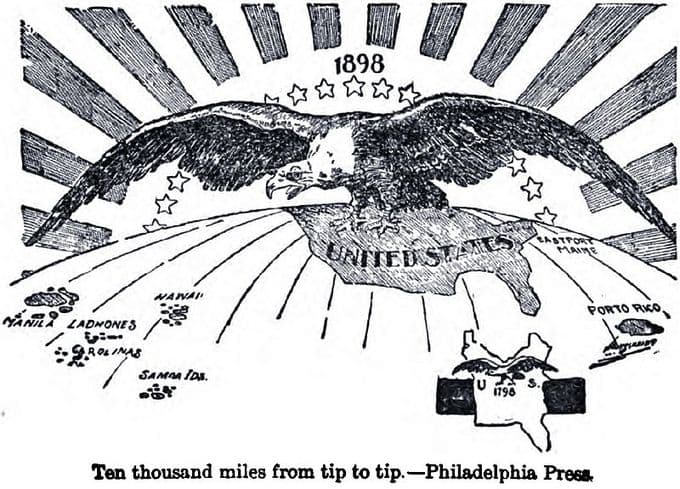
Their combined impact on policy was enormous. Turner supplied the why (America needs new frontiers to thrive), and Mahan supplied the how (build a navy, acquire bases, control sea lanes). Together, their ideas influenced leaders like Theodore Roosevelt and Senator Henry Cabot Lodge, who pushed for naval expansion and territorial acquisition. The results showed up in concrete policy: the annexation of Hawaii (1898), the acquisition of Puerto Rico, Guam, and the Philippines after the Spanish-American War, and the eventual construction of the Panama Canal (completed 1914).

Geopolitical and Ideological Factors
Naval power became the measuring stick of a great nation in the late 1800s. American leaders looked at Britain's Royal Navy and concluded that the U.S. needed a comparable fleet to protect its trade and assert its interests.
Social Darwinism gave imperialism a pseudo-scientific veneer. Thinkers like John Fiske and Josiah Strong applied Darwin's ideas about natural selection to nations and races, arguing that "stronger" civilizations were destined to dominate "weaker" ones. This wasn't real science, but it was widely accepted and gave Americans a convenient justification for taking control of foreign peoples and territories.
Overseas expansion was also framed as an economic necessity. Global trade networks were growing rapidly, and policymakers argued that the U.S. couldn't afford to sit on the sidelines while European empires locked up markets and resources around the world.
Motivations for American Imperialism
Economic, Religious, and Social Motivations
Economic motivations were the most concrete driver of expansion:
- American manufacturers wanted access to markets in Asia (especially China) and Latin America to sell surplus goods.
- Industries needed raw materials they couldn't get domestically: rubber, sugar, tobacco, and minerals from tropical regions.
- American businesses saw foreign investment as a way to grow profits, building railroads, plantations, and mines in less-developed countries.
- Where American commercial interests already existed, the government felt pressure to protect them, especially in regions where European powers competed for the same resources.
Religious motivations blended genuine faith with cultural arrogance. Many Protestant missionaries believed they had a duty to spread Christianity to non-Christian peoples in Asia, Africa, and the Pacific Islands. Organizations like the American Board of Commissioners for Foreign Missions sent thousands of missionaries abroad. These efforts often went hand-in-hand with imperialism: missionaries built schools and hospitals, but they also pushed Western cultural norms and sometimes paved the way for political control.
Social motivations were tangled up with racial ideology:
- The concept of the "white man's burden" (a phrase from Rudyard Kipling's 1899 poem) captured the belief that Anglo-Saxon peoples had a duty to "civilize" non-white societies. This paternalistic idea assumed that colonized peoples couldn't govern themselves.
- Many Americans wanted the U.S. to prove itself as a world power. Acquiring an empire was seen as a sign of national strength and prestige.
- Racial anxieties at home, including fears about Asian immigration, sometimes fueled support for projecting American power abroad as a way to assert dominance and control.
These motivations reinforced each other. Businessmen wanted markets, missionaries wanted converts, politicians wanted influence, and racial ideology told Americans they deserved all of it. That combination made imperialism feel not just profitable but morally justified to many people at the time.
See Fiveable more often in Google
Mark Fiveable as a preferred source and Google is more likely to show you our guides in Top Stories, with a "preferred" badge in AI Mode and AI Overviews.