23.4 From War to Peace

🗽US History Unit 23 Review
23.4 From War to Peace
🗽 US History
The United States and World War I
The United States' entry into World War I in 1917 tipped the scales for the Allies. With over 4 million troops mobilized and vast industrial resources, America helped defeat Germany and end the war in 1918. This section covers how U.S. involvement shaped the war's outcome, Wilson's ambitious peace plan, and why the Senate ultimately rejected the Treaty of Versailles.

Top images from around the web for U.S. influence in World War I
American Expeditionary Forces on the Western Front (World War I) order of battle - Wikipedia View original
Is this image relevant?
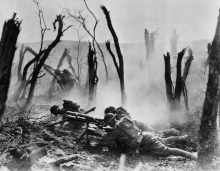
Meuse–Argonne offensiven - Wikipedia, den frie encyklopædi View original
Is this image relevant?
Meuse–Argonne offensive - Wikipedia View original
Is this image relevant?
American Expeditionary Forces on the Western Front (World War I) order of battle - Wikipedia View original
Is this image relevant?
Meuse–Argonne offensiven - Wikipedia, den frie encyklopædi View original
Is this image relevant?
U.S. Influence in World War I
By 1917, the Allied Powers (Britain, France, and Russia) had been fighting for three years and were running low on manpower and supplies. The arrival of the American Expeditionary Forces (AEF), commanded by General John J. Pershing, provided the fresh troops and resources the Allies desperately needed to push back the Central Powers (Germany, Austria-Hungary, and the Ottoman Empire).
- The U.S. mobilized over 4 million troops and provided massive financial support through loans to Allied governments
- Fresh American forces helped turn the tide on the Western Front, particularly during the Meuse-Argonne Offensive (September–November 1918), one of the war's largest and final Allied campaigns
- Germany's army was exhausted, its resources dwindling, and a British naval blockade was starving the home front
Facing collapse on multiple fronts, Germany agreed to an armistice on November 11, 1918, ending the fighting. The U.S. had been in the war for only about 19 months, but its entry proved decisive.

Impact of Wilson's Fourteen Points
In January 1918, President Woodrow Wilson presented his "Fourteen Points" to Congress. This was his vision for a just and lasting peace, one built on cooperation rather than punishment.
Key proposals included:
- Open diplomacy and an end to secret treaties between nations
- Removal of trade barriers and freedom of the seas
- Reduction of armaments (military weapons) across nations
- The right to self-determination, meaning peoples like the Poles and Czechs could form their own independent nations
- Creation of the League of Nations, an international organization designed to promote cooperation and prevent future wars
Wilson brought these ideas to the Paris Peace Conference in 1919, but the other Allied leaders had different priorities. France's Georges Clemenceau wanted to punish Germany and ensure it could never threaten France again. Britain's David Lloyd George faced public pressure to make Germany pay. Both France and Britain also sought territorial gains in Europe and the Middle East.
The result was a compromise that frustrated Wilson. The League of Nations was included in the final treaty, and several new nations were created based on self-determination. But many of Wilson's points were abandoned. The Treaty of Versailles imposed harsh terms on Germany, including a war guilt clause (Article 231) that forced Germany to accept full blame for the war, along with massive financial reparations. This diverged sharply from Wilson's more idealistic vision of reconciliation.

U.S. Rejection of the Versailles Treaty
Even though Wilson helped negotiate the Treaty of Versailles, the U.S. Senate refused to ratify it. The Constitution requires a two-thirds Senate vote to approve treaties, and Wilson could not secure enough support. Several factors drove the rejection:
Opposition to the League of Nations. Republican senators, led by Henry Cabot Lodge, targeted Article X of the League's covenant. Article X committed member nations to protect the territorial integrity of other members. Lodge and his allies argued this would:
- Infringe on U.S. sovereignty
- Drag the nation into foreign conflicts without congressional approval
- Limit America's ability to act independently in foreign affairs
Growing isolationist sentiment. After the horrors of the war (over 116,000 American deaths), many Americans wanted to return to a policy of non-involvement in European affairs. The public was wary of joining an international organization that could pull the U.S. into future wars.
Wilson's refusal to compromise. Lodge proposed adding reservations (conditions) to the treaty that would have limited U.S. obligations under Article X. Wilson refused to accept any changes, insisting the treaty be ratified as written. This stubbornness alienated moderate senators who might have voted yes with reservations attached.
Partisan politics. Republicans controlled the Senate and saw an opportunity to undermine Wilson's political legacy. Personal animosity between Wilson and Lodge made negotiation nearly impossible.
The Senate voted on the treaty twice (November 1919 and March 1920) and rejected it both times. The shift in public mood was confirmed when Warren G. Harding won the 1920 presidential election on a promise of a "return to normalcy."
Postwar International Relations
Without U.S. participation, the League of Nations was significantly weakened. The world's largest economy and emerging military power sat on the sidelines, which meant the League lacked the economic and military backing to enforce its decisions during crises like Japan's invasion of Manchuria in 1931.
- The Treaty of Versailles imposed heavy reparations on Germany, contributing to economic instability and deep resentment that would fuel the rise of extremist movements in the 1920s and 1930s
- Wilson's principle of self-determination led to the redrawing of national boundaries across Europe and the Middle East, creating new nations like Poland, Czechoslovakia, and Yugoslavia
- The U.S. rejection of the treaty foreshadowed the nation's broader retreat into isolationism during the interwar period, a stance that would persist until the approach of World War II
See Fiveable more often in Google
Mark Fiveable as a preferred source and Google is more likely to show you our guides in Top Stories, with a "preferred" badge in AI Mode and AI Overviews.