30.3 Vietnam: The Downward Spiral

🗽US History Unit 30 Review
30.3 Vietnam: The Downward Spiral
🗽 US History
The Vietnam War: Growing Opposition and Its Consequences
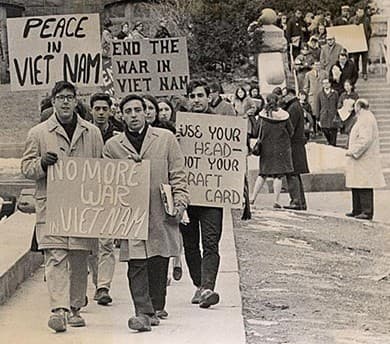
Opposition to the Vietnam War grew as U.S. casualties mounted, military progress remained unclear, and media coverage brought the conflict into American homes. The Tet Offensive, draft inequities, the Pentagon Papers, and campus activism deepened public distrust and made Vietnam a defining crisis of the late 1960s and early 1970s.

Top images from around the web for Factors in antiwar sentiment growth
Anti War Demonstration 1966 (AP Photo/Bill Ingraham) | Flickr View original
Is this image relevant?
Challenging the Status Quo | United States History II View original
Is this image relevant?
World News Trust - Do you remember your first anti-war protest? | Mickey Z. View original
Is this image relevant?
Anti War Demonstration 1966 (AP Photo/Bill Ingraham) | Flickr View original
Is this image relevant?
Challenging the Status Quo | United States History II View original
Is this image relevant?
Factors in antiwar sentiment growth
- Mounting U.S. casualties
- Over 58,000 American soldiers were killed over the course of the war, and hundreds of thousands more were wounded or returned home suffering from post-traumatic stress disorder (PTSD). As casualty numbers climbed through the late 1960s, public support for the war dropped sharply.
- Perceived lack of progress
- Despite massive U.S. military escalation, North Vietnamese and Viet Cong forces remained resilient. The 1968 Tet Offensive was the turning point: communist forces launched coordinated attacks on over 100 cities and towns across South Vietnam, including the U.S. embassy in Saigon. Militarily, the U.S. repelled the attacks, but the offensive shattered the Johnson administration's claims that victory was near.
- Media coverage and public awareness
- Vietnam was the first "living room war." Nightly television broadcasts showed combat footage, body bags, and civilian suffering in a way no previous conflict had. Iconic images like the photograph of nine-year-old Phan Thi Kim Phuc fleeing a napalm attack turned public opinion. The My Lai massacre (1968), where U.S. soldiers killed hundreds of unarmed Vietnamese civilians, further intensified antiwar sentiment when it became public in 1969.
- Draft system and its inequities
- Working-class and minority communities bore a disproportionate share of the draft burden. College deferments allowed many affluent young men to avoid service entirely, making the system feel deeply unfair. Draft resistance grew as the war dragged on, with some men fleeing to Canada or publicly burning their draft cards.
- Revelations of government deception
- The Pentagon Papers, leaked by Daniel Ellsberg in 1971, were classified Defense Department documents showing that multiple administrations had misled the public about the war's progress and prospects. This confirmed what many already suspected: the government had not been honest about Vietnam.
- Counterculture movement and student activism
- A growing youth movement rejected traditional authority and embraced antiwar ideals. College campuses like Berkeley and Columbia became centers of protest and civil disobedience, with teach-ins, sit-ins, and mass demonstrations becoming regular occurrences.

Nixon's Vietnam withdrawal strategy
- Vietnamization
- This was Nixon's plan to gradually shift combat responsibility to South Vietnamese forces while withdrawing U.S. troops. The goal was to reduce American casualties and quiet domestic opposition while keeping South Vietnam from collapsing.
- Bombing campaigns and incursions into Cambodia and Laos
- Nixon secretly expanded the war by bombing Cambodia and Laos to disrupt the Ho Chi Minh Trail, the supply network North Vietnam used to funnel troops and weapons south. When the Cambodia incursion became public in 1970, it triggered a new wave of protests, including the demonstrations at Kent State.
- Madman Theory
- Nixon and National Security Adviser Henry Kissinger cultivated the impression that Nixon was unpredictable and willing to take extreme action, even nuclear strikes. The idea was to make North Vietnam fear escalation and agree to negotiate on American terms. The strategy had limited success.
- Détente with the Soviet Union and rapprochement with China
- Nixon pursued warmer relations with both communist superpowers, partly to gain diplomatic leverage over North Vietnam. By engaging Moscow and Beijing, Nixon hoped to isolate Hanoi and pressure it into a settlement.
- Paris Peace Accords (1973)
- Signed by the U.S., South Vietnam, North Vietnam, and the Viet Cong, the accords established a ceasefire and required U.S. troop withdrawal. But the agreement failed to resolve the underlying political conflict. Without American military support, South Vietnam fell to communist forces in 1975.

Vietnam War's societal impact
- Polarization and erosion of trust in government
- The war deepened divisions along generational, cultural, and political lines. Revelations like the Gulf of Tonkin incident (where the justification for escalation was based on disputed or exaggerated intelligence) and the Pentagon Papers destroyed public faith in government honesty. This erosion of trust carried over into Watergate and beyond.
- Protests and social unrest
- Massive demonstrations drew hundreds of thousands of participants. The 1969 Moratorium to End the War in Vietnam saw protests in cities across the country. The Kent State shootings (May 1970), where Ohio National Guard troops killed four unarmed student protesters, shocked the nation and escalated campus unrest nationwide.
- Generational and cultural divide
- The war exposed a deep rift between an older generation that largely valued Cold War anticommunism and military service, and younger Americans who questioned the war's morality and America's global role. These debates played out in families, churches, and communities across the country.
- Political realignment and the rise of the "New Right"
- Backlash against the antiwar movement and counterculture helped fuel a conservative resurgence. Politicians like Richard Nixon appealed to the "silent majority" who resented protest culture, and figures like Ronald Reagan built political careers partly on opposition to campus radicalism and liberal social policies.
- Economic impact and the "guns vs. butter" debate
- The war's enormous costs strained the U.S. economy and contributed to rising inflation. Military spending competed directly with funding for Great Society domestic programs like Medicare and Head Start, forcing difficult trade-offs that weakened both efforts.
- Vietnam Syndrome
- The war's legacy made Americans and policymakers deeply reluctant to commit troops abroad. This caution shaped U.S. foreign policy for decades, influencing decisions about involvement in Central America, the Middle East, and other Cold War flashpoints.
Cold War context and aftermath
The domino theory was the core rationale for U.S. involvement: if South Vietnam fell to communism, neighboring countries would follow. This fear drove escalation under Kennedy, Johnson, and Nixon.
The U.S. military's use of chemical defoliants, especially Agent Orange, caused devastating long-term health effects for both Vietnamese civilians and American veterans, along with widespread environmental destruction.
The Fall of Saigon in April 1975 marked the war's end. North Vietnamese forces captured the South Vietnamese capital, and the country was reunified under communist rule. Iconic images of helicopters evacuating Americans and South Vietnamese allies from rooftops became symbols of the war's chaotic conclusion.
Robert McNamara, Secretary of Defense under Kennedy and Johnson, later publicly expressed regret over his role in escalating the conflict, acknowledging in his 1995 memoir that the war had been "terribly wrong."
See Fiveable more often in Google
Mark Fiveable as a preferred source and Google is more likely to show you our guides in Top Stories, with a "preferred" badge in AI Mode and AI Overviews.