3.4 The Impact of Colonization

🗽US History Unit 3 Review
3.4 The Impact of Colonization
🗽 US History
Colonial America saw the rise of slavery, driven by economic demands and racial beliefs. This system exploited Africans for cheap labor in cash crop production, backed by legal codes and social hierarchies that stripped enslaved people of rights and freedoms.
Native American societies faced devastating changes due to European colonization. Disease, warfare, and cultural shifts led to population declines and altered traditional ways of life. Economic practices shifted as Native Americans adapted to new trade goods and European influences.
Colonial America

Top images from around the web for Factors in colonial American slavery
File:United States Slavery Map 1860.jpg - Wikimedia Commons View original
Is this image relevant?
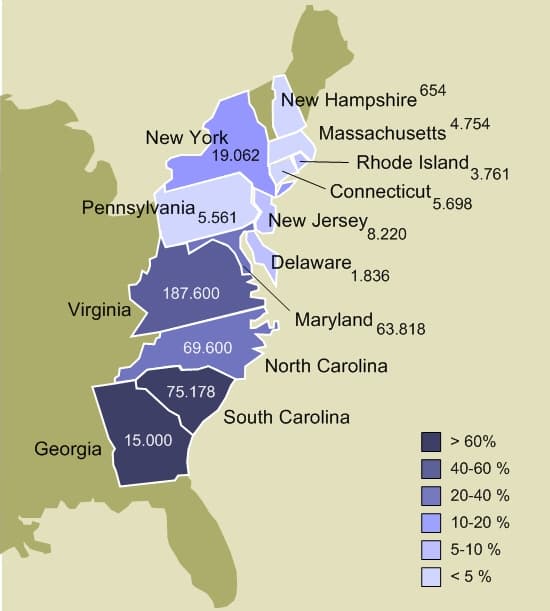
File:Slavery in the 13 colonies.jpg - Wikipedia View original
Is this image relevant?
Slave states and free states - Wikipedia View original
Is this image relevant?
File:United States Slavery Map 1860.jpg - Wikimedia Commons View original
Is this image relevant?
File:Slavery in the 13 colonies.jpg - Wikipedia View original
Is this image relevant?
Factors in Colonial American Slavery
Slavery didn't emerge from a single cause. It grew out of overlapping economic pressures, social attitudes, and legal decisions that reinforced one another over time.
Economic factors were the primary driver. Southern colonies depended on labor-intensive cash crops like tobacco and sugar, and planters needed a large, cheap workforce to turn a profit. At first, indentured servants filled this role, but enslaved Africans became more economically attractive because they were considered property for life, not just contracted workers for a set number of years. The broader mercantilist system also played a role: colonies existed to enrich the mother country, so maximizing resource extraction with the cheapest possible labor was the whole point.
Social factors gave slavery its justification. European colonists developed a belief in racial superiority that cast Africans as inherently inferior. This ideology helped maintain a rigid social hierarchy with white Europeans at the top and enslaved Africans at the bottom. Over time, race became the defining line between freedom and bondage.
Legal factors locked the system in place. Colonial legislatures passed slave codes that restricted enslaved people's movements, banned them from learning to read, and denied them legal protections. These laws made it nearly impossible for enslaved individuals to resist or escape their condition, and they gave slaveholders almost unlimited power over the people they claimed to own.
Geographical factors made the system practical. The southern colonies had the warm climate and fertile soil suited for plantation agriculture. Meanwhile, proximity to Caribbean slave-trading networks made it relatively easy to transport enslaved Africans to mainland colonies.
Native American Societal Transformations
European colonization reshaped nearly every aspect of Native American life. The changes were rapid, often catastrophic, and interconnected.
Population decline was the most devastating consequence. Native Americans had no immunity to European diseases like smallpox, measles, and influenza. In many communities, these epidemics killed 50% to 90% of the population within just a few generations. Warfare and violence from conflicts with colonizers compounded these losses.
Changes in social structures followed. Traditional gender roles shifted as European influence altered the division of labor and power dynamics within Native communities. Political alliances also changed: some groups, like the Huron, allied with the French for trade advantages and military protection, while others, like many Algonquian-speaking peoples, resisted colonization outright. These choices often created new rivalries between Native groups themselves.
Economic shifts transformed daily life. European trade goods like metal tools, firearms, and textiles became highly desirable, and many Native communities began participating in the fur trade to acquire them. This created a growing dependence on European trade networks and pulled communities away from traditional subsistence patterns like seasonal farming and hunting cycles.
Cultural adaptations took many forms. Some Native groups adopted European technologies like horses and metal weapons, which reshaped warfare and hunting. Religious syncretism also occurred, as Native spiritual practices blended with elements of European Christianity. At the same time, colonizers actively pursued cultural assimilation, pressuring Native peoples to abandon their languages, customs, and traditions in favor of European ways.

Land and Environment
Land Ownership: European vs. Native American
One of the deepest conflicts between Europeans and Native Americans came down to fundamentally different ideas about land.
European concepts treated land as private property. It could be bought, sold, fenced off, and inherited. Colonists viewed land primarily as a resource to exploit for individual profit through intensive agriculture or resource extraction. Ownership was documented through legal deeds and enforced by colonial governments.
Native American concepts were built around communal stewardship. Land wasn't something one person "owned." Instead, it was a shared resource managed collectively for the benefit of the entire community. Many Native peoples also held a deep spiritual connection to the land, viewing it as a sacred entity to be respected rather than a commodity. Their resource management practices tended to emphasize sustainability and ecological balance over short-term extraction.
These clashing worldviews meant that European land purchases and treaties often meant something very different to each side. Colonists believed they were acquiring exclusive ownership; Native peoples often understood the agreements as permission to share the land.

Environmental Impact of Colonization
European colonization physically transformed the American landscape in ways that were often irreversible.
- Deforestation: Colonists cleared vast stretches of forest for farmland, settlements, and timber exports. Regions that had been densely wooded for centuries were stripped bare within a few generations.
- Soil degradation: Monoculture farming of crops like tobacco exhausted soil nutrients quickly. Planters often responded by simply moving to new land rather than rotating crops. Overgrazing by introduced livestock like cattle and sheep compacted soil and reduced vegetation cover.
- Decline in biodiversity: The fur trade drove overhunting of species like beavers, whose population crashes disrupted entire ecosystems (beavers maintain wetlands through dam-building). Invasive species brought by Europeans, including rats and pigs, competed with native animals and destroyed native plant life.
- Pollution: Mining operations and colonial waste contaminated soil and waterways. Sewage disposal into rivers created health hazards for both colonists and Native communities downstream.
- Altered ecosystems: Many Native American groups had used controlled burning to manage forests, clear underbrush, and encourage new growth. When colonizers suppressed these practices, forest composition and structure changed significantly, and natural habitats were further disrupted by new patterns of land use.
Colonial Economic Systems
Several large-scale economic systems shaped how colonization actually worked on the ground.
The triangular trade connected Europe, Africa, and the Americas in a three-legged exchange. European manufactured goods went to Africa, enslaved Africans were transported to the Americas (the brutal Middle Passage), and colonial raw materials like sugar, tobacco, and cotton flowed back to Europe. Each leg of the triangle enriched European merchants and colonial planters at enormous human cost.
In Spanish colonies, the encomienda system granted individual colonists (encomenderos) control over groups of Native Americans, who were forced to provide labor and tribute in exchange for supposed protection and Christian instruction. In practice, it was a system of forced labor that devastated Native populations.
Underlying all of this was mercantilism, the economic theory that a nation's power depended on accumulating wealth, especially gold and silver, through a favorable balance of trade. This ideology drove European nations to establish and expand colonial territories, extract resources, and tightly control colonial commerce for the benefit of the mother country.
See Fiveable more often in Google
Mark Fiveable as a preferred source and Google is more likely to show you our guides in Top Stories, with a "preferred" badge in AI Mode and AI Overviews.