23.2 The United States Prepares for War

🗽US History Unit 23 Review
23.2 The United States Prepares for War
🗽 US History
World War I transformed America's economy and society. The government mobilized resources, coordinating production and rationing food. Propaganda campaigns rallied public support, while new laws restricted civil liberties.
The war effort reshaped the home front. Women entered the workforce in greater numbers, and German-Americans faced discrimination. These changes had lasting impacts on American society and politics.
Mobilization and Propaganda in World War I

Top images from around the web for Mobilization of US resources
Liberty bond - Wikipedia View original
Is this image relevant?
War bond - Wikipedia View original
Is this image relevant?
Image of the Week #27: Liberty Bonds View original
Is this image relevant?
Liberty bond - Wikipedia View original
Is this image relevant?
War bond - Wikipedia View original
Is this image relevant?
Mobilization of US Resources
Once the U.S. entered the war in April 1917, the federal government took on a level of economic control it had never exercised before. Several new agencies were created to coordinate the shift from a peacetime to a wartime economy.
- The Selective Service Act of 1917 required all men aged 21–30 to register for the military draft (later expanded to ages 18–45). By war's end, about 2.8 million men had been drafted through this system of conscription.
- The War Industries Board (WIB) coordinated wartime production by allocating raw materials, setting production priorities, and pushing standardization and mass production techniques to maximize efficiency.
- The Food Administration, led by Herbert Hoover, promoted voluntary rationing through campaigns like "Meatless Mondays" and "Wheatless Wednesdays." The goal was to reduce domestic consumption so more food could be shipped to Allied troops overseas.
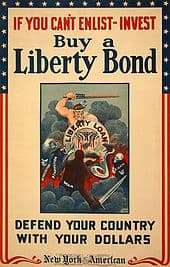
- Liberty Bonds were government-issued bonds sold directly to the public to finance the war. Four bond drives raised over $21 billion and served a dual purpose: funding the military and making ordinary citizens feel personally invested in the war effort.
- The National War Labor Board mediated disputes between workers and employers to prevent strikes that could slow wartime production. It also pushed reforms like the eight-hour workday and improved working conditions.
Taken together, these measures represented a dramatic expansion of federal power over industry and daily life.

Propaganda and Public Support
Winning the war required more than soldiers and supplies. The government also needed to shape public opinion, especially since many Americans had opposed entering the conflict.
- The Committee on Public Information (CPI), headed by journalist George Creel, was the government's main propaganda arm. It produced posters, pamphlets, and films promoting patriotism and support for the war. The CPI also recruited roughly 75,000 "Four-Minute Men" to deliver short pro-war speeches at movie theaters, churches, and public gatherings.
- The Espionage Act of 1917 went beyond targeting actual spies. It prohibited interference with the draft or military operations, banned the mailing of anti-war materials, and punished those who made statements deemed harmful to the war effort.
- The Sedition Act of 1918 went even further, criminalizing any speech or writing that cast the government or the war effort in a negative light. Socialist leader Eugene V. Debs was sentenced to ten years in prison for giving an anti-war speech, one of the most prominent cases under these laws.

Impact on Civil Liberties
The wartime crackdown on dissent was broad and often targeted people based on their political beliefs or ethnic background rather than any actual threat to national security.
- Anti-war groups bore the brunt of government suppression. The Socialist Party and the Industrial Workers of the World (IWW) were singled out for their opposition to the war. Leaders were arrested and organizations disrupted.
- German-Americans faced widespread discrimination. German-language newspapers were shut down, schools dropped German-language instruction, and some communities renamed German-sounding streets and foods (sauerkraut became "liberty cabbage"). Some German-Americans were pressured to buy Liberty Bonds to prove their loyalty, and others faced vandalism or physical attacks.
- The American Protective League (APL), a private organization of around 250,000 volunteers, worked with the Justice Department to spy on neighbors, report suspected draft dodgers, and identify dissenters. The government also monitored mail and telegrams for anti-war content.
These wartime policies set precedents for government suppression of dissent that would resurface during the Red Scare of 1919–1920 and in later conflicts. They demonstrated both the power of propaganda to shape public opinion and the fragility of civil liberties during national crises.
Home Front and Preparedness
The shift to a war footing changed daily life across the country. Rationing of essential goods became common, and women entered the workforce in greater numbers to fill jobs left vacant by men who had gone to fight. Women's contributions during the war strengthened the case for suffrage, which was achieved with the Nineteenth Amendment in 1920.
Even before the U.S. formally entered the war, a preparedness movement had been building. Advocates pushed for military readiness, arguing that neutrality would not protect the country forever. As events like unrestricted German submarine warfare and the Zimmermann Telegram shifted public opinion, isolationist sentiment gave way to support for intervention.
Economic and Social Impact of World War I
See Fiveable more often in Google
Mark Fiveable as a preferred source and Google is more likely to show you our guides in Top Stories, with a "preferred" badge in AI Mode and AI Overviews.