10.2 The Rise of American Democracy

🗽US History Unit 10 Review
10.2 The Rise of American Democracy
🗽 US History
The Jacksonian Era and the Expansion of Democracy

Top images from around the web for Factors in Jackson's 1828 victory
Category:United States presidential election, 1828 – Wikimedia Commons View original
Is this image relevant?
1828 United States elections - Wikipedia View original
Is this image relevant?
The Second Party System | Boundless US History View original
Is this image relevant?
Category:United States presidential election, 1828 – Wikimedia Commons View original
Is this image relevant?
1828 United States elections - Wikipedia View original
Is this image relevant?
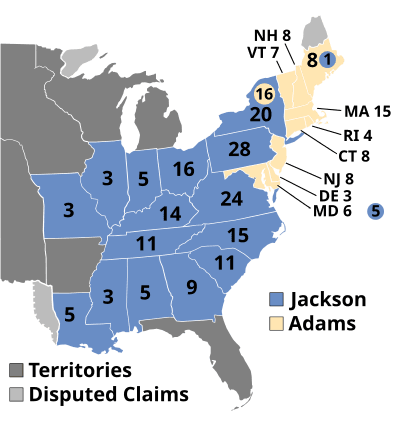
Factors in Jackson's 1828 Victory
Andrew Jackson's win in 1828 wasn't just about one man's popularity. It came from a perfect storm of political changes, personal appeal, and voter anger.
Expanding voting rights played a huge role. By the late 1820s, most states had dropped property ownership requirements for white men. This meant thousands of new voters who had never cast a ballot before, and Jackson's "common man" message spoke directly to them.
Jackson's image as a war hero gave him instant credibility. His victory at the Battle of New Orleans in 1815 and his campaigns against the Creek Indians made him a household name. He was portrayed as a rugged frontiersman and champion of the working class, a sharp contrast to the polished politicians in Washington.
The "corrupt bargain" of 1824 fueled voter outrage. In that election, Jackson won the most popular votes and the most electoral votes but didn't secure a majority. The House of Representatives chose John Quincy Adams instead, and when Adams then appointed Henry Clay as Secretary of State, Jackson's supporters cried foul. Whether or not an actual deal was struck, the perception of backroom dealing gave Jackson a powerful rallying cry for 1828.
The formation of the Democratic Party gave Jackson an organized political machine. His supporters built a new party structure focused on expanding political participation and limiting federal power. Combined with aggressive campaign tactics like newspapers, pamphlets, rallies, and barbecues, Jackson's team mobilized voters on a scale American politics hadn't seen before.

Impact of Jackson's Spoils System
Once in office, Jackson replaced a significant number of federal officeholders with his own supporters. He called this "rotation in office" and argued it prevented a permanent class of bureaucrats from becoming corrupt and out of touch.
- Jackson believed ordinary citizens were perfectly capable of holding government jobs, and that fresh faces brought fresh ideas
- In practice, loyalty to Jackson and the Democratic Party became the main qualification for federal appointments
- Patronage served a strategic purpose: it rewarded allies, punished opponents, and built a loyal political network
Critics had a different name for it: the spoils system (from the phrase "to the victor belong the spoils"). They argued it filled government offices with unqualified people who owed their jobs to political connections rather than competence. The debate over merit vs. loyalty in government appointments would continue for decades, eventually leading to civil service reform in the 1880s with the Pendleton Act.

Transformation of American Democracy
The Jacksonian era reshaped how American politics worked at nearly every level.
Broadening of the electorate. State after state removed property and tax-paying requirements for white male voters during the 1820s and 1830s. This dramatically increased the number of people who could vote. Voter turnout in presidential elections roughly tripled between 1824 and 1840. That said, this "expansion" had clear limits: women, enslaved people, free Black men (in most states), and Native Americans remained excluded.
Rise of mass politics. Candidates started appealing directly to voters through rallies, parades, and public events. Personal charisma and a connection to "the common man" mattered more than elite family background. Politics became a form of popular entertainment.
Emergence of a two-party system. Jackson's Democratic Party faced off against the newly formed Whig Party, which united groups opposed to Jackson. The Whigs generally favored a stronger federal role in the economy (internal improvements, a national bank, protective tariffs), while Democrats championed limited government and states' rights. This two-party competition organized campaigns, mobilized voters, and gave structure to political debate.
The partisan press. Newspapers became essential political weapons. Partisan editors openly supported specific candidates and parties, shaping public opinion and driving voter turnout. There was no pretense of journalistic neutrality.
Popular sovereignty became a guiding principle. The idea that political authority comes from the will of the people gained real traction. This concept would later become central to debates over whether new territories should allow slavery.
Major Events and Policies of the Jacksonian Era
Indian Removal Act (1830) and the Trail of Tears. Jackson signed the Indian Removal Act, authorizing the federal government to negotiate (and in practice, force) the relocation of Native American tribes from the Southeast to lands west of the Mississippi River. The Cherokee Nation challenged removal in court and won a favorable ruling in Worcester v. Georgia (1832), but Jackson refused to enforce the decision. The forced marches west, particularly the Cherokee removal in 1838, killed thousands from exposure, disease, and starvation.
Nullification Crisis (1832–1833). South Carolina declared federal tariffs of 1828 and 1832 null and void within its borders, arguing that states had the right to reject federal laws they deemed unconstitutional. Jackson responded forcefully, calling nullification treason and securing a Force Bill authorizing military action. A compromise tariff defused the immediate crisis, but the underlying tension between federal authority and states' rights remained unresolved.
Bank War. Jackson vetoed the recharter of the Second Bank of the United States in 1832, calling it a tool of wealthy elites that concentrated too much economic power. He then withdrew federal deposits and placed them in state banks (critics called them "pet banks"). The Bank's demise removed a stabilizing force from the economy and contributed to the Panic of 1837, a severe economic depression that hit Jackson's successor, Martin Van Buren.
Broader Social and Economic Changes
These political shifts happened alongside massive social and economic transformations.
The Second Great Awakening was a religious revival movement that swept the country in the early 1800s. It emphasized personal salvation and individual moral responsibility, and it fueled reform movements including abolitionism, temperance, and women's rights. By democratizing religion (anyone could achieve salvation, not just the elect), it reinforced the era's broader democratic spirit.
The Market Revolution transformed the American economy. Improvements in transportation (canals, railroads, steamboats), the growth of factories, and the expansion of commercial agriculture connected regions and created a national marketplace. These changes brought new wealth but also new inequalities, as wage labor replaced older patterns of artisan work and subsistence farming.
Westward expansion accelerated during this period, driven by the belief in Manifest Destiny, the idea that Americans had a divine right and duty to spread across the continent. This expansion shaped national policy, intensified conflicts with Native Americans, and raised increasingly urgent questions about whether slavery would extend into new territories.
See Fiveable more often in Google
Mark Fiveable as a preferred source and Google is more likely to show you our guides in Top Stories, with a "preferred" badge in AI Mode and AI Overviews.