10.1 A New Political Style: From John Quincy Adams to Andrew Jackson

🗽US History Unit 10 Review
10.1 A New Political Style: From John Quincy Adams to Andrew Jackson
🗽 US History
The Emergence of Jacksonian Democracy
The Jacksonian era marked a shift from elite-dominated politics to a more democratic system. As voting rights expanded to most white men, candidates began appealing directly to the masses. This change was driven by westward expansion, economic shifts, and religious movements that emphasized individual agency.
Andrew Jackson's rise embodied this new populist spirit. A military hero seen as a champion of the common man, Jackson's charismatic leadership style and formation of the Democratic Party reshaped American politics. His presidency ushered in significant changes and controversies that would define the era.

Top images from around the web for Shift to democratic politics
Women’s Movements | US History II (American Yawp) View original
Is this image relevant?
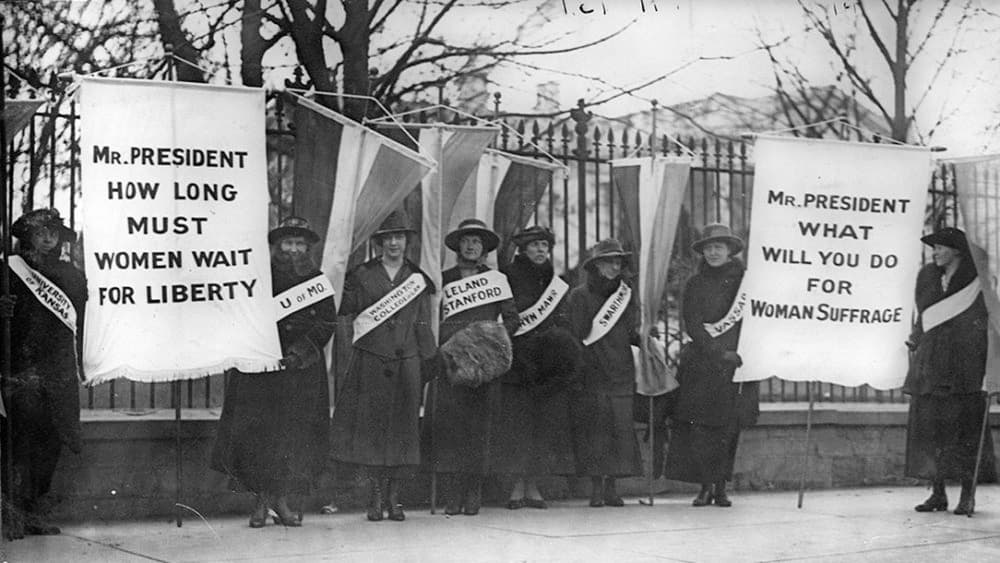
Primary Source Images: The Progressive Era | United States History II View original
Is this image relevant?
Women's suffrage in the United States - Wikipedia View original
Is this image relevant?
Women’s Movements | US History II (American Yawp) View original
Is this image relevant?
Primary Source Images: The Progressive Era | United States History II View original
Is this image relevant?
Shift to Democratic Politics
Deferential politics describes the older system where political life was dominated by elite, well-educated, wealthy men like the Founding Fathers. Voters generally deferred to the judgment of these "natural leaders," trusting that men of education and standing knew what was best. Candidates were expected to maintain a dignified, reserved public presence rather than actively campaign for votes.
Democratic politics replaced this model as several forces converged in the 1820s and 1830s:
- Expansion of suffrage: States dropped property ownership requirements for voting, opening the polls to most white men. This dramatically increased the size of the electorate and brought farmers, laborers, and frontiersmen into politics.
- Direct appeals to voters: Candidates began holding rallies and giving speeches using emotional, populist language. The old expectation that gentlemen didn't campaign for themselves faded quickly.
- Popular sovereignty: The idea that political authority comes from the will of the people became central to political rhetoric. Leaders were supposed to serve the people, not the other way around.
Three major factors drove this shift:
- Westward expansion fostered a culture of frontier egalitarianism. Settlers in the West had less attachment to old social hierarchies and expected a more equal political system.
- The Market Revolution created new economic opportunities and expanded the middle class. People with growing economic power wanted matching political influence.
- The Second Great Awakening emphasized individual agency and spiritual equality before God. If every person could seek salvation on their own terms, why couldn't they also have a say in government?

Impact of John Quincy Adams' Presidency
The Election of 1824 shattered the old one-party system. Four candidates split the vote: John Quincy Adams, Andrew Jackson, William Crawford, and Henry Clay. Jackson actually won the most electoral votes and the most popular votes, but he didn't win a majority of electoral votes. Under the 12th Amendment, the election went to the House of Representatives, where each state delegation cast one vote among the top three candidates.
Henry Clay, who finished fourth and was eliminated from contention, used his influence as Speaker of the House to rally support for Adams. Adams won the contingent election, and shortly afterward appointed Clay as his Secretary of State. Jackson's supporters were furious.
The "Corrupt Bargain" accusation became a defining issue for the next four years. Jacksonians charged that Adams and Clay had struck a backroom deal: Clay's support in exchange for the top cabinet post. Whether or not a formal deal existed, the appearance of corruption was devastating. It gave Jackson's supporters a powerful rallying cry and cast Adams as someone who had stolen the presidency from the rightful winner.
Adams' presidency (1825–1829) was ambitious but largely ineffective:
- He proposed an expansive program of internal improvements, scientific research, and support for the American System (tariffs, a national bank, and federally funded infrastructure).
- Jacksonians in Congress blocked most of his agenda, viewing his proposals as federal overreach.
- Adams came across as aloof and elitist, unable to connect with ordinary voters in the way the new democratic politics demanded.
The result was a deeply polarized political landscape. The old Republican Party fractured into two camps: Adams' National Republicans and Jackson's Democrats. This rivalry laid the groundwork for the Second Party System that would dominate the 1830s and 1840s.

Andrew Jackson's Populist Rise
Jackson's path to the presidency was built on several reinforcing strengths:
Military hero status. His decisive victory at the Battle of New Orleans (1815) made him the most celebrated military figure since George Washington. Even though the battle was fought after the Treaty of Ghent had already been signed, it didn't matter to the public. Jackson represented strength and decisiveness at a time when Americans wanted bold leadership.
"Champion of the common man" image. Jackson grew up on the frontier with little formal education, and he leaned into that background. Voters saw him as one of their own, a self-made man who would fight for ordinary citizens against the entrenched elite. This was a sharp contrast to Adams, the Harvard-educated son of a president.
Charismatic, confrontational style. Jackson spoke plainly and acted boldly. He didn't shy away from conflict, and his supporters admired that directness. His public appearances and speeches connected with voters in a way that the reserved Adams never could.
Formation of the Democratic Party. Jackson's supporters organized themselves into a disciplined political party under the leadership of strategists like Martin Van Buren. The Democratic Party embraced white male suffrage, limited federal government, and westward expansion, building a broad coalition of Southern planters, Western farmers, and Northern laborers.
The Election of 1828 was a rematch with Adams, and this time Jackson won decisively. He carried both the popular vote and the electoral vote by wide margins. The campaign was notoriously nasty on both sides, but Jackson's populist message and the lingering anger over the "Corrupt Bargain" proved overwhelming. His victory marked the beginning of what historians call the Age of Jackson.
Jacksonian Era Policies and Controversies
Jackson's presidency brought several defining policies and conflicts:
- Spoils system: Jackson replaced many federal officeholders with his own political supporters. He argued this practice made government more democratic by rotating citizens through office rather than letting a permanent bureaucratic class take hold. Critics saw it as rewarding loyalty over competence.
- Indian Removal Act (1830): This law authorized the forced relocation of Native American nations from the southeastern United States to lands west of the Mississippi River. The Cherokee, Creek, Chickasaw, Choctaw, and Seminole were among those displaced. The Cherokee's forced march, known as the Trail of Tears (1838), killed thousands and remains one of the darkest chapters of the era.
- Nullification Crisis (1832–1833): South Carolina declared it had the right to nullify (void) federal tariffs it considered unconstitutional. Jackson responded forcefully, threatening military action and calling nullification treason. The crisis was resolved through a compromise tariff, but it exposed deep tensions over states' rights and federal authority that would persist until the Civil War.
- Manifest Destiny: Though the term itself wasn't coined until 1845, the belief that the United States was destined to expand across North America shaped Jackson's policies on westward expansion and Native American removal. Jackson saw continental expansion as both inevitable and beneficial for white American settlers.
See Fiveable more often in Google
Mark Fiveable as a preferred source and Google is more likely to show you our guides in Top Stories, with a "preferred" badge in AI Mode and AI Overviews.