28.2 The Cold War

🗽US History Unit 28 Review
28.2 The Cold War
🗽 US History
The Cold War: Origins and Early Developments
The Cold War emerged from ideological clashes between the US and Soviet Union after World War II. As both superpowers competed for global influence, tensions escalated through proxy wars, a nuclear arms race, and the division of Europe into capitalist and communist blocs.
At home, fear of communist infiltration sparked witch hunts like McCarthyism. The Second Red Scare led to blacklists, loyalty oaths, and restrictions on civil liberties as Americans grappled with the perceived threat of communism in their midst.

Top images from around the web for Origins of the Cold War
File:Cold War alliances mid-1975.svg - Wikimedia Commons View original
Is this image relevant?
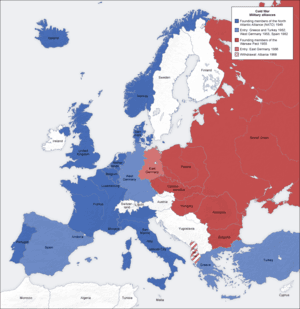
Cold War - Vikidia, the encyclopedia for children, teenagers, and anyone else View original
Is this image relevant?
File:Cold War alliances mid-1975.svg - Wikimedia Commons View original
Is this image relevant?
Cold War - Vikidia, the encyclopedia for children, teenagers, and anyone else View original
Is this image relevant?
Origins of the Cold War
The Cold War didn't start with a single event. It grew out of deep ideological differences and a postwar power vacuum that put the US and Soviet Union on a collision course.
Ideological divide: The US championed capitalism, democracy, and individual freedoms. The Soviet Union promoted communism and authoritarian state control over the economy and society. These two systems were fundamentally incompatible, and each side saw the other as a threat to its way of life.
Power vacuum after WWII: The decline of European colonial powers like Britain and France left openings across Europe and Asia. Both the US and the Soviet Union rushed to fill those gaps, each pushing its own vision for the postwar world order.
Disagreements over Europe's future: The Soviets installed communist governments in Eastern European countries like Poland and Czechoslovakia, tightening their grip on the region. The US backed Western European democracies, including West Germany and France, and pushed for their economic recovery.
Two major policies defined the early US response:
- The Truman Doctrine (1947) committed the US to providing economic and military aid to countries threatened by communism. Its goal was to contain Soviet expansion before it could spread further.
- The Marshall Plan (1948) channeled about $13 billion in US economic aid to rebuild Western Europe. Beyond humanitarian goals, it was designed to create stable, prosperous societies that would be less vulnerable to communist influence.
Containment Strategies in Europe and Asia
The US policy of containment aimed to stop the spread of communism without directly attacking the Soviet Union. This played out through alliances, military interventions, and support for anti-communist governments around the world.
NATO (1949): The North Atlantic Treaty Organization was a collective defense alliance among Western European nations, Canada, and the United States. Its core principle was that an attack on one member would be treated as an attack on all, which was meant to deter Soviet aggression in Europe.
The Berlin Airlift (1948–1949): When the Soviets blockaded all land routes into West Berlin, the US and Britain responded by airlifting food, fuel, and supplies into the city for nearly a year. Over 200,000 flights delivered roughly 2.3 million tons of cargo. The effort demonstrated Western resolve to maintain a presence in Berlin and resist Soviet pressure.
The Korean War (1950–1953): After Soviet-backed North Korea invaded South Korea in June 1950, the US led a UN coalition to defend the South. China entered the war on North Korea's side later that year. The conflict ended in a stalemate, with Korea divided along the 38th parallel and a demilitarized zone (DMZ) separating the two sides. It remains divided today.
SEATO (1954): The Southeast Asia Treaty Organization was a collective defense alliance modeled loosely on NATO, aimed at containing communism in Southeast Asia, particularly in Vietnam, Laos, and Cambodia.
The US also supported anti-communist governments and movements in several key regions:
- Taiwan: Military and economic aid helped prevent the spread of communism from mainland China after Mao Zedong's communist forces took power in 1949.
- South Vietnam: The US backed South Vietnam against communist North Vietnam and the Viet Cong guerrillas, a commitment that would deepen dramatically in the 1960s.
- Iran: The US supported the Shah of Iran as a bulwark against Soviet influence in the oil-rich Middle East.
Underlying many of these decisions was the domino theory, the idea that if one country fell to communism, its neighbors would follow like a row of dominoes. This logic drove US involvement in regions where communism seemed to be gaining ground.

Cold War Tensions and Strategies
Several broader dynamics shaped the Cold War during this period:
- The Iron Curtain was the term Winston Churchill used in 1946 to describe the ideological and physical boundary dividing Europe into Soviet-controlled communist states in the East and capitalist democracies in the West.
- The nuclear arms race accelerated after the Soviets tested their first atomic bomb in 1949. Both sides developed and stockpiled increasingly powerful nuclear weapons, including hydrogen bombs.
- Proxy wars allowed the superpowers to compete without fighting each other directly. Instead, they supported opposing sides in local conflicts around the globe.
- Mutually Assured Destruction (MAD) was the concept that both sides had enough nuclear weapons to destroy each other completely, meaning any nuclear attack would be suicidal. This grim logic maintained a fragile peace.
- Détente refers to periods when Cold War tensions eased and the superpowers attempted diplomatic cooperation, though the most significant détente efforts came in the 1970s, beyond this unit's timeframe.
Domestic Impact of the Cold War
Domestic Impacts of Anti-Communism
Cold War fears didn't stay overseas. The Second Red Scare (late 1940s to late 1950s) brought intense suspicion of communist infiltration into American life, leading to investigations, firings, and persecution of suspected communists.
McCarthyism refers to the tactics of Senator Joseph McCarthy, who from 1950 to 1954 made sweeping, often unsubstantiated accusations that communists had infiltrated the US government, military, and other institutions. His aggressive interrogations created a climate of fear. McCarthy's influence collapsed after the televised Army-McCarthy hearings in 1954, when his bullying tactics were exposed to a national audience.
The House Un-American Activities Committee (HUAC) was a congressional committee that investigated suspected communist activities across American society. Its most famous hearings targeted Hollywood. The Hollywood Ten, a group of screenwriters and directors, were jailed for contempt of Congress after refusing to answer questions about their political beliefs or name other suspected communists.
The Rosenberg Trial (1951): Julius and Ethel Rosenberg were convicted and executed in 1953 for passing atomic secrets to the Soviet Union. The trial remains controversial; while evidence against Julius was strong, many historians believe Ethel's involvement was minimal. The case highlighted the intense anti-communist sentiment of the era and the government's determination to root out perceived threats to national security.
Impact on civil liberties: The Red Scare led to real restrictions on Americans' freedoms.
- Loyalty oaths were required for government employees and, in some states, teachers and other public workers.
- Surveillance and intimidation were used to suppress dissent and limit free speech and association.
- Labor unions, intellectuals, and left-leaning organizations were targeted on suspicion of harboring communist sympathies.
Influence on popular culture: Anti-communist themes saturated American media, with films like The Red Menace (1949) and I Was a Communist for the FBI (1951) reinforcing the dominant political narrative. The prevailing climate also encouraged self-censorship and conformity, as individuals and organizations avoided anything that might attract suspicion.
See Fiveable more often in Google
Mark Fiveable as a preferred source and Google is more likely to show you our guides in Top Stories, with a "preferred" badge in AI Mode and AI Overviews.