21.2 Progressivism at the Grassroots Level

🗽US History Unit 21 Review
21.2 Progressivism at the Grassroots Level
🗽 US History
Progressive Reforms at the Grassroots Level
The Progressive Era wasn't just driven by presidents and Congress. Much of the real energy came from ordinary citizens, local organizations, and city-level reformers who demanded change from the bottom up. These grassroots efforts reshaped how American government worked, who got to participate in democracy, and what protections people could expect in their daily lives.

Top images from around the web for Key initiatives of grassroots Progressivism
Chapter 5: Theories of Democracy – Politics, Power, and Purpose: An Orientation to Political Science View original
Is this image relevant?
History of Social Progress | Organizational Behavior and Human Relations View original
Is this image relevant?
America Revealed: How Progressives Can Take Back America View original
Is this image relevant?
Chapter 5: Theories of Democracy – Politics, Power, and Purpose: An Orientation to Political Science View original
Is this image relevant?
History of Social Progress | Organizational Behavior and Human Relations View original
Is this image relevant?
Expanding Democracy
Progressives believed that corruption thrived because everyday people had too little control over their government. Their solution was to put more power directly in voters' hands.
- Direct primary elections let party members choose candidates instead of letting party bosses pick them behind closed doors.
- Initiative allowed citizens to propose new laws by gathering signatures, bypassing unresponsive legislatures.
- Referendum gave voters the power to approve or reject laws directly at the ballot box.
- Recall enabled citizens to remove elected officials before their term ended if they weren't doing their job.
- Secret ballot (also called the Australian ballot) protected voters from intimidation by making their choices private.
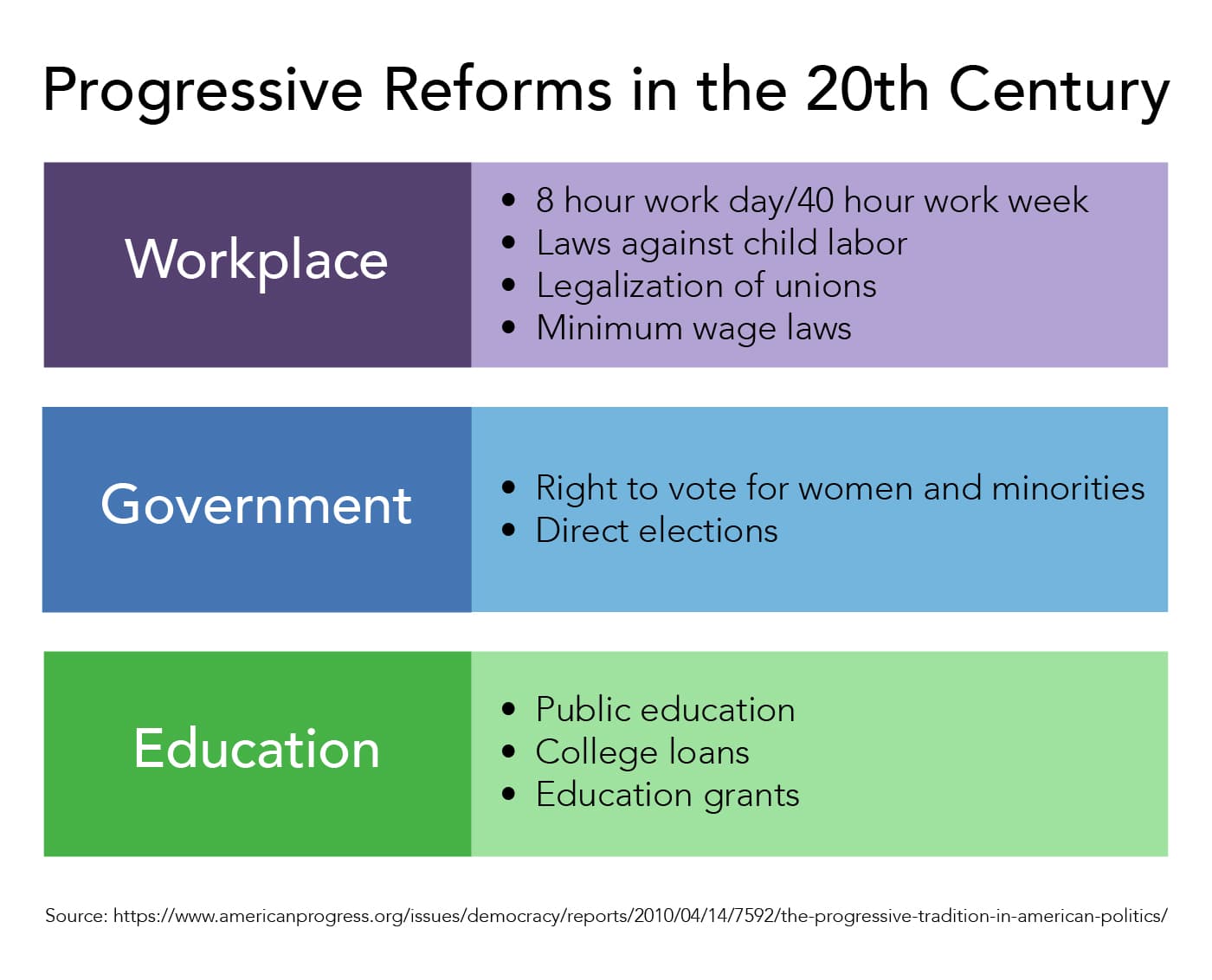
- The 17th Amendment (1913) established the direct election of U.S. Senators. Previously, state legislatures chose senators, a process riddled with backroom deals.
- The 19th Amendment (1920) guaranteed women's suffrage after decades of organizing by groups like the National American Woman Suffrage Association.
Together, these reforms made government more accountable to the public rather than to political machines and wealthy interests.
Increasing Government Efficiency
Progressives didn't just want more democracy; they wanted government that actually worked well. Many cities were run by corrupt political machines that handed out jobs to loyal supporters regardless of qualifications. Reformers pushed for a more professional approach.
- Civil service reform and merit-based hiring replaced the patronage system, requiring government employees to earn their positions through competence rather than political connections.
- The city manager system replaced elected mayors with appointed professionals trained in public administration. The idea was to run a city more like a well-managed organization.
- The commission system divided city government among elected commissioners, each responsible for a specific department (fire, police, public works, etc.).
- Municipal research bureaus studied city problems using data and proposed evidence-based solutions, bringing a more scientific approach to governance.

Promoting Social Justice
Some of the most visible grassroots work happened in the fight against poverty, unsafe working conditions, and the exploitation of vulnerable populations.
Settlement houses were a major force in this effort. Jane Addams's Hull House in Chicago (founded 1889) became the model: middle-class reformers lived in immigrant neighborhoods and provided education, childcare, English classes, and job training. These weren't just charities. Settlement house workers studied the conditions around them and used that research to push for policy changes.
Other key social justice reforms included:
- Child labor laws restricted the employment of children in factories and mines. By 1900, roughly 1.7 million children under 15 worked in American industry.
- Minimum wage laws set wage floors, first targeting women and children workers at the state level.
- Workers' compensation required employers to pay benefits to workers injured on the job, replacing a system where injured workers often got nothing.
- Mothers' pensions provided financial support to widows with children, an early form of public assistance.
- The juvenile court system (first established in Cook County, Illinois, in 1899) treated young offenders as candidates for rehabilitation rather than punishment.
- The temperance movement campaigned to ban alcohol, arguing it fueled poverty, domestic violence, and political corruption. This eventually led to the 18th Amendment (1920).
Combating Political Corruption
Urban political machines like Tammany Hall in New York City controlled city politics through patronage (giving government jobs to supporters) and graft (using public office for personal profit). Machine bosses delivered services to immigrant communities in exchange for votes, creating a system that was both functional for some residents and deeply corrupt.
Muckraking journalists played a critical role in exposing this corruption to a national audience. Lincoln Steffens's The Shame of the Cities (1904) documented machine politics across several American cities. Ida Tarbell exposed Standard Oil's monopolistic practices. Upton Sinclair's The Jungle (1906) revealed horrifying conditions in the meatpacking industry. These writers didn't just inform the public; they created the outrage that made reform politically possible.
Urban reformers worked to dismantle machine power by pushing for the structural government changes described above (civil service reform, city managers, commissions) and by improving public services like sanitation, utilities, and public health so that residents no longer depended on machine bosses for basic needs.

Radical vs. Mainstream Progressivism
Not all reformers agreed on how far change should go. Mainstream Progressives generally accepted capitalism but wanted to regulate its worst abuses. Radicals wanted to replace the system entirely.
Socialist Party of America: Led by Eugene V. Debs, who received nearly 1 million votes in the 1912 presidential election. Socialists advocated for public ownership of major industries and workers' control of production. They ran candidates at every level of government and won hundreds of local offices.
Industrial Workers of the World (IWW): Known as the "Wobblies," the IWW organized workers that mainstream unions ignored, including unskilled laborers, immigrants, and migrant workers. They promoted industrial unionism (organizing all workers in an industry together, not by craft) and used direct action tactics like strikes and work slowdowns. Unlike the Socialists, the IWW largely rejected electoral politics in favor of economic pressure.
The key difference: mainstream Progressives sought incremental reforms within the existing system, while radicals like the Socialists and IWW challenged capitalism itself and emphasized class struggle. Both movements pressured the political establishment, but mainstream reforms are what ultimately got enacted into law.
Impact of Progressive Reforms
Progressive Era changes at the grassroots level had lasting effects across several areas:
Labor protections reduced working hours, improved safety conditions, established minimum wages in some states, provided compensation for workplace injuries, and began restricting child labor. These didn't solve every problem, but they established the principle that government had a role in regulating the workplace.
Municipal governance became more professional and less corrupt. Cities expanded public services like sanitation, water systems, and public utilities. Some cities even took over ownership of utilities to keep costs down and reduce corporate influence.
Social welfare programs created a basic safety net that hadn't existed before: mothers' pensions, juvenile courts, expanded public education, public libraries, and improved public health measures.
Taken together, these reforms marked a fundamental shift in American political thinking. The old laissez-faire idea that government should stay out of economic and social life gave way to a new expectation that government should actively protect citizens from exploitation and hardship. This laid the groundwork for the modern welfare state and contributed to the growth of a more stable middle class.
See Fiveable more often in Google
Mark Fiveable as a preferred source and Google is more likely to show you our guides in Top Stories, with a "preferred" badge in AI Mode and AI Overviews.