20.1 Political Corruption in Postbellum America

🗽US History Unit 20 Review
20.1 Political Corruption in Postbellum America
🗽 US History
Political Corruption in the Gilded Age

Top images from around the web for Weak leadership and congressional patronage
Progressive Charlestown: Is the CVS-Aetna merger in the public interest? View original
Is this image relevant?
Spoils system - Wikipedia View original
Is this image relevant?
Political Corruption in Postbellum America · US History View original
Is this image relevant?
Progressive Charlestown: Is the CVS-Aetna merger in the public interest? View original
Is this image relevant?
Spoils system - Wikipedia View original
Is this image relevant?
Weak leadership and congressional patronage
During the Gilded Age (roughly 1870–1900), the federal government was plagued by corruption rooted in a simple problem: presidents were weak, and Congress filled the power vacuum. Rather than providing executive oversight, presidents like Grant, Hayes, and Arthur largely deferred to congressional leaders and party bosses who ran the show behind the scenes.
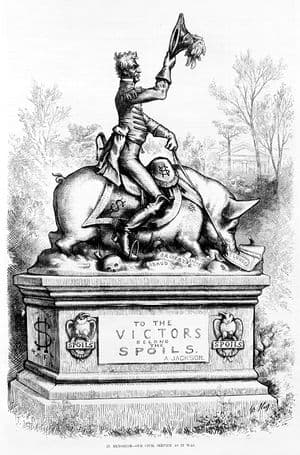
At the center of this was the spoils system, a practice where government jobs were handed out as rewards for political loyalty rather than qualifications. Senators and representatives controlled federal appointments in their states and districts, building networks of supporters who owed them favors. There were no standardized hiring practices or job protections for federal employees, so every election cycle could mean a complete turnover of government workers.
This environment made bribery and graft routine. Politicians accepted payments from businesses and interest groups in exchange for government contracts and favorable treatment. "Graft" refers specifically to this practice of using political office for personal financial gain. The line between public service and private enrichment was, for many officeholders, nonexistent.

Impact of the Compromise of 1877
The Compromise of 1877 resolved the bitterly disputed 1876 presidential election between Republican Rutherford B. Hayes and Democrat Samuel Tilden. Tilden won the popular vote, but 20 electoral votes from three Southern states were contested. The deal awarded the presidency to Hayes in exchange for key concessions to Democrats.
The most consequential concession was the withdrawal of federal troops from the South. Without military enforcement of Reconstruction-era protections, Southern states quickly reasserted white supremacy through voting restrictions (poll taxes, literacy tests) and segregation laws. Reconstruction was effectively over.
The compromise also reshaped the national political landscape:
- Republicans kept the presidency and maintained influence over the federal government
- Democrats consolidated the "Solid South," dominating Southern politics for decades
- Public trust in government eroded, as many Americans viewed the deal as a corrupt bargain that sacrificed African American rights for political convenience

Influence of machines and interest groups
Urban political machines were tightly organized networks that controlled city governments in places like New York, Chicago, and Boston. The most famous was Tammany Hall, the Democratic Party machine in New York City led by bosses like William "Boss" Tweed. These machines operated on a transactional model: they provided jobs, housing assistance, and social services to immigrants and working-class residents, and in return, those residents voted the way the machine told them to. The bosses who ran these operations wielded enormous power over local government, contracts, and patronage.
At the national level, corporate interests gained increasing influence over policy. Railroads, steel companies, and other large businesses lobbied politicians aggressively for favorable legislation, including protective tariffs, land grants, and minimal regulation. The relationship between big business and government was often hard to distinguish from outright corruption.
Two movements pushed back against this concentration of power:
- Organized labor grew in the late 19th century, with unions like the Knights of Labor and the American Federation of Labor pressing for the eight-hour workday, safer working conditions, and better wages
- The Populist movement emerged from agrarian discontent, challenging the dominance of banks and railroads. Populists advocated for free silver (expanding the money supply by coining silver alongside gold) and the direct election of senators, which would bypass the state legislatures that machines and corporations so easily controlled
Economic and journalistic influences
Laissez-faire economics shaped government policy throughout this period. The prevailing belief was that government should not interfere in business, which gave industrialists like Andrew Carnegie, John D. Rockefeller, and Jay Gould enormous freedom to consolidate wealth and power. Critics called these figures "robber barons" for the way they exploited workers and manipulated markets while benefiting from government inaction.
Muckraking journalists served as a crucial check on this system. Reporters and writers exposed corruption, unsafe conditions, and corporate abuses to a growing reading public. While the term "muckraker" wasn't coined until Theodore Roosevelt used it in 1906, investigative journalism in the Gilded Age laid the groundwork for the reform movements that followed.
Lobbying also became a more organized practice during this era. Rather than relying solely on personal relationships with politicians, interest groups began developing systematic strategies to influence legislation, a trend that would only accelerate into the Progressive Era.
See Fiveable more often in Google
Mark Fiveable as a preferred source and Google is more likely to show you our guides in Top Stories, with a "preferred" badge in AI Mode and AI Overviews.