31.1 The Reagan Revolution

🗽US History Unit 31 Review
31.1 The Reagan Revolution
🗽 US History
The Reagan Revolution
Ronald Reagan's presidency (1981–1989) represented a decisive turn toward conservatism in American politics. His administration reshaped the relationship between government and the economy, cut social programs, and built up the military. The debates Reagan fueled about taxes, government spending, and social values continued to define American politics through the end of the century and beyond.

Top images from around the web for Reagan's approach to governance
Presidency of Ronald Reagan - Wikipedia View original
Is this image relevant?
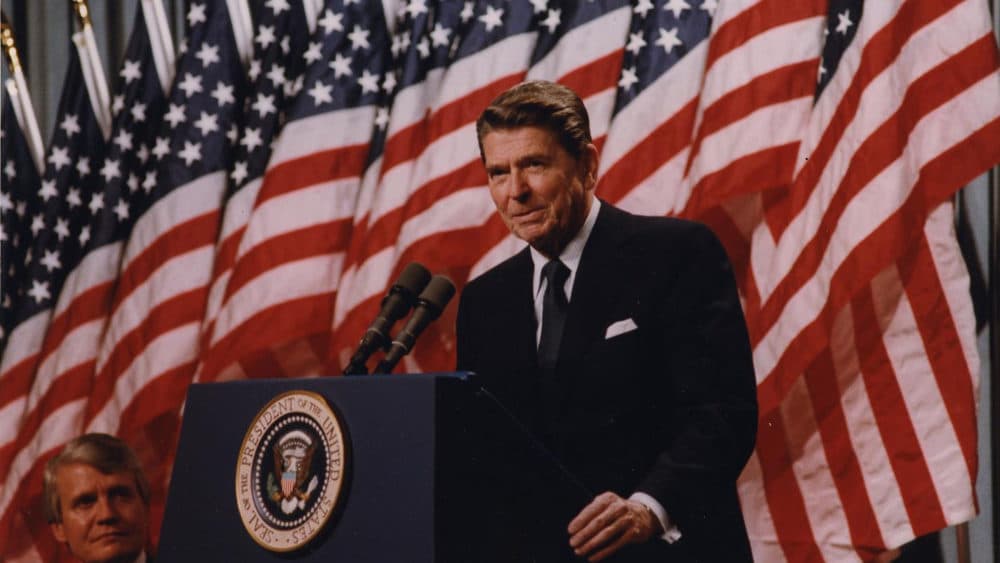
Primary Source Media: The Triumph of the Right | United States History II View original
Is this image relevant?
Presidency of Ronald Reagan - Wikipedia View original
Is this image relevant?
Primary Source Media: The Triumph of the Right | United States History II View original
Is this image relevant?
Reagan's Approach to Governance
Reagan built his political identity around a core belief: the federal government had grown too large and too involved in American life. His governing philosophy rested on several pillars:
- Limited government: He sought to shrink the size and scope of federal agencies and reduce Washington's role in everyday life.
- Free-market economics: He argued that private enterprise, not government programs, was the best engine for prosperity.
- States' rights: He favored transferring power from the federal government to state and local governments, arguing they were closer to the people they served.
- Deregulation: He pushed to remove government regulations on industries, believing they stifled competition and entrepreneurship. The Garn-St. Germain Depository Institutions Act (1982), which deregulated the savings and loan industry, was a signature example.
Impact on federal policies:
Reagan translated these principles into concrete action across domestic and defense policy.
On the domestic side, he cut funding for welfare programs like Aid to Families with Dependent Children (AFDC), the Women, Infants, and Children (WIC) nutrition program, food stamps, and Medicaid. He eliminated the Comprehensive Employment and Training Act (CETA), which had funded job training for unemployed workers.
On the economic side, he implemented supply-side economics, the theory that cutting taxes on businesses and high earners would "trickle down" to benefit the broader economy. The Economic Recovery Tax Act of 1981 slashed the top marginal income tax rate from 70% to 28% and lowered corporate tax rates to encourage business investment.
On defense, Reagan dramatically increased military spending. He launched the Strategic Defense Initiative (SDI), a proposed missile defense system critics nicknamed "Star Wars," and expanded weapons programs including the B-1 bomber and MX missile.
Impact of Reaganomics on Society
Reaganomics produced sharply different outcomes depending on where you sat on the economic ladder.
Effects on the wealthy and businesses: The top earners and corporations were the clearest beneficiaries. Lower tax rates meant higher take-home income for the rich, and deregulation created a more favorable environment for business expansion. Wealth accumulated rapidly at the top during the 1980s.
Effects on the middle class: Middle-class families received modest tax cuts, but several factors eroded those gains. Congress eliminated certain tax deductions and exemptions, and payroll taxes for Social Security and Medicare actually increased. Wage growth stagnated even as the cost of living rose, meaning many middle-class households didn't feel much better off.
Effects on the poor and working class: These groups bore the heaviest burden. Cuts to welfare, food stamps, Medicaid, and job training programs reduced the safety net at a time when unemployment remained high in many communities. Economic opportunities narrowed for those at the bottom.
Effects on the economy as a whole: The picture was mixed. The economy did experience strong growth in the mid-1980s, with GDP surging 7.2% in 1984. But the tax cuts, combined with massive defense spending increases, ballooned the national debt from trillion to trillion. Income inequality widened significantly: the Gini coefficient (a standard measure of inequality where higher numbers mean more inequality) rose from 0.403 in 1980 to 0.436 by 1989.

The New Right's Influence on Reagan
Reagan didn't rise in a vacuum. His success was powered by the New Right, a broad conservative movement that had been building since the 1960s and 1970s. The New Right united several groups that opposed the social upheavals of those decades, including the civil rights movement, feminism, the counterculture, and the Supreme Court's Roe v. Wade (1973) decision legalizing abortion.
The coalition brought together three distinct camps: religious conservatives focused on traditional moral values, economic libertarians who wanted lower taxes and less regulation, and neoconservatives who favored an aggressive anti-communist foreign policy.
Key organizations and figures:
- The Heritage Foundation — A conservative think tank that developed detailed policy proposals promoting free markets and limited government. It served as an intellectual engine for the movement.
- The Moral Majority — Founded by televangelist Jerry Falwell, this organization mobilized millions of evangelical Christians into political action, registering voters and campaigning for conservative candidates.
- Phyllis Schlafly — A conservative activist who led the successful campaign to defeat the Equal Rights Amendment (ERA), arguing it would undermine traditional family structures.
Influence on Reagan's political success: The New Right gave Reagan a grassroots army of volunteers and voters for his 1980 and 1984 campaigns. He embraced their agenda, incorporating proposals like the Family Protection Act into his platform. His social conservatism won over evangelical voters, while his populist economic message attracted working-class Democrats in northern industrial states, a group that became known as "Reagan Democrats." His fierce anti-communist rhetoric, including his famous description of the Soviet Union as an "Evil Empire," aligned perfectly with the movement's hawkish foreign policy stance.
Reagan's Economic and Social Policies
Reagan's legacy rests on four interconnected shifts he brought to American governance:
- Conservative governance: He made conservatism the dominant framework for policy debates, redefining what Americans expected from their government.
- Neoliberal economics: His emphasis on free markets, deregulation, and tax cuts became the default economic approach for both parties well into the 1990s.
- Religion in politics: By strengthening ties with evangelical Christianity, he made religious values a permanent part of Republican political identity.
- Cold War escalation: His military buildup and confrontational rhetoric toward the Soviet Union defined the final chapter of the Cold War, increasing both defense spending and global tensions before the eventual thaw of the late 1980s.
See Fiveable more often in Google
Mark Fiveable as a preferred source and Google is more likely to show you our guides in Top Stories, with a "preferred" badge in AI Mode and AI Overviews.