22.2 The Spanish-American War and Overseas Empire

🗽US History Unit 22 Review
22.2 The Spanish-American War and Overseas Empire
🗽 US History
The Spanish-American War

Top images from around the web for Causes and events of Spanish-American War
Yellow journalism - Wikiquote View original
Is this image relevant?
Yellow journalism - Wikipedia View original
Is this image relevant?
The Spanish-American War and Overseas Empire – US History II View original
Is this image relevant?
Yellow journalism - Wikiquote View original
Is this image relevant?
Yellow journalism - Wikipedia View original
Is this image relevant?
Causes and Events of the Spanish-American War
The Spanish-American War of 1898 transformed the United States from a continental power into a global empire in just a few months. Understanding why and how it happened reveals a lot about the forces shaping American foreign policy at the turn of the century.
Causes of the war:
- Cuban independence struggle. Cuba had been fighting for independence from Spain for years. Many Americans sympathized with the rebels, and US businesses had roughly $50 million invested in Cuban sugar plantations, giving the country both emotional and economic reasons to care.
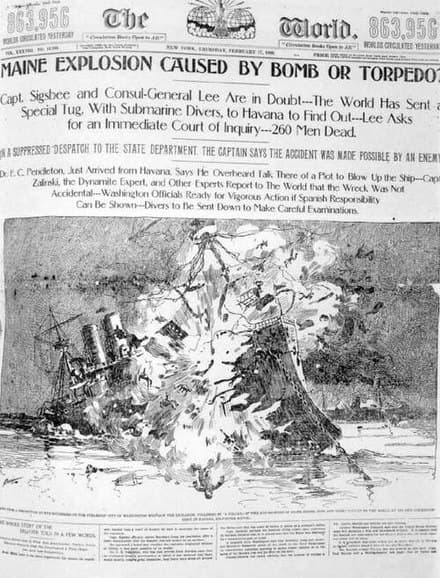
- Yellow journalism. Newspapers owned by Joseph Pulitzer (New York World) and William Randolph Hearst (New York Journal) published sensationalized stories about Spanish atrocities in Cuba. These reports inflamed public opinion and pushed the country toward war, whether or not every detail was accurate.
- Sinking of the USS Maine. In February 1898, the American battleship USS Maine exploded in Havana harbor, killing 266 sailors. The press blamed Spain immediately ("Remember the Maine!"), though the actual cause was never conclusively determined. This became the final trigger for war.
Major events of the war:
- Congress declared war on Spain in April 1898 after diplomatic efforts collapsed.
- Battle of Manila Bay (May 1898). Commodore George Dewey destroyed the entire Spanish fleet in the Philippines without losing a single American ship. This shocked many Americans, who hadn't expected the war to extend to the Pacific.
- Battles in Cuba. The first land engagement came at Las Guasimas in June 1898. The most famous battle was San Juan Hill in July, where Theodore Roosevelt and his volunteer cavalry regiment, the Rough Riders, charged up nearby Kettle Hill. Roosevelt's role made him a national hero and launched his political career.
- Spanish forces in Santiago, Cuba surrendered in July 1898 after an American siege.
- US forces invaded and captured Puerto Rico in July-August 1898, meeting minimal resistance.
Treaty of Paris (December 1898):
- Spain gave up control of Cuba, which became nominally independent under US protection.
- Spain ceded Puerto Rico, Guam, and the Philippines to the United States.
- The US paid Spain $20 million for the Philippines.
Perspectives on American Imperialism
The war was quick, but the debate over what to do with the new territories was long and fierce. It split the country along ideological lines that still echo today.
Support for imperialism:
- Manifest Destiny extended. Many believed the US had a God-given duty to spread its influence beyond the continent.
- Economic interests. New territories meant access to sugar plantations, naval bases, and Asian trade routes.
- Strategic power. Overseas possessions allowed the US to project naval power and protect shipping lanes.
- "White Man's Burden." This paternalistic idea, drawn from Rudyard Kipling's 1899 poem, held that white Americans had a duty to "civilize" and Christianize peoples they considered backward. This rationale was widely used at the time, though it's recognized today as deeply racist.
Opposition to imperialism:
- The Anti-Imperialist League, formed in 1898, opposed annexation of the Philippines and other territories. Its members included Mark Twain, Andrew Carnegie, and former president Grover Cleveland.
- Critics argued that ruling other peoples without their consent directly contradicted the Declaration of Independence and core American values of self-governance and democracy.
- Practical concerns mattered too: maintaining overseas territories was expensive and risked dragging the US into foreign conflicts.
- The Philippine-American War (discussed below) proved these fears justified, as the US found itself suppressing the very kind of independence movement it had once championed.
The Election of 1900 became a referendum on imperialism. William McKinley defeated William Jennings Bryan, and many interpreted the result as public endorsement of expansionist policies.

Impact on America's Global Power
The Spanish-American War didn't just add territory to a map. It fundamentally reshaped how the United States operated in the world.
New territories and protectorates:
- Puerto Rico, Guam, and the Philippines became unincorporated territories under US control.
- The Platt Amendment (1901) made Cuba a US protectorate, giving America the right to intervene in Cuban affairs and maintain a naval base at Guantánamo Bay.
The Philippine-American War (1899-1902):
This is the part of the story that often gets overlooked. Filipino independence leader Emilio Aguinaldo had fought alongside the US against Spain, expecting independence for the Philippines. When the US annexed the islands instead, a brutal war broke out.
- The conflict killed an estimated 4,200 American soldiers and over 200,000 Filipino civilians (many from disease and famine).
- American forces used controversial tactics including the "water cure" (a form of waterboarding) and reconcentration camps, drawing sharp criticism at home.
- After the war, William Howard Taft became the first civilian governor-general of the Philippines in 1901, overseeing political, economic, and educational reforms that served both modernization goals and US interests.
Expanding influence in the Caribbean and Latin America:
- The Roosevelt Corollary to the Monroe Doctrine (1904) asserted America's right to intervene in Latin American countries to maintain stability and protect US interests. This went well beyond the original Monroe Doctrine, which had simply warned European powers to stay out of the Western Hemisphere.
- The Panama Canal (built 1904-1914) connected the Atlantic and Pacific oceans, dramatically enhancing US naval mobility and commercial shipping.
Growth of the US Navy:
- Congress increased naval funding significantly after the war.
- The Great White Fleet (1907-1909) sent 16 battleships on a world tour visiting 20 ports across six continents, announcing American naval power to the globe.
Broader foreign policy shifts:
- The US moved away from its traditional isolationism toward active global engagement.
- President Theodore Roosevelt mediated the end of the Russo-Japanese War in 1905 at the Portsmouth Peace Conference, earning a Nobel Peace Prize.
- The US joined other powers in responding to the Boxer Rebellion in China (1900), sending troops to protect American citizens and suppress the anti-foreign uprising.
- The Open Door Policy (1899) sought to ensure equal trading access to China for all nations, preventing any single power from monopolizing Chinese markets through exclusive spheres of influence.
American Imperialism and Its Consequences

US Foreign Policy Approaches in the Early 20th Century
The US developed several distinct strategies for exercising its new global power. Each reflected different ideas about how to advance American interests abroad.
- Gunboat diplomacy used the threat or limited use of naval force to pressure other countries into favorable agreements. The US employed this approach frequently in Latin America and the Caribbean.
- Dollar diplomacy, associated with President Taft, aimed to use American economic power rather than military force to extend US influence, particularly in Latin America and East Asia. The idea was that American investment would create stability and dependence simultaneously.
- Colonial administration involved governing overseas territories directly. In places like the Philippines and Puerto Rico, the US built infrastructure, established school systems, and created local government structures. The central tension was always between American control and local demands for self-governance.
Long-Term Consequences
- The precedent of overseas intervention, often justified by the Roosevelt Corollary, shaped US foreign policy for decades, from repeated interventions in Central America to broader Cold War-era actions.
- US involvement in the Philippines left lasting marks on Filipino society, politics, and the relationship between the two countries. The Philippines didn't gain full independence until 1946.
- The debate over whether a democratic republic should govern other peoples without their consent never fully resolved. It resurfaced during decolonization after World War II and continues to inform discussions about American power abroad.
See Fiveable more often in Google
Mark Fiveable as a preferred source and Google is more likely to show you our guides in Top Stories, with a "preferred" badge in AI Mode and AI Overviews.