25.3 The Depths of the Great Depression

🗽US History Unit 25 Review
25.3 The Depths of the Great Depression
🗽 US History
Economic Impact and Government Response

Top images from around the web for Economic hardships of Great Depression
No Known Restrictions: Bread Line Beside the Brooklyn Bridge, ca. 1930s by OWI (LOC) | Flickr ... View original
Is this image relevant?
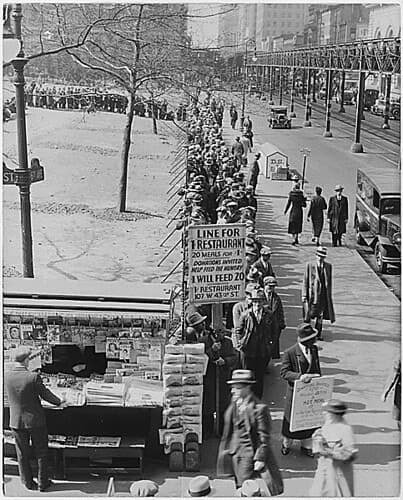
Public Domain: Depression Era Breadline by Unknown (NARA) | Flickr - Photo Sharing! View original
Is this image relevant?
Hooverville - Wikipedia View original
Is this image relevant?
No Known Restrictions: Bread Line Beside the Brooklyn Bridge, ca. 1930s by OWI (LOC) | Flickr ... View original
Is this image relevant?
Public Domain: Depression Era Breadline by Unknown (NARA) | Flickr - Photo Sharing! View original
Is this image relevant?
Economic Hardships of the Great Depression
By 1933, unemployment hit roughly 25%, meaning 1 in 4 Americans was out of work. Layoffs cut across manufacturing, construction, and agriculture, leaving entire communities without income.
The banking system collapsed alongside the job market. Over 9,000 banks failed between 1929 and 1933, and because deposits were uninsured, ordinary people lost their life savings overnight. Bank runs made things worse: when word spread that a bank was in trouble, panicked depositors rushed to withdraw their money, which guaranteed the bank would fail even if it might have survived otherwise.
With no jobs and no savings, millions of Americans ended up homeless. Shantytowns sprang up on the edges of cities, sarcastically nicknamed "Hoovervilles" after the president many blamed for the crisis. Breadlines and soup kitchens became the only source of food for countless families.
President Hoover's response relied on limited government intervention and voluntary cooperation from businesses and local charities. Two major policy moves fell short:
- The Smoot-Hawley Tariff Act (1930) raised tariffs on imported goods, but it backfired by provoking retaliatory tariffs from other countries and shrinking global trade.
- The Reconstruction Finance Corporation (1932) provided loans to banks and large businesses, but critics argued it helped institutions at the top while doing little for ordinary workers and families.
Impact on African American Communities
African Americans were hit harder than almost any other group. In some cities, Black unemployment reached 50%, roughly double the national average. A common pattern held across industries: Black workers were the first laid off and the last rehired.
Federal relief programs that were supposed to help often made things worse through discrimination. The Agricultural Adjustment Act paid farmers to reduce production, but white landowners pocketed the payments and evicted Black sharecroppers. The National Recovery Administration allowed industries to set wage codes that paid Black workers less. And the Federal Housing Administration practiced redlining, systematically denying mortgage loans to Black neighborhoods.
Economic desperation also fueled racial violence. Lynchings increased during the early 1930s, and the Scottsboro Boys case (1931), in which nine Black teenagers were falsely accused of assault in Alabama, exposed deep injustices in the legal system and became a national flashpoint.
.jpg.)
The Stock Market Crash and Its Aftermath
The stock market crash of October 1929 didn't cause the Depression by itself, but it triggered a devastating chain reaction. Billions of dollars in wealth vanished almost overnight, destroying consumer and business confidence.
Deflation set in as demand collapsed. Prices for goods and services kept falling, which sounds helpful but actually made things worse: businesses earned less revenue, so they cut wages and laid off workers, which reduced demand even further. This downward spiral deepened the crisis year after year.
By the 1932 presidential election, the country was desperate for change. Franklin D. Roosevelt won in a landslide, promising a "New Deal" to combat the crisis. At that point, unemployment was approaching its peak of nearly 25% in 1933.
Challenges in the Great Plains

Challenges for Great Plains Farmers
Farmers on the Great Plains faced a double disaster. Years of over-cultivation had stripped the topsoil of its natural grasses, and when severe drought hit in the early 1930s, the exposed soil turned to dust. The resulting Dust Bowl rendered millions of acres of farmland unusable, with massive dust storms that blackened skies across the region.
Even before the Dust Bowl, farmers were struggling. Overproduction during the 1920s had driven crop prices down, and when demand collapsed further during the Depression, many farmers couldn't cover their debts. Foreclosures and bankruptcies forced families off land they had worked for generations.
Hundreds of thousands of displaced farmers, often called "Okies" and "Arkies" (from Oklahoma and Arkansas), migrated west to California hoping to find work. What they found instead was discrimination, exploitation, and miserable conditions in overcrowded migrant camps.
Cultural Impact
Influence on American Values
The Depression reshaped how Americans thought about the relationship between individuals, communities, and government. Where the 1920s had celebrated rugged individualism, the 1930s pushed the country toward collectivism, with growing acceptance that government had a responsibility to protect ordinary people from economic catastrophe.
This shift showed up across American culture:
- Social realism in art and literature captured the struggles of everyday Americans. Dorothea Lange's photographs of migrant families and John Steinbeck's The Grapes of Wrath (1939) became defining works of the era. The Works Progress Administration (WPA) funded thousands of artists, writers, and musicians, making art a form of public relief.
- Escapist entertainment offered a counterpoint. Hollywood comedies and musicals, featuring stars like Fred Astaire and Ginger Rogers, gave audiences a few hours of relief from daily hardship.
- Political activism surged. Labor unions grew rapidly, especially the Congress of Industrial Organizations (CIO), which organized workers across entire industries. Movements on the political left, including the American Communist Party, gained members. Events like the 1932 Bonus Army march (when WWI veterans descended on Washington demanding early payment of promised bonuses) and the 1934 West Coast Longshoremen's Strike showed a population increasingly willing to challenge the status quo.
See Fiveable more often in Google
Mark Fiveable as a preferred source and Google is more likely to show you our guides in Top Stories, with a "preferred" badge in AI Mode and AI Overviews.