5.5 Disaffection: The First Continental Congress and American Identity

🗽US History Unit 5 Review
5.5 Disaffection: The First Continental Congress and American Identity
🗽 US History
Colonial Disaffection and the First Continental Congress
By 1774, the relationship between Britain and its American colonies had reached a breaking point. A series of punitive British laws pushed colonists beyond isolated protests toward coordinated, inter-colonial resistance. The First Continental Congress, which met that fall, became the clearest sign yet that the colonies were beginning to see themselves not as thirteen separate entities, but as a unified political community.

Top images from around the web for Causes of colonial disaffection
Quebec - Wikipedia View original
Is this image relevant?
wikihistoria - Committee of Correspondence View original
Is this image relevant?
wikihistoria - Committee of Correspondence View original
Is this image relevant?
wikihistoria - Committee of Correspondence View original
Is this image relevant?
wikihistoria - Committee of Correspondence View original
Is this image relevant?
wikihistoria - Committee of Correspondence View original
Is this image relevant?
wikihistoria - Committee of Correspondence View original
Is this image relevant?
Grade 8 Inquiry: Road to Revolution | OER Commons View original
Is this image relevant?
Grade 8 Inquiry: Road to Revolution | OER Commons View original
Is this image relevant?
Quebec - Wikipedia View original
Is this image relevant?
Quebec - Wikipedia View original
Is this image relevant?
Intolerable Acts - Wikipedia View original
Is this image relevant?
Quebec - Wikipedia View original
Is this image relevant?
wikihistoria - Committee of Correspondence View original
Is this image relevant?
Causes of Colonial Disaffection
The Intolerable Acts (known in Britain as the Coercive Acts) were Parliament's punishment for the Boston Tea Party. They included closing Boston Harbor to trade, sharply limiting Massachusetts's ability to govern itself, and allowing royal officials accused of crimes to be tried in Britain rather than by colonial juries. Colonists across the continent viewed these acts as a direct assault on rights they believed belonged to all British subjects, not just to Massachusetts.
The Quebec Act of 1774 added fuel to the fire, though it wasn't technically one of the Coercive Acts. It expanded Quebec's boundaries into the Ohio River Valley and granted religious freedom to French Catholics there. Colonists objected on two fronts: it blocked westward expansion they considered their right, and many Protestant colonists feared the official toleration of Catholicism.
These grievances didn't stay local. Committees of Correspondence, first organized in the early 1770s, served as communication networks linking the colonies together. When one colony faced a new British crackdown, the others heard about it quickly. This infrastructure of shared information turned scattered complaints into a sense of common cause.
Economic pressure also mattered. British trade restrictions and taxes cut into colonial commerce, and colonists responded with non-importation agreements, refusing to buy British goods as a form of organized protest.
Outcomes of the First Continental Congress
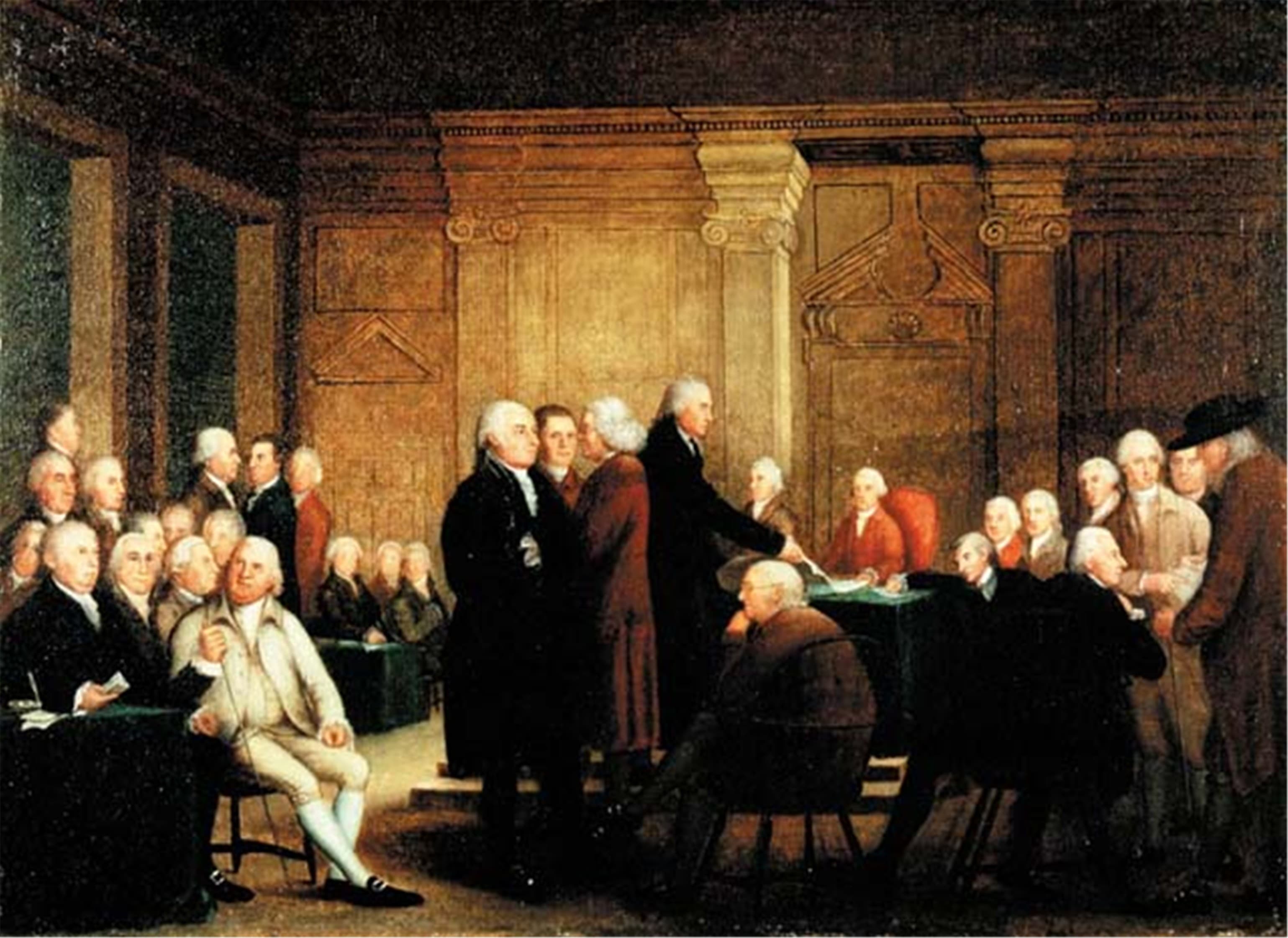
The Congress convened in September 1774 in Philadelphia, drawing 56 delegates from 12 colonies. Georgia was the only colony that did not send representatives. Notable delegates included John Adams, Samuel Adams, George Washington, and Patrick Henry.
The Congress produced several key outcomes:
- Declaration of Rights and Grievances: Affirmed that colonists possessed the same rights as all Englishmen, denounced the Intolerable Acts, and asserted the principle of "no taxation without representation."
- Continental Association: Established a coordinated economic boycott with three parts: non-importation (don't buy British goods), non-consumption (don't use British goods), and non-exportation (don't sell goods to Britain). The goal was to squeeze Britain economically until it repealed the Intolerable Acts.
- Petition to the King: Expressed continued loyalty to the Crown while requesting that colonial grievances be addressed. This reflected the fact that most delegates still hoped for reconciliation, not independence.
- Plans for a Second Continental Congress: Delegates agreed to reconvene in May 1775 if Britain did not respond satisfactorily.
Evolution of American Identity
Before the 1770s, most colonists identified primarily with their own colony. A Virginian thought of himself as a Virginian, not as an "American." That began to change as shared experiences of British crackdowns created common ground.
The Committees of Correspondence and newly formed Provincial Congresses did more than just coordinate protests. They functioned as alternative governing bodies, gradually replacing the authority of British-appointed officials. This was a practical shift with enormous implications: colonists were already practicing self-governance before they formally declared it.
Not everyone agreed on where this was heading. A real debate existed within the colonies:
- Reconciliationists wanted to remain within the British Empire and believed that firm but respectful protest would restore colonial rights.
- More radical voices had begun questioning whether British rule over the colonies was legitimate at all, and whether independence might be necessary.
Underlying much of this debate was the growing influence of republican ideology, drawn from Enlightenment thinkers like John Locke. This philosophy emphasized individual liberty, the right of self-governance, and the duty to resist tyranny.
Emerging Concepts of Governance and Rights
Three political ideas were taking shape in colonial thought during this period, each of which would become central to the American Revolution:
- Republicanism: Government should be grounded in civic virtue and citizen participation, not in the personal authority of a monarch. Corruption in government was seen as a direct threat to liberty.
- Sovereignty: Where does political authority actually come from? Colonists increasingly argued it came from the consent of the governed, challenging the traditional claim that the king's authority was absolute.
- Representation: Colonists rejected Britain's concept of virtual representation, which held that every member of Parliament represented all British subjects everywhere. Colonists demanded actual representation, meaning that only legislators they had directly elected could tax or govern them.
See Fiveable more often in Google
Mark Fiveable as a preferred source and Google is more likely to show you our guides in Top Stories, with a "preferred" badge in AI Mode and AI Overviews.