29.1 The Kennedy Promise

🗽US History Unit 29 Review
29.1 The Kennedy Promise
🗽 US History
The Kennedy Presidency
Kennedy's presidency marked a pivotal era in the Cold War. His foreign policy centered on flexible response and counterinsurgency, producing tense standoffs like the Bay of Pigs and the Cuban Missile Crisis. Domestically, he pushed ambitious initiatives like the Space Race and Peace Corps while gradually committing more to civil rights. His assassination in November 1963 shocked the nation and reshaped the political landscape for years to come.

Top images from around the web for Kennedy's Cold War foreign policy
Situation Room (Foto) – Wikipedia View original
Is this image relevant?
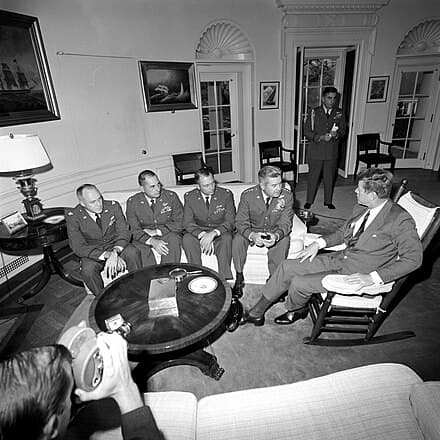
Cuban Missile Crisis - Simple English Wikipedia, the free encyclopedia View original
Is this image relevant?
John F. Kennedy - Wikipedia View original
Is this image relevant?
Situation Room (Foto) – Wikipedia View original
Is this image relevant?
Cuban Missile Crisis - Simple English Wikipedia, the free encyclopedia View original
Is this image relevant?
Kennedy's Cold War Foreign Policy
Kennedy rejected the Eisenhower-era reliance on massive nuclear retaliation. Instead, his flexible response strategy built up a range of military options, from conventional forces to counterinsurgency units like the Green Berets, so the U.S. could match communist threats at every level without immediately escalating to nuclear war.
- Bay of Pigs Invasion (1961): The CIA trained roughly 1,400 Cuban exiles to invade Cuba and overthrow Fidel Castro's communist government. The operation failed badly. Kennedy withheld promised air support, and the invaders were outnumbered and quickly defeated. The embarrassment damaged U.S. credibility and emboldened the Soviet Union.
- Cuban Missile Crisis (1962): U.S. spy planes discovered Soviet nuclear missile sites under construction in Cuba, just 90 miles from Florida. Kennedy imposed a naval blockade (he called it a "quarantine") and demanded the missiles be removed. For 13 days, the world stood on the brink of nuclear war. Khrushchev ultimately agreed to remove the missiles in exchange for a U.S. pledge not to invade Cuba. Secretly, the U.S. also agreed to remove its own missiles from Turkey. This is widely considered the closest the Cold War came to turning hot.
- Vietnam escalation: Kennedy subscribed to the Domino Theory, the idea that if one Southeast Asian country fell to communism, neighboring countries would follow. He increased the number of U.S. military advisors in South Vietnam from about 900 to over 16,000 and supported the South Vietnamese government against the communist Viet Cong. This deepening commitment set the stage for full-scale U.S. involvement under Johnson.
- Nuclear Test Ban Treaty (1963): Signed by the U.S., Soviet Union, and Great Britain, this treaty banned nuclear weapons tests in the atmosphere, outer space, and underwater. Underground tests were still permitted. It was a meaningful step toward easing Cold War tensions and limiting radioactive fallout.

Kennedy's Domestic and International Initiatives
Kennedy branded his agenda the "New Frontier," promising bold action on science, poverty, and global development.
- Space Race: In May 1961, Kennedy set the ambitious goal of landing an American on the moon before the end of the decade. This dramatically accelerated NASA's budget and programs, directly competing with Soviet achievements like Yuri Gagarin's orbital flight. The goal was fulfilled in July 1969 with Apollo 11.
- Alliance for Progress: This program directed economic aid to Latin American countries to promote development and democratic reform. The underlying goal was to counter communist influence in the region, especially after Castro's revolution in Cuba. Results were mixed, as many of the targeted reforms stalled.
- Peace Corps: Created in 1961, the Peace Corps sent American volunteers to developing nations to assist with education, agriculture, and health care. It served a dual purpose: genuine humanitarian aid and a tool of Cold War soft power, projecting a positive image of the United States abroad.

Kennedy's Civil Rights Initiatives
Kennedy's approach to civil rights started cautious and grew bolder under mounting pressure from activists and escalating racial violence.
He initially avoided aggressive action on civil rights because he depended on Southern Democrats in Congress to pass the rest of his legislative agenda. He believed gradual progress through executive action was more realistic than pushing sweeping legislation.
Events on the ground forced his hand:
- Freedom Rides (1961): When mobs attacked integrated bus riders testing desegregation in interstate travel, Kennedy sent federal marshals to protect the Freedom Riders and pressured the Interstate Commerce Commission to enforce desegregation at bus terminals.
- University of Mississippi (1962): When James Meredith attempted to enroll as the first Black student at Ole Miss, Governor Ross Barnett blocked him. Kennedy sent federal troops and U.S. marshals to enforce Meredith's enrollment. Riots broke out, killing two people, but Meredith registered for classes.
- Civil rights legislation (1963): After televised images of police using fire hoses and attack dogs on peaceful protesters in Birmingham, Alabama, Kennedy went on national television in June 1963 to call civil rights a "moral issue." He proposed legislation to ban discrimination in public accommodations and employment. He did not live to see it pass. The bill became the Civil Rights Act of 1964 under Lyndon Johnson.
Impact of Kennedy's Assassination
On November 22, 1963, Kennedy was shot and killed in Dallas, Texas. The event sent shockwaves through the country and the world.
- National grief: Kennedy's youth, charisma, and optimistic rhetoric had inspired deep public attachment. His death left many Americans feeling a profound sense of loss and uncertainty about the country's direction.
- Conspiracy theories: The Warren Commission concluded in 1964 that assassin Lee Harvey Oswald acted alone. Many Americans remained skeptical, especially after Oswald himself was murdered by Jack Ruby two days later. Conspiracy theories about possible government involvement, organized crime, or Cuban connections have persisted for decades.
- Johnson's legislative push: President Lyndon B. Johnson skillfully used the national mourning to build support for Kennedy's stalled agenda. He pushed through the Civil Rights Act of 1964 and the Voting Rights Act of 1965, then expanded Kennedy's New Frontier vision into his own Great Society programs targeting poverty, education, and health care (including Medicare and Medicaid).
- Legacy: Kennedy is remembered as a symbol of youthful idealism and public service. His assassination became a defining generational moment, often compared to Pearl Harbor for the previous generation. The phrase "Where were you when Kennedy was shot?" became a cultural touchstone, and his call to "ask what you can do for your country" continued to inspire political engagement long after his death.
See Fiveable more often in Google
Mark Fiveable as a preferred source and Google is more likely to show you our guides in Top Stories, with a "preferred" badge in AI Mode and AI Overviews.