10.4 Indian Removal

🗽US History Unit 10 Review
10.4 Indian Removal
🗽 US History
Legal Arguments and Public Perception
The Indian Removal Act of 1830 authorized the president to negotiate "voluntary" exchanges of Native land in the Southeast for territory west of the Mississippi. In practice, it became the legal foundation for forced relocation. The debates surrounding it touched on treaty rights, state versus federal power, and the very question of whether Native nations were sovereign.

Top images from around the web for Legal debates of Indian Removal Act
Indian Removal Act - Wikipedia View original
Is this image relevant?
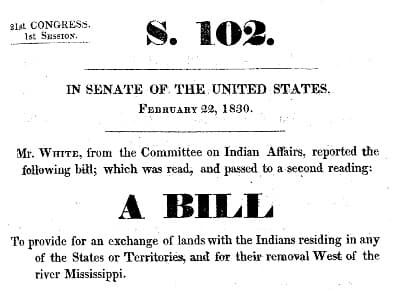
NATIVE HISTORY ASSOCIATION - The Indian Removal Act of 1830 View original
Is this image relevant?
Indian Removal Act - Wikipedia View original
Is this image relevant?
Indian Removal Act - Wikipedia View original
Is this image relevant?
NATIVE HISTORY ASSOCIATION - The Indian Removal Act of 1830 View original
Is this image relevant?
Legal Debates over the Indian Removal Act
Supporters and opponents framed their arguments around different constitutional principles.
Supporters argued:
- Native Americans were not using land "efficiently," and white settlers would put it to better economic use
- Removal would actually protect tribes from conflict and the corrupting influences of white society
- States, as sovereign entities, had the right to extend their jurisdiction over Native lands within their borders
Opponents argued:
- Forcibly removing Native Americans violated existing treaties and their inherent rights to ancestral lands
- The Act was motivated by desire for land and resources, not genuine concern for Native welfare
- The federal government, not individual states, held authority over relations with Native tribes
The Supreme Court weighed in with Worcester v. Georgia (1832), ruling that Native American tribes were sovereign nations and that states had no authority over tribal lands. Only the federal government could negotiate treaties and interact with tribes.
President Andrew Jackson refused to enforce the ruling. He argued the decision applied only to the specific parties in the case and that, as president, he had the authority to carry out laws passed by Congress, including the Indian Removal Act. This created a constitutional crisis: the executive branch effectively ignored the judiciary to push removal forward.
Cultural Portrayals and Removal Support
Popular culture in the early 19th century shaped how white Americans viewed Native peoples, and those views made removal politically easier.
Two contradictory stereotypes dominated. The "noble savage" image portrayed Native Americans as uncivilized but possessing an innate, doomed nobility. The opposing image cast them as barbaric and violent, a direct threat to white settlers. Both stereotypes served removal's purposes.
These portrayals spread through multiple channels:
- Captivity narratives sensationalized accounts of white settlers captured by Native Americans
- Paintings and illustrations either romanticized Native life or depicted aggressive warriors
- Plays and novels dramatized conflicts between Native Americans and white settlers
The "noble savage" stereotype suggested Native Americans were a vanishing race, destined to disappear as civilization advanced. Under this logic, removal seemed almost humane, a way to preserve them from the worst effects of white expansion. The "violent savage" stereotype, meanwhile, fueled fears that Native communities posed a direct danger to white settlements.
Both portrayals dehumanized Native Americans and made forced relocation seem necessary and justified. The growing ideology of manifest destiny, the belief that American expansion across the continent was inevitable and divinely ordained, provided further justification for displacing Native peoples.

Consequences and Resistance
Consequences for Native American Communities
The Indian Removal Act resulted in the forced relocation of tens of thousands of Native Americans, primarily from the Southeast to designated Indian Territory (present-day Oklahoma). The removal process was devastating:
- Military coercion and threats of violence forced compliance
- Inadequate supplies and support during the journey led to widespread suffering and death
- Families and communities were separated, disrupting social and cultural ties
The Trail of Tears, the forced removal of the Cherokee Nation, stands as the most well-known example. An estimated 4,000 Cherokees died during the journey, roughly 25% of the Cherokee population, from harsh conditions, exposure, and disease. The tribe also lost its ancestral lands and the resources that sustained its economy and culture.
The Cherokee were not alone. The Chickasaw, Choctaw, Muscogee (Creek), and Seminole, collectively known as the Five Civilized Tribes, all faced significant hardships and losses during their own removals.

Resistance to Removal
Native communities fought removal through multiple strategies:
- Legal challenges: The Cherokee Nation sued Georgia, producing the Worcester v. Georgia decision that affirmed tribal sovereignty
- Diplomatic efforts: Tribal leaders negotiated with the federal government and asserted their nations' rights through formal channels
- Armed resistance: The Seminoles fought the Second Seminole War (1835–1842), one of the costliest conflicts the U.S. military faced in this era, resulting in over 1,500 U.S. soldier deaths and countless Seminole casualties
Despite these efforts, the majority of Native American tribes in the Southeast were ultimately forced into Indian Territory.
The Treaty of New Echota and Cherokee Resistance
In 1835, a minority faction of the Cherokee Nation signed the Treaty of New Echota, ceding all Cherokee lands east of the Mississippi River. This faction did not have the authority to speak for the nation as a whole.
John Ross, the principal chief, led the opposition. He argued the treaty was fraudulent and did not represent the will of the Cherokee people. Ross organized a petition with over 15,000 signatures, representing the vast majority of the Cherokee population, protesting the treaty.
The U.S. government used the treaty as its legal basis for Cherokee removal anyway. This pattern, negotiating with unrepresentative factions and then treating those agreements as binding, became a recurring tactic in U.S. dealings with Native nations.
Long-Term Impact
The Indian Removal Act and the removals that followed had consequences that extended far beyond the 1830s:
- Displaced communities faced long-term poverty and marginalization in Indian Territory
- Loss of ancestral lands undermined cultural practices and identities tied to specific places
- The removals set a precedent for future U.S. policies of forced assimilation and land dispossession targeting Native American communities throughout the 19th century and beyond
See Fiveable more often in Google
Mark Fiveable as a preferred source and Google is more likely to show you our guides in Top Stories, with a "preferred" badge in AI Mode and AI Overviews.