9.6 Solving Motion Problems Using Parametric and Vector-Valued Functions

♾️AP Calculus AB/BC Unit 9 Review
9.6 Solving Motion Problems Using Parametric and Vector-Valued Functions
♾️ AP Calculus AB/BC
9.1
Defining and Differentiating Parametric Equations
9.2
Second Derivatives of Parametric Equations
9.3
Finding Arc Lengths of Curves Given by Parametric Equations
9.4
Defining and Differentiating Vector-Valued Functions
9.5
Integrating Vector-Valued Functions
9.6
Solving Motion Problems Using Parametric and Vector-Valued Functions
9.7
Defining Polar Coordinates and Differentiating in Polar Form
9.8
Find the Area of a Polar Region or the Area Bounded by a Single Polar Curve
9.9
Finding the Area of the Region Bounded by Two Polar Curves
Planar motion uses a position vector , where the velocity vector is and the acceleration vector is . To get displacement, integrate the velocity vector component by component; to get total distance traveled, integrate the speed .
Why This Matters for the AP Calculus Exam
This topic is BC only and lives in Unit 9, which carries a noticeable share of the BC exam. It pulls together skills from earlier units (derivatives, definite integrals, the arc length idea) and applies them to objects moving along curves in the plane, not just along a line.
On the exam you can expect to:
- Find velocity, speed, or acceleration at a specific time from a position or velocity vector.
- Set up and evaluate definite integrals for displacement and total distance traveled.
- Recover a position from velocity using initial conditions.
- Interpret what your answer means with correct units and direction.
Because many of these problems allow a calculator for the integral, your job is usually to set up the correct expression. Clean notation and the right setup make your work easy to follow and easy to check.
Key Takeaways
- Position is ; differentiate component by component to get velocity and acceleration .
- Speed is the magnitude of velocity: .
- Displacement over is the definite integral of the velocity vector, taken one component at a time.
- Total distance traveled over is , the integral of speed.
- To go from velocity back to position, integrate and use an initial condition like to solve for the constant.
- Decide differentiation versus integration first: derivatives move toward velocity and acceleration, integrals move toward displacement, distance, and position.
Recap of Motion Terms
Position, velocity, acceleration, displacement, and distance traveled work the same way in the plane as on a line, just with two components. If you want a fuller refresher on the line version, this guide covers it.
Position
Position is where the object is in the coordinate plane at time . For planar motion it is given by a vector .
Velocity
Velocity is the rate of change of position with respect to time, and it carries both speed and direction. It is the derivative of position: .
Speed
Speed is the magnitude of the velocity vector, so it is a single positive number with no direction:
Acceleration
Acceleration is the rate of change of velocity with respect to time. It is the derivative of velocity and the second derivative of position:
Displacement
Displacement is the net change in position from start to end, regardless of the path taken. As a vector it equals the final position minus the initial position. You can find it by integrating the velocity vector over the time interval.
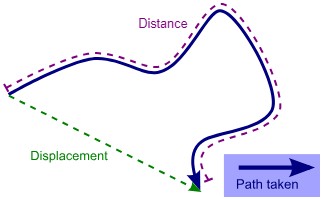
Distance Traveled
Distance traveled is the total length of the path the object covers. Unlike displacement, it ignores direction and just adds up all the ground covered.
Here is a quick analogy. Say you leave home, go a mile, realize you forgot your homework, and return. Your displacement is zero because you end where you started, but your distance traveled is 1 mile + 1 mile = 2 miles.
Calculus with Vector-Valued Functions
A vector-valued function is written , where and give the position at time . Differentiating each component gives velocity and acceleration.
Take the position . Differentiating each component gives the velocity vector , so the velocity in the x-direction is and in the y-direction is .
Differentiating again gives the acceleration vector . The x-acceleration is a constant units (often ) and the y-acceleration is .
You can always reverse this with integration to recover velocity or position, but you will need initial values to pin down the constant and get a particular solution.
Integrating to Find Displacement
To find displacement, take the definite integral of the velocity vector, one component at a time. Using , find the displacement from to :
Evaluating:
So the displacement vector is , meaning the object ended 117 units in the positive x-direction and 21 units in the positive y-direction from where it started.
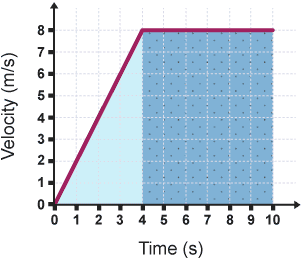
Using the Speed Integral to Find Distance Traveled
Distance traveled is the total length of the path, which is exactly the arc length of the curve. For a vector-valued function the formula is
where is the velocity vector. In words, integrate the magnitude of the velocity, which is the speed. Note that this is the same idea as integrating speed over time. For a more detailed look at how arc length connects to distance traveled, see this guide.
Calculus with Parametric Functions
Parametric functions work the same way; the only difference is notation. A parametric description uses the parameter to drive each coordinate:
Each coordinate is its own function of , which is just the component form of . Take and . Differentiate each with respect to to get velocity:
Differentiate again for acceleration:
Each of these tells you how fast that coordinate is changing and in which direction.
Integrating Parametric Functions to Find Displacement
Just like with vector-valued functions, integrate the and rates separately. Take and and find the displacement from to :
So the final x-position is 23 units left of the start, and the final y-position is units above the start.
Using Parametric Arc Length to Find Distance Traveled
The parametric arc length formula looks a little different from the vector form, but it is really the same thing. For more on where it comes from, see this guide on parametric arc length. The formula is:
Read one operation at a time: you are finding the magnitude of the velocity (the speed) and integrating it over the interval. That is exactly in component form.
How to Use This on the AP Calculus Exam
Problem Solving
Start every motion problem by asking which direction you are moving: toward derivatives or toward integrals.
- Given position, differentiate to get velocity, then differentiate again for acceleration.
- Given velocity, integrate for displacement or position, or take the magnitude for speed.
- Need total distance? Integrate the speed .
Free Response
- When you need position from velocity, write the antiderivative and then use the initial condition, such as , to solve for the constant in each component.
- For displacement, set up and handle the and components separately.
- Distance traveled problems usually let you use a calculator for the integral, so the main work is writing correctly.
- Label answers with units and direction so your meaning is clear and easy to check.
Common Trap
Speed is a scalar, so do not integrate the velocity components separately and then try to call that distance. Distance traveled requires integrating the magnitude , which combines both components under a square root before integrating.
Worked Example
A particle moves along a curve defined by (in meters). Determine the total distance traveled from second to seconds.
Solution
This is a distance traveled problem, so use . First differentiate the position vector to get velocity:
Next find the magnitude using (this is the Pythagorean Theorem applied to the components):
Notice this is the same as the parametric arc length setup, since is just the speed. Now integrate the speed from to :
Evaluating with a calculator gives approximately meters.
Common Misconceptions
- Misconception: Displacement is distance traveled.Actually: Displacement is not distance traveled. Displacement is the net change in position (integrate the velocity vector); distance traveled is the total path length (integrate the speed ). They only match when motion never reverses direction.
- Misconception: Speed is a vector.Actually: Speed is not a vector. Speed is the magnitude of velocity, a single nonnegative number. Velocity has direction and components; speed does not.
- Misconception: You cannot integrate components and take the magnitude later for distance.Actually: Take the magnitude first, then integrate. Order matters because is not the same as .
- Misconception: Integrating velocity gives the actual position without an initial condition.Actually: Recovering position needs an initial condition. Integrating velocity gives position only up to a constant vector. Without an initial value like , you only have the general solution, not the actual position.
- Misconception: The slope along a parametric path is , and acceleration is the second derivative of with respect to .Actually: For parametric motion the slope along the path is , not alone, and acceleration is not just the second derivative of with respect to .
Related AP Calculus Guides
- 9.1 Defining and Differentiating Parametric Equations
- 9.4 Defining and Differentiating Vector-Valued Functions
- Unit 9 Overview: Parametric Equations, Polar Coordinates, and Vector-Valued Functions
- 9.2 Second Derivatives of Parametric Equations
- 9.3 Finding Arc Lengths of Curves Given by Parametric Equations
- 9.7 Defining Polar Coordinates and Differentiating in Polar Form
Practice Questions for 9.6
1 of 10
The velocity of a particle moving in the -plane is given by . At time , the particle is at the point . Which of the following expressions represents the position vector of the particle at time ?
A.
B.
C.
D.
Vocabulary
The following words are mentioned explicitly in the AP® course framework for this topic.Term | Definition |
|---|---|
acceleration | The derivative of the velocity function with respect to time, representing the rate of change of velocity for a moving particle. |
displacement | The net change in position of a particle over a time interval, found by integrating the velocity vector. |
parametric function | Functions where x and y coordinates are each expressed as separate functions of a third variable, typically time (t), rather than y as a function of x. |
planar motion | The movement of a particle in a two-dimensional plane, described using parametric or vector-valued functions. |
speed | The magnitude of the velocity vector, representing the rate at which a particle is moving without regard to direction. |
total distance traveled | The total length of the path traveled by a particle over a time interval, found by integrating the speed. |
vector-valued function | Functions that output vectors rather than scalar values, where each component is a function of the same independent variable. |
velocity | The derivative of a position function with respect to time, representing the rate and direction of change of position for a moving particle. |
Frequently Asked Questions
What is planar motion in AP Calculus BC?
Planar motion describes movement in the coordinate plane using position, velocity, and acceleration vectors instead of one-dimensional position functions.
How do you find velocity from a vector-valued position function?
Differentiate the position vector component by component. If position is r(t), then velocity is r prime of t.
How do you find speed from parametric equations?
Speed is the magnitude of the velocity vector, so use the square root of dx/dt squared plus dy/dt squared.
What is the difference between displacement and total distance traveled?
Displacement is the net change in position, a vector. Total distance traveled is the length of the path, found by integrating speed over the time interval.
How do you recover position from velocity?
Integrate the velocity vector component by component, then use the initial position to solve for the constants.
How is parametric and vector motion tested on AP Calculus BC?
You may need to compute velocity, speed, acceleration, displacement, total distance, or position and interpret the answer with units and direction.
See Fiveable more often in Google
Mark Fiveable as a preferred source and Google is more likely to show you our guides in Top Stories, with a "preferred" badge in AI Mode and AI Overviews.