4.6 Approximating Values of a Function Using Local Linearity and Linearization

♾️AP Calculus AB/BC Unit 4 Review
4.6 Approximating Values of a Function Using Local Linearity and Linearization
♾️ AP Calculus AB/BC
4.1
Interpreting the Meaning of the Derivative in Context
4.2
Straight-Line Motion: Connecting Position, Velocity, and Acceleration
4.3
Rates of Change in Applied Contexts other than Motion
4.4
Intro to Related Rates
4.5
Solving Related Rates Problems
4.6
Approximating Values of a Function Using Local Linearity and Linearization
4.7
Using L'Hopitals Rule for Determining Limits in Indeterminate Forms
Linearization uses the tangent line at a known point to estimate a nearby function value when finding the exact value is hard. Build the tangent line with the point and the derivative, plug in your target x, and solve for y. For AP Calculus, use concavity to explain whether the tangent-line estimate is too high or too low.
Why This Matters for the AP Calculus Exam
Linear approximation shows up in both multiple-choice and free-response work in AP Calculus. You may be asked to write a tangent line equation, use it to approximate a value, and then explain whether that approximation overestimates or underestimates the true value. The reasoning part matters as much as the number, since you need to connect concavity (the sign of the second derivative) to the position of the tangent line. This skill also reinforces a core idea: a differentiable function looks like a straight line when you zoom in close enough.
Key Takeaways
- The tangent line at a point is a local linear model of the function near that point.
- You can build the tangent line with point-slope form: , where .
- The linearization formula is the same idea written a different way.
- Plug your target x-value into the tangent line to get the approximation.
- Concave up at the point of tangency means the tangent line sits below the curve, so the estimate is an underestimate.
- Concave down at the point of tangency means the tangent line sits above the curve, so the estimate is an overestimate.
Linearization and Tangent Line Approximation
At any single point on a curve, the slope of the tangent line is the function's derivative at that point. With that slope and the coordinates of the point, you can write the tangent line using point-slope form:
You may also see the linearization formula, which gives the same line:
Here is the x-value where you know the function value and the derivative. Both forms produce the same tangent line, so use whichever you remember more reliably. Point-slope form is a solid fail-safe.
Once you have the tangent line, plug in the x-value you want to approximate and solve for y. The result is your linear approximation of the function near that point. The closer your target x-value is to , the better the approximation tends to be.
Overestimates and Underestimates
A common exam task asks whether your approximation is greater than or less than the true value. You can decide this by looking at the function's concavity at the point of tangency.
If the graph is concave up at the point of tangency, the tangent line lies below the curve, so your approximation is an underestimate. Every tangent line value comes out lower than the actual function value.
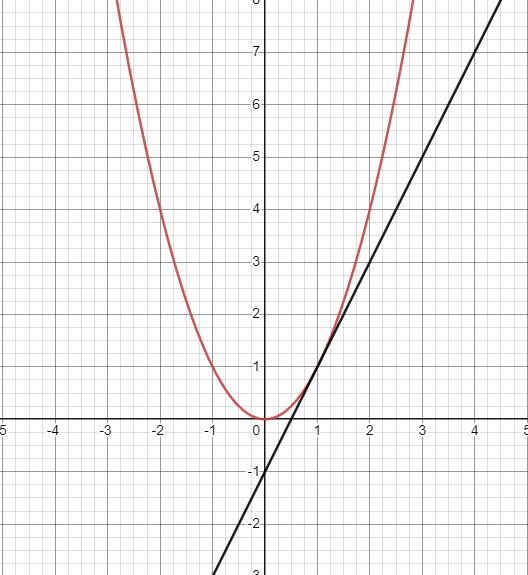
If the graph is concave down at the point of tangency, the tangent line lies above the curve, so your approximation is an overestimate. Every tangent line value comes out higher than the actual function value.
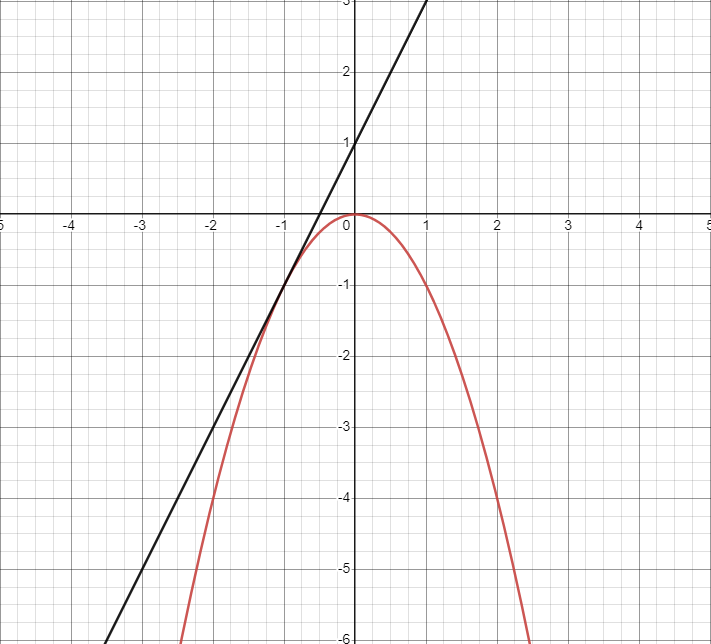
A quick way to connect this to the second derivative: if near the point, the function is concave up (underestimate); if near the point, the function is concave down (overestimate).
How to Use This on the AP Calculus Exam
Free Response
The free-response question below is from the 2010 AP Calculus AB exam administered by College Board. All credit to College Board.
Solutions to the differential equation also satisfy . Let be a particular solution to the differential equation with .
a) Write an equation for the line tangent to the graph of at .
First find the slope of the tangent line at . Since the point is given, plug it into the derivative:
Now use point-slope form to write the tangent line equation:
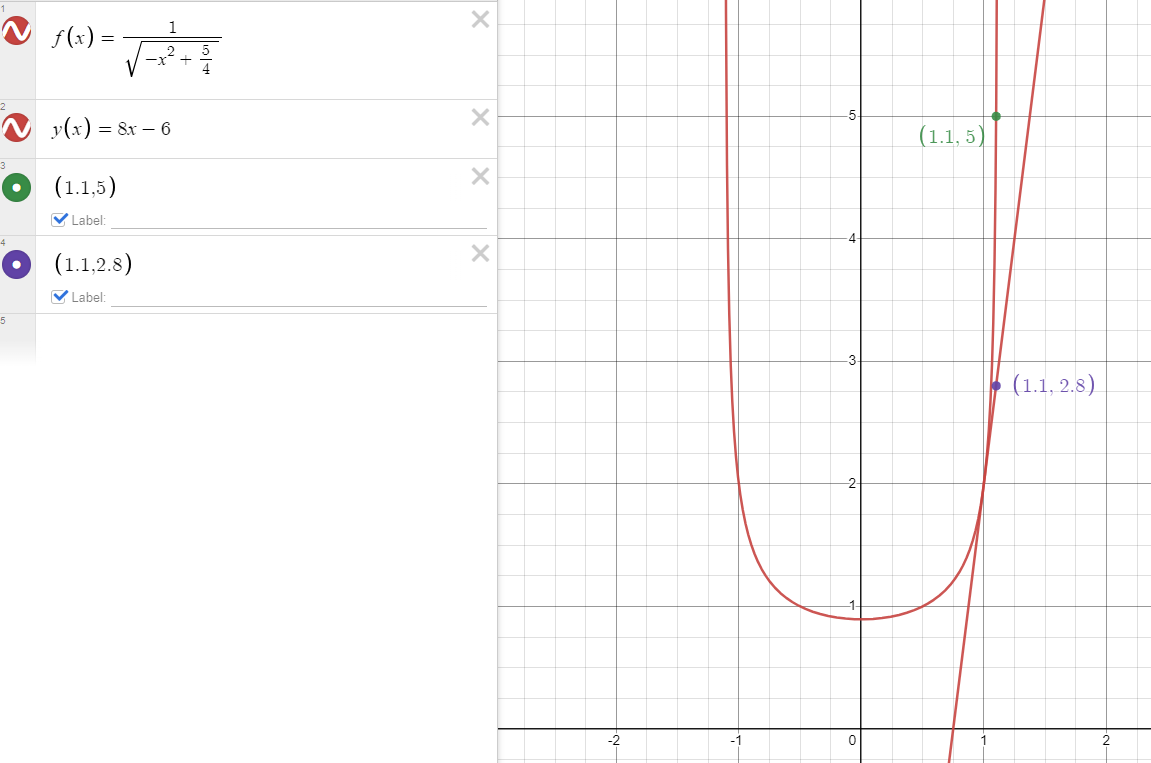
b) Use the tangent line equation from part (a) to approximate . Given that for , is the approximation for greater than or less than ? Explain your reasoning.
Use the tangent line to estimate the function value at :
Because for , the second derivative is positive, so the function is concave up on that interval. A concave up function sits above its tangent line, so the approximation is an underestimate of .
Common Trap
Show your reasoning for the over/underestimate claim, not just the word. Connect the concavity (or sign of the second derivative) to the position of the tangent line relative to the curve. A stated answer without that justification usually does not support a stronger score.
Common Misconceptions
- Misconception: The tangent line value is the exact function value.Actually: The tangent line value is not the exact function value. It is an approximation that works best very close to the point of tangency and gets worse as you move farther away.
- Misconception: Concave up means overestimate.Actually: Concave up does not mean overestimate. Concave up puts the tangent line below the curve, which makes the approximation an underestimate. It is easy to flip these, so picture the curve bending away from the line.
- Misconception: You need to check the slope, not the concavity.Actually: You need to check concavity at or near the point, not the slope. The slope tells you the tangent line direction, but the second derivative (concavity) decides over or underestimate.
- Misconception: The two formulas are different methods.Actually: The two formulas are not different methods. and point-slope form describe the same tangent line. Pick one and use it consistently.
- Misconception: "Locally linear" means everywhere.Actually: "Locally linear" means nearby, not everywhere. A linear approximation is only reliable in a small region around the point of tangency.
Related AP Calculus Guides
- Unit 4 Overview: Contextual Applications of Differentiation
- 4.1 Interpreting the Meaning of the Derivative in Context
- 4.2 Straight-Line Motion: Connecting Position, Velocity, and Acceleration
- 4.4 Intro to Related Rates
- 4.5 Solving Related Rates Problems
- 4.3 Rates of Change in Applied Contexts other than Motion
Practice Questions for 4.6
1 of 10
The volume of a spherical balloon, , is expanding. At radius centimeters, the volume is cubic centimeters and the rate of change of volume with respect to radius is square centimeters. The second derivative of volume with respect to radius at is centimeters. Using the local linear approximation at , what is the estimated volume when centimeters, and how does it compare to the actual volume?
A.
The estimate is ; it is an overestimate because the graph of is concave up.
B.
The estimate is ; it is an underestimate because the graph of is concave up.
C.
The estimate is ; it is an underestimate because the graph of is increasing.
D.
The estimate is ; it is an overestimate because the graph of is increasing.
Vocabulary
The following words are mentioned explicitly in the AP® course framework for this topic.Term | Definition |
|---|---|
locally linear approximation | An approximation of a function's behavior in a small region around a point using a linear function, typically the tangent line at that point. |
overestimate | An approximation that is greater than the actual value of a function. |
point of tangency | The point where a tangent line touches a curve. |
tangent line | A line that touches a curve at a single point and has a slope equal to the derivative of the function at that point. |
underestimate | An approximation that is less than the actual value of a function. |
Frequently Asked Questions
What is local linearity in AP Calculus?
Local linearity means a differentiable function looks almost like its tangent line when you zoom in near a point. AP Calculus Topic 4.6 uses this idea to approximate nearby function values with the tangent line at a known point.
What is the linearization formula?
The linearization of f at x = a is L(x) = f(a) + f'(a)(x - a). This is just the tangent line written as a function. You use it when you know f(a) and f'(a) and want to estimate f(x) for an x-value close to a.
How do you approximate a function value using a tangent line?
Find the point of tangency, find the derivative value there, write the tangent line, and plug in the nearby x-value. The result is an approximation, not usually an exact value. The closer the x-value is to the point of tangency, the more reliable the estimate tends to be.
When is a linear approximation an underestimate?
A tangent line approximation is an underestimate when the function is concave up near the point of tangency. If f''(x) > 0 on the interval, the graph bends above its tangent line, so the tangent line value is below the actual function value.
When is a linear approximation an overestimate?
A tangent line approximation is an overestimate when the function is concave down near the point of tangency. If f''(x) < 0 on the interval, the graph bends below its tangent line, so the tangent line value is above the actual function value.
What should I show on AP Calculus linearization FRQs?
Show the tangent line or linearization formula, substitute the target x-value, and justify any overestimate or underestimate with concavity. A strong answer connects the sign of the second derivative to the position of the tangent line relative to the curve.
See Fiveable more often in Google
Mark Fiveable as a preferred source and Google is more likely to show you our guides in Top Stories, with a "preferred" badge in AI Mode and AI Overviews.