Is AP Calculus AB/BC Hard? Is AP Calc Worth Taking?

♾️AP Calculus AB/BC Review
Is AP Calculus AB/BC Hard? Is AP Calc Worth Taking?
♾️ AP Calculus AB/BC
Overview ♾️
AP Calculus will probably be more difficult than the other math classes you've taken. At the same time, it's totally doable! Concepts build on each other pretty quickly, so make sure to keep up with the work and ask questions if you're confused. It's a new way of thinking, but as long as you have a solid foundation in algebra, you'll make it through.
On the test, you'll have 100 minutes to answer 42 multiple-choice questions, then 1 hour and 30 minutes to answer 6 free-response questions. You will not be able to use a graphing calculator on 4 of the FRQs, but don't worry! If you have to work with numbers on a non-calculator question, the calculations will be relatively simple. Check out past FRQs to get an idea of what questions you might be asked.
Data 📊
Here are the score distributions from 2019:
AP Calculus AB:
- 5: 19.1%
- 4: 18.7%
- 3: 20.6%
- 2: 23.3%
- 1: 18.3%
AP Calculus BC:
- 5: 43%
- 4: 18.5%
- 3: 19.5%
- 2: 13.9%
- 1: 5.2%
In comparison to other AP classes, AP Calculus AB has a middle-of-the-road pass rate and an above-average 5 rates. AP Calculus BC has a high pass rate and 5 rates. This data seems to suggest that AP Calculus isn't too difficult, but it's important to consider that students who are taking an AP math class are more likely to be math-inclined. So, how do students feel?
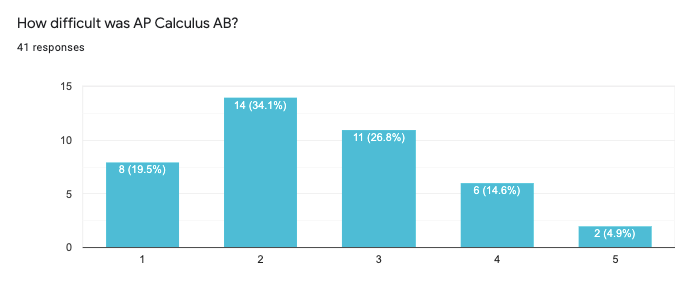
We surveyed 41 students about the difficulty of AP Calculus. They ranked each class on a scale of 1 to 5, where 1 was "extremely easy" and 5 was "extremely difficult." Here are the results:
- Of those who considered themselves a "math person," AP Calculus AB was not very difficult (average score: 2.04), and AP Calculus BC was slightly difficult (average score: 2.64).
- Of those who considered themselves somewhat of a "math person," AP Calculus AB was moderately difficult (average score: 3.42).
- Of those who did not consider themselves a "math person," AP Calculus AB was also moderately difficult (average score: 3.5).
For some tips on how to get a 5, check out this guide!
Resources to Dig Deeper 📚
- What to know before taking AP Calculus AB
- Video reviews and study guides for each unit
- A list of helpful calculator functions
- A list of the best Quizlet decks by unit
Other Factors to Consider 🤔
- Motivation. In AP Calculus, concepts are interconnected, so falling behind can seriously hurt you as you move forward.
- The workload. This is a math class, so you won't have to do a lot of reading, but you will have to do repetitive problems. Expect plenty of worksheets to finish outside of class.
- Your teacher shapes your experience. The good news is that AP Calculus AB and BC are popular subjects, so if you feel like you're not getting enough support in the classroom, there are a lot of online resources to choose from.
What Students Have to Say 💬
In that survey from earlier, we asked for advice for students going into AP Calculus. There were three common tips that people seemed to agree on.
First, don't just memorize formulas. Try to understand the reasoning behind each concept. There's a large focus on graphing and real-world applications, so make sure to figure out the meaning behind formulas and rules.
Second, brush up on your algebra skills. Oftentimes, students will understand the calculus part of a question, but they'll make mistakes because of small algebraic errors.
Third, practice FRQs! Try to answer questions in the time limit. When you finish, look at the answer key and compare your work. Remember that every time you correct a mistake, you learn something.
Lastly, listen to some words of wisdom from the Fiveable community:
"It's a different kind of math. Don't feel bad if you don't like it, but give it a shot because you really might!"
"Don’t give up! Especially for the first few months. It's hard to get adjusted, but you’ll get the hang of it. And if you don’t understand one topic, it's okay! Some topics will be better than others."
"Remember that it's an entirely new way of thinking, so it's normal to struggle at first. Stick with it and you'll have a lot of fun!"
Closing statement
All in all, AP Calculus is definitely worth taking. It's extremely useful for most STEM fields, like physics, chemistry, and biology. Even if you aren't going into STEM, calculus is a new type of math that you just might like if you try.
If you start to find it difficult, don't get discouraged! You'll come out of the class knowing more than you did before, and Fiveable has plenty of free resources to help you along the way.
Frequently Asked Questions
Is AP Calculus hard?
AP Calculus is hard for many students because it combines algebra fluency, conceptual reasoning, and written justification. AP Calculus AB is usually manageable with strong precalculus skills, while AP Calculus BC is harder because it adds parametric, polar, vector, and series topics.
Is AP Calculus AB or BC harder?
AP Calculus BC has harder content because it includes all AB topics plus additional units on parametric equations, polar coordinates, vector-valued functions, and infinite series. BC pass rates are higher mostly because BC students are often more self-selected and prepared.
Is AP Calculus worth taking?
AP Calculus is worth taking if you plan to study STEM, economics, business, data science, architecture, medicine, or another field that uses mathematical models. It can also help with college placement or credit, depending on your score and college policy.
What is the hardest part of AP Calculus?
The hardest part of AP Calculus is usually the FRQ section, especially questions that require setup, notation, interpretation, and justification. Fiveable practice data shows later no-calculator FRQs are a common pressure point for both AB and BC students.
See Fiveable more often in Google
Mark Fiveable as a preferred source and Google is more likely to show you our guides in Top Stories, with a "preferred" badge in AI Mode and AI Overviews.