8.7 Volumes with Cross Sections: Squares and Rectangles

♾️AP Calculus AB/BC Unit 8 Review
8.7 Volumes with Cross Sections: Squares and Rectangles
♾️ AP Calculus AB/BC
8.1
Finding the Average Value of a Function on an Interval
8.2
Connecting Position, Velocity, and Acceleration of Functions Using Integrals
8.3
Using Accumulation Functions and Definite Integrals in Applied Contexts
8.4
Finding the Area Between Curves Expressed as Functions of x
8.5
Finding the Area Between Curves Expressed as Functions of y
8.6
Finding the Area Between Curves That Intersect at More Than Two Points
8.7
Volumes with Cross Sections: Squares and Rectangles
8.8
Volumes with Cross Sections: Triangles and Semicircles
8.9
Volume with Disc Method: Revolving Around the x- or y-Axis
8.10
Volume with Disc Method: Revolving Around Other Axes
8.11
Volume with Washer Method: Revolving Around the x- or y-Axis
8.12
Volume with Washer Method: Revolving Around Other Axes
8.13
The Arc Length of a Smooth, Planar Curve and Distance Traveled
To find the volume of a solid with square or rectangular cross sections, integrate the cross-section area along the axis the slices are perpendicular to: . For squares, , and for rectangles, , where the side or width usually comes from the distance between two curves. For AP Calculus, write the side length or dimensions before setting up the integral.
AP Calc 8.7: Volumes with Cross Sections
In AP Calc 8.7, you find volume by slicing a base region into known shapes and adding their areas with a definite integral. The setup is usually or , where is the area of each square or rectangular cross section.
The most important move is writing the side length or dimensions correctly. For slices perpendicular to the x-axis, use top minus bottom and integrate with ; for slices perpendicular to the y-axis, use right minus left and integrate with .
Why This Matters for the AP Calculus Exam
This topic shows up when you need to turn a flat region between curves into a 3D solid and find its volume. The core skill is setting up a definite integral from a geometric description: read the problem, figure out the cross-section shape, write its area as a function of or , and integrate over the correct bounds.
These problems test the same procedure-selection and setup skills that the AP Calculus exam rewards. You'll see them in both multiple-choice (often as a setup or quick evaluation) and free-response, where writing a correct integral expression with proper notation matters for clear, complete work. Getting comfortable with cross-section volumes also builds the foundation for the disc and washer methods in later topics.
Key Takeaways
- Volume of a solid with known cross sections: , where is the cross-section area and is the slice thickness.
- Square cross sections use ; rectangular cross sections use .
- The side length or width usually equals the distance between the two bounding curves (top minus bottom, or right minus left).
- If cross sections are perpendicular to the x-axis, integrate with respect to . If perpendicular to the y-axis, integrate with respect to and write everything in terms of .
- Find bounds where the curves intersect, or use a given line like or .
- Sketching the base region and one slice helps you set up the correct side length and limits.
Solids with Cross Sections
When a 3D object is hard to handle with basic geometry, slice it into infinitely thin pieces that are easier to work with. The volume of a solid with known cross sections is:
Here is the area of a cross section (a 2D shape) perpendicular to the x-axis on the interval , and is the slice thickness. Each slice is basically a very thin prism, and integrating adds up all the slices.
Square Cross Sections
For square cross sections, use . Substituting into the volume formula:
You're stacking up rectangular prisms whose thickness is infinitely thin, represented by .
Rectangular Cross Sections
The area of a rectangle is , where is the width and is the height. So the volume of a solid with rectangular cross sections is:
Again, is your thickness.
How to Use This on the AP Calculus Exam
Problem Solving
Once you have the formulas, the real work is figuring out , , or and the bounds. Use these steps:
- Identify the cross-section shape and pick the matching area formula.
- Decide whether slices are perpendicular to the x-axis (integrate with respect to ) or the y-axis (integrate with respect to ).
- Write the side length or dimensions using the bounding curves.
- Find the limits of integration from intersection points or given boundary lines.
- Set up the integral, then evaluate.
Example 1: Solids with Square Cross Sections
Suppose a region bounded by and forms the base of a solid, and each cross section perpendicular to the x-axis is a square. What is the volume of the solid?
Question courtesy of Flipped Math
Since the cross sections are squares, use .
Start by visualizing the region. A picture may or may not be given, but sketching the graphs helps you see the region and choose correct bounds.
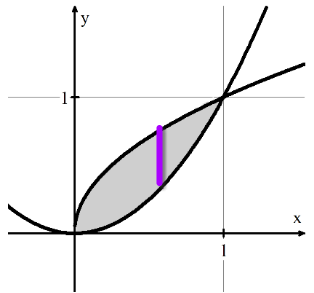
Here is the upper curve and is the lower curve. Let and . The grey area is the base, and the purple line is one cross section coming toward you along a z-axis not drawn here.
The side length of the square at a given is the difference between the upper and lower curves, so .
Next, find the bounds. The curves intersect at and , so the interval is . You can confirm this algebraically:
Now plug in:
Evaluating gives , about 0.1285.
The steps:
First, expand and integrate.
Then evaluate over the bounds.
Example 2: Solids with Rectangular Cross Sections
The base of a solid is bounded by , , and . Find the volume if the cross sections, taken perpendicular to the y-axis, form a rectangle whose height is 6.
Question courtesy of Flipped Math
Two important differences from Example 1: the cross sections are perpendicular to the y-axis, and three boundaries are given. Since the slices are perpendicular to the y-axis, integrate with respect to using .
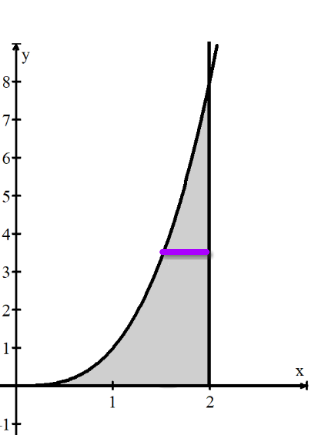
Here is the left curve and is the right curve. The purple line is a cross section perpendicular to the y-axis. To find the width at a given , rewrite as . The width is the right boundary minus the left boundary: . The problem gives the height as .
For the bounds, the curves meet at , and the boundary gives the lower limit, so the interval is . Plugging in:
This evaluates to 24.
Common Trap
Mixing up which variable to integrate with respect to. If slices are perpendicular to the x-axis, your integral uses and everything must be in terms of . If slices are perpendicular to the y-axis, switch to and rewrite functions in terms of .
Common Misconceptions
- Misconception: Forgetting to square the side length.Actually: For square cross sections, , not just . If , you must square the entire difference before integrating.
- Misconception: Squaring incorrectly.Actually: is not . Expand it fully: .
- Misconception: Using the wrong variable.Actually: Cross sections perpendicular to the y-axis require integrating with respect to , so rewrite your curves as functions of first.
- Misconception: Picking bounds that don't match the slicing direction.Actually: When integrating with respect to , your limits are -values, not -values.
- Misconception: Confusing cross-section volume with solids of revolution.Actually: This topic uses a flat base region with shapes built on top of it. It is not the disc or washer method, which spins a region around an axis.
- Misconception: Treating the side length as one curve.Actually: The side or width is usually the distance between two curves (top minus bottom or right minus left), not just one function's value.
Summary
To find the volume of a solid with known cross sections:
where is the area of a cross section perpendicular to the x-axis on .
- Square cross sections: , where is the side length.
- Rectangular cross sections: , where is width and is height.
Use the methods for finding areas between curves to write , or and , then find the bounds from intersection points or given boundary lines. Plug in , integrate, and you have the volume.
Related AP Calculus Guides
- Unit 8 Overview: Applications of Integration
- 8.1 Finding the Average Value of a Function on an Interval
- 8.2 Connecting Position, Velocity, and Acceleration of Functions Using Integrals
- 8.4 Finding the Area Between Curves Expressed as Functions of x
- 8.3 Using Accumulation Functions and Definite Integrals in Applied Contexts
- 8.6 Finding the Area Between Curves That Intersect at More Than Two Points
Practice Questions for 8.7
1 of 10
The graph of is shown above. A solid has a base bounded by the curve , the y-axis, and the horizontal line . Cross sections perpendicular to the y-axis are squares.
Which of the following integrals represents the volume of the solid?
A.
B.
C.
D.
Vocabulary
The following words are mentioned explicitly in the AP® course framework for this topic.Term | Definition |
|---|---|
cross section | Two-dimensional slices of a three-dimensional solid, perpendicular to an axis, used to build up the volume through integration. |
definite integral | The integral of a function over a specific interval [a, b], representing the net signed area between the curve and the x-axis. |
rectangular cross sections | Two-dimensional rectangular slices of a solid whose areas can be integrated to find the total volume. |
square cross sections | Two-dimensional square slices of a solid whose areas can be integrated to find the total volume. |
volumes of solids | The measure of three-dimensional space occupied by a solid object, calculated using integration techniques. |
Frequently Asked Questions
What is AP Calc 8.7 about?
AP Calc 8.7 covers finding volumes of solids with known square or rectangular cross sections using definite integrals.
How do I set up volume with cross sections?
Write the volume as an integral of cross-section area: V = integral A(x) dx or V = integral A(y) dy. The area formula depends on the cross-section shape.
What formula do I use for square cross sections?
For square cross sections, the area is A = s^2, where s is the side length. The side length often comes from the distance between two curves.
What formula do I use for rectangular cross sections?
For rectangular cross sections, use A = width times height. One dimension may come from the distance between curves, while the other may be given as a constant or ratio.
How do I know whether to integrate with dx or dy?
If slices are perpendicular to the x-axis, integrate with dx and write lengths in terms of x. If slices are perpendicular to the y-axis, integrate with dy and write lengths in terms of y.
How are cross-section volumes different from washers?
Cross-section problems build known shapes on a base region. Washer and disk methods involve rotating a region around an axis, so the area formulas and setup are different.
See Fiveable more often in Google
Mark Fiveable as a preferred source and Google is more likely to show you our guides in Top Stories, with a "preferred" badge in AI Mode and AI Overviews.