4.5 Solving Related Rates Problems

♾️AP Calculus AB/BC Unit 4 Review
4.5 Solving Related Rates Problems
♾️ AP Calculus AB/BC
4.1
Interpreting the Meaning of the Derivative in Context
4.2
Straight-Line Motion: Connecting Position, Velocity, and Acceleration
4.3
Rates of Change in Applied Contexts other than Motion
4.4
Intro to Related Rates
4.5
Solving Related Rates Problems
4.6
Approximating Values of a Function Using Local Linearity and Linearization
4.7
Using L'Hopitals Rule for Determining Limits in Indeterminate Forms
Related rates problems ask you to find how fast one quantity changes by connecting it to other quantities whose rates you already know. You write an equation linking the variables, differentiate both sides with respect to time using the chain rule, then plug in known values and solve for the unknown rate. For AP Calculus, substitute values after differentiating so variables keep their rate meanings.
Why This Matters for the AP Calculus Exam
Related rates pull together the chain rule, implicit differentiation, and rate-of-change interpretation from earlier in AP Calculus. This topic builds on the setup work from Introduction to Related Rates and pushes you to finish the problem and explain what your answer means.
On the exam, related rates show up in both multiple-choice and free-response style questions. You will need to translate a word problem into an equation, differentiate with respect to time, substitute correctly, and interpret the rate you find in context. Clear setup, correct chain rule use, and matching units make your work easy to follow and easy to score.
Key Takeaways
- A related rate connects an unknown rate to known rates through an equation that ties the variables together.
- Differentiate both sides of your equation with respect to time, applying the chain rule to every variable that depends on time.
- A quantity that stays constant has a rate of change of zero, so its derivative drops out.
- Plug in numbers only after differentiating, not before, so constants do not hide variables you still need to differentiate.
- Use geometry formulas (area, volume, Pythagorean theorem, similar triangles) to build the relationship between variables.
- Always report your answer with correct units and say whether the quantity is increasing or decreasing.
Steps to Solve Related Rates Problems
A related rates problem often hands you a lot of information at once. Organize before you solve.
- Read carefully and identify the rates. Note which rates are given and which rate you need to find. Circling or rewriting key values off to the side helps.
- Draw a diagram. A labeled picture shows how the variables connect and which ones are changing.
- Set up an equation that relates the variables. These are usually geometric formulas or relationships given in the problem.
- Differentiate implicitly with respect to time t. Apply the chain rule to each term that contains a variable depending on time.
- Substitute known values. Plug in known quantities and rates after differentiating.
- Solve for the desired rate. Isolate the rate you want, then check that your units make sense in context.
Related Rates Practice Problems
1) Expanding Rectangle
An expanding rectangle has one side of length 6 feet and the other side of length 8 feet. If the length of the shorter side is increasing at a rate of 2 feet per minute, at what rate is the area of the rectangle increasing?
Start by identifying key facts and drawing a picture.
Known Information
- ft
- ft
Important Equations
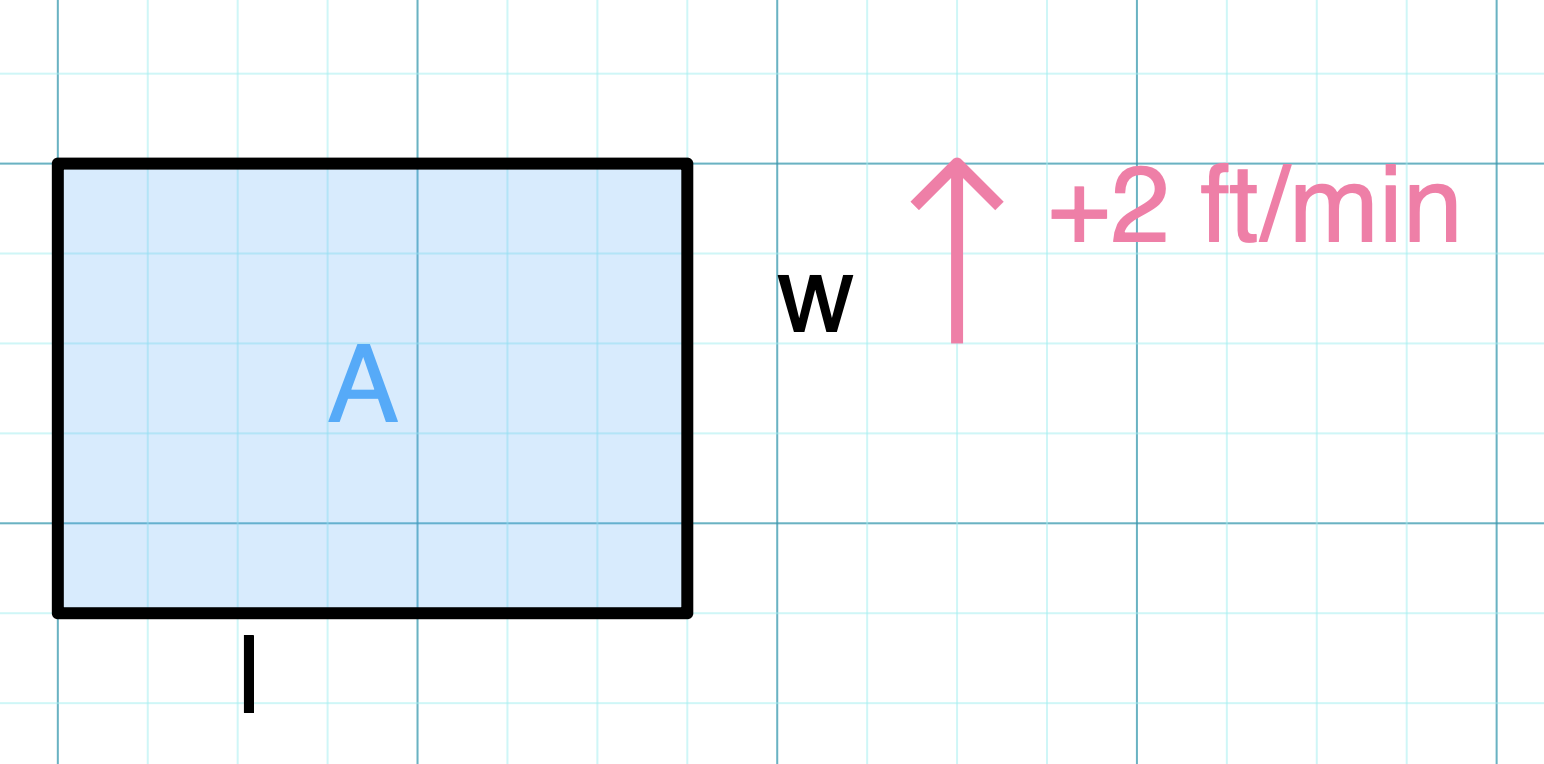
The length is not changing, so . Only the width changes here.
After plugging in the constant length, the area is at any time. Now differentiate with respect to time using the chain rule.
The area of the rectangle is increasing at a rate of 16 square feet per minute. Notice the units are square feet per minute, since area is measured in square feet.
2) Sliding Ladder
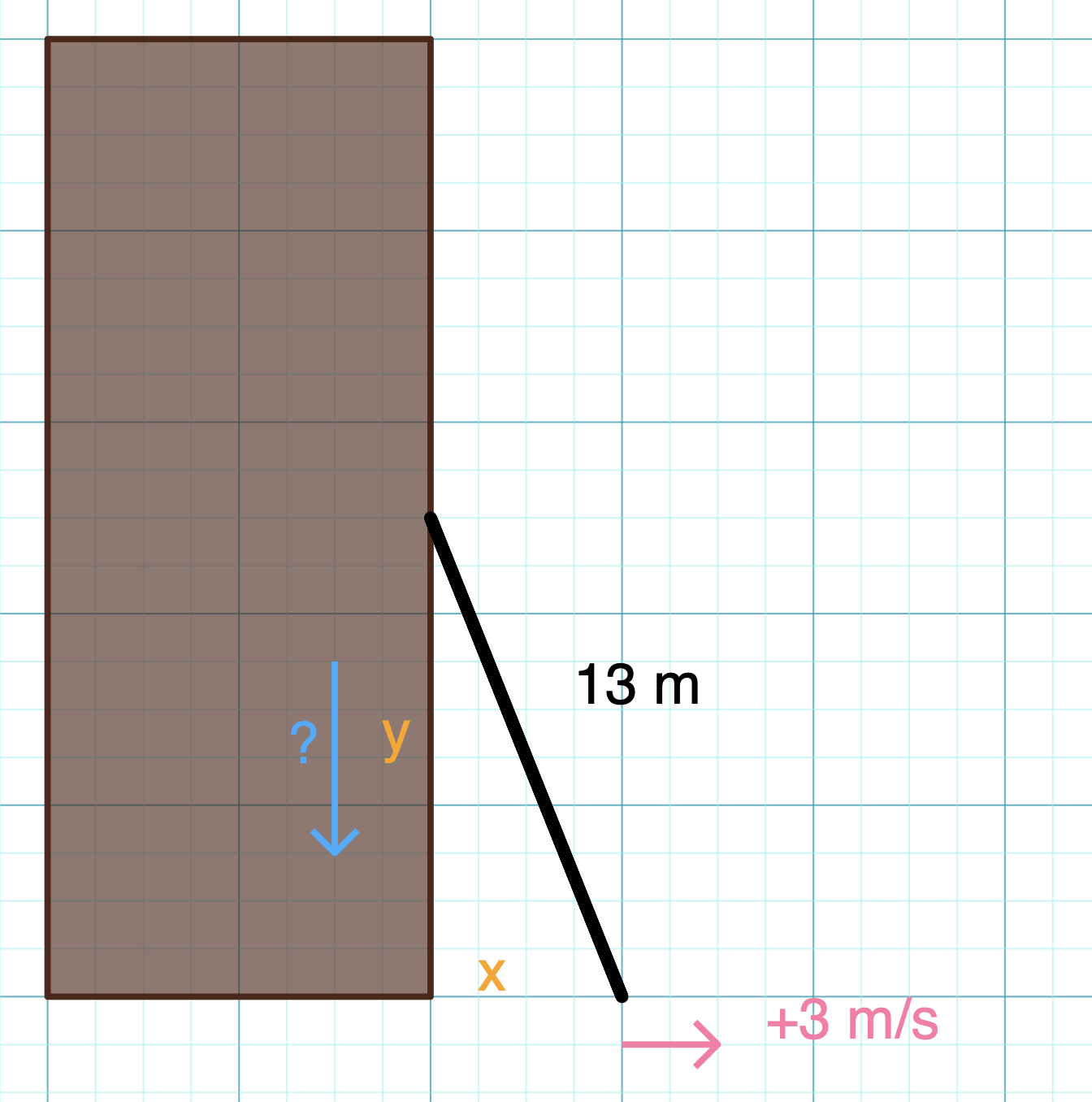
Consider a meter long ladder leaning against a wall. If the distance between the wall and the bottom of the ladder is increasing at m/s, how fast is the distance between the ground and the top of the ladder changing when the bottom of the ladder is meters away from the wall?
This question throws a lot at you at once, so reread the scenario before working.
Start by identifying key facts and drawing a picture.
Known Information
- m
Important Equations
- (Pythagorean Theorem)
The ladder length is the hypotenuse, and it does not change, so .
After plugging in the constant hypotenuse, the relationship is . Now take the derivative with respect to time, using the chain rule:
Plug in the known values:
You still need two things: the value of when , and , which is the answer.
Find using the Pythagorean Theorem. The sides form a Pythagorean triple, but you can also solve directly:
Now solve for :
The distance between the top of the ladder and the ground is decreasing at a rate of meters per second when the bottom of the ladder is 5 meters from the wall. The negative sign tells you the top is sliding down.
How to Use This on the AP Calculus Exam
Free Response
- Show your relating equation before differentiating. Graders and your own work both depend on seeing the setup.
- Differentiate with respect to time first, then substitute. Plugging in numbers too early can erase a variable you still need.
- Find any missing instantaneous value (like the height when the base is 5) using your original equation before solving for the rate.
- Interpret your final answer in words, including units and whether the quantity is increasing or decreasing.
MCQ
- Watch for which rate is given and which is unknown. Mixing them up is a common error.
- A constant quantity has a derivative of zero, which often simplifies the equation quickly.
- Check that your units match the answer choices, since area rates use squared units and volume rates use cubed units.
Common Trap
A value that is true only at one instant, like a specific radius or distance, is not constant over time. Do not plug it in before differentiating. Treat it as a variable, differentiate, then substitute its value.
Common Misconceptions
- Misconception: You should substitute before differentiating.Actually: If you plug in a value that is changing before you take the derivative, you lose the term for that variable's rate. Differentiate first, then substitute.
- Misconception: You can forget the chain rule.Actually: Every variable that depends on time needs a factor when you differentiate. Leaving it off is the most common related rates mistake.
- Misconception: A rate is the same as a value.Actually: A rate like is how fast something changes, not the size of the quantity itself. Keep these separate in your setup.
- Misconception: You should ignore the sign.Actually: A negative rate means the quantity is decreasing. Do not drop the sign or treat the answer as positive when the problem describes something shrinking.
- Misconception: Using the wrong units is acceptable.Actually: Area rates are in squared units per time and volume rates are in cubed units per time. Match the unit to the quantity you are tracking.
- Misconception: A constant should be treated as a variable.Actually: If a length truly never changes (like a fixed ladder), its derivative is zero and that term drops out. Only treat quantities as variable if they actually change over time.
Related AP Calculus Guides
- Unit 4 Overview: Contextual Applications of Differentiation
- 4.1 Interpreting the Meaning of the Derivative in Context
- 4.2 Straight-Line Motion: Connecting Position, Velocity, and Acceleration
- 4.4 Intro to Related Rates
- 4.6 Approximating Values of a Function Using Local Linearity and Linearization
- 4.3 Rates of Change in Applied Contexts other than Motion
Practice Questions for 4.5
1 of 10
A snowball melts so that its surface area decreases at a constant rate of 12 square inches per minute. Which relationship should be used to find how fast the radius is decreasing?
A.
, then
B.
, then
C.
, then differentiate to get
D.
, then differentiate to relate volume and radius rates
Vocabulary
The following words are mentioned explicitly in the AP® course framework for this topic.Term | Definition |
|---|---|
derivative | The instantaneous rate of change of a function at a specific point, representing the slope of the tangent line to the function at that point. |
rate of change | The measure of how quickly a quantity changes with respect to another variable, often time. |
related rates | Problems in which the rates of change of two or more related quantities are connected, and the derivative is used to find an unknown rate of change from known rates. |
Frequently Asked Questions
Why do you differentiate with respect to time?
Related rates describe how quantities change over time, so every changing variable needs a chain rule factor such as dx/dt, dy/dt, or dV/dt.
See Fiveable more often in Google
Mark Fiveable as a preferred source and Google is more likely to show you our guides in Top Stories, with a "preferred" badge in AI Mode and AI Overviews.