1.13 Removing Discontinuities

♾️AP Calculus AB/BC Unit 1 Review
1.13 Removing Discontinuities
♾️ AP Calculus AB/BC
1.1
Introducing Calculus: Can Change Occur at An Instant?
1.2
Defining Limits and Using Limit Notation
1.3
Estimating Limit Values from Graphs
1.4
Estimating Limit Values from Tables
1.5
Determining Limits Using Algebraic Properties of Limits
1.6
Determining Limits Using Algebraic Manipulation
1.7
Selecting Procedures for Determining Limits
1.8
Determining Limits Using the Squeeze Theorem
1.9
Connecting Multiple Representations of Limits
1.10
Exploring Types of Discontinuities
1.11
Defining Continuity at a Point
1.12
Confirming Continuity over an Interval
1.13
Removing Discontinuities
1.14
Connecting Infinite Limits and Vertical Asymptotes
1.15
Connecting Limits at Infinity and Horizontal Asymptotes
1.16
Working with the Intermediate Value Theorem (IVT Calc)
A removable discontinuity is a "hole" in a graph: the function is undefined or defined wrong at one point, but the limit there still exists. You remove it by redefining the function at that point to equal the limit, often after factoring and canceling. For AP Calculus, always confirm the left- and right-hand limits agree before trying to make a function continuous.
Why This Matters for the AP Calculus Exam
Removing discontinuities pulls together limits and continuity, two ideas that show up across the whole AP Calculus exam. You will need to recognize a hole versus a jump or infinite discontinuity, decide whether a limit exists, and then solve for an x-value or a constant that makes a function continuous. This skill appears in multiple-choice questions and can support free-response work where you justify continuity by checking that a limit equals a function value. Writing clear setups and correct limit notation is important for clear exam work.
Key Takeaways
- A discontinuity is removable only when the limit at that point exists (the left and right limits are equal and finite).
- To remove a hole, redefine the function at that point so it equals the limit as x approaches it.
- Factor and cancel common factors in rational functions to simplify, then substitute to find the limit value.
- For piecewise functions, set the expressions on both sides of a boundary equal, and make sure the function value at the boundary matches too.
- Jump and infinite discontinuities are not removable because the limit does not exist there.
- Always confirm the limit exists before trying to "patch" the function.
What are Discontinuities?
A function is discontinuous where its graph "breaks." There are three types: removable, jump, and infinite. This guide focuses on removable discontinuities, which are the only kind you can fix by redefining a single point.
If you need a refresher on confirming continuity over an interval, see 1.12 Confirming Continuity over an Interval.
Removable Discontinuities
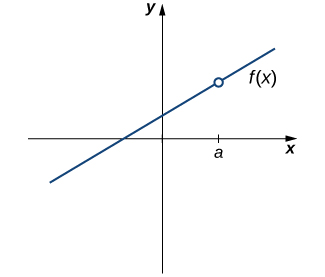
Removable discontinuities are often called "holes" in a graph. They happen when a function is undefined at a point, but the limit there exists. Because the limit exists, you can fill the hole and make the graph continuous.
When the limit as approaches a point exists but the function is undefined or defined as something else at that point, redefining the value to equal the limit removes the discontinuity.
Filling the Gap
To remove a discontinuity, redefine the function's value at that point to equal the limit of the function as approaches that point. For example:
To remove this discontinuity, factor the denominator and cancel like terms:
After canceling, substitute to find the limit value:
So defining removes the discontinuity.
Practice: Filling the Gap
Consider the function defined as follows:
where is a constant. Determine the value of that makes continuous at .
First, factor the numerator so you can see what cancels with the denominator:
There is an term in the numerator, so cancel it with the in the denominator:
For :
Piecewise Functions
For piecewise functions, check the left limit and right limit at the boundary, and make sure they match the value the function is defined to take there.
Ensuring Continuity
Consider defined by two pieces of a function on either side of :
- On the left side, approaches as approaches .
- On the right side, approaches as approaches .
For to be continuous at , you need .
For example, this is a continuous piecewise function:
The limit of as approaches from the left equals , and from the right it is also . The function is defined at as . Since the left limit, right limit, and function value all match, the function is continuous there.
Practice: Ensuring Continuity
Consider the function:
What must be for the function to be continuous?
Use the first piece to find the limit at . First, factor and cancel:
Now plug in :
Set this equal to (the defined value at ) and solve:
Visualizing Continuity
Graphs make it easy to spot continuity or the lack of it. A continuous graph can be drawn without lifting your pencil, and a removable discontinuity shows up as a single hole.
Practice: Visualizing Continuity
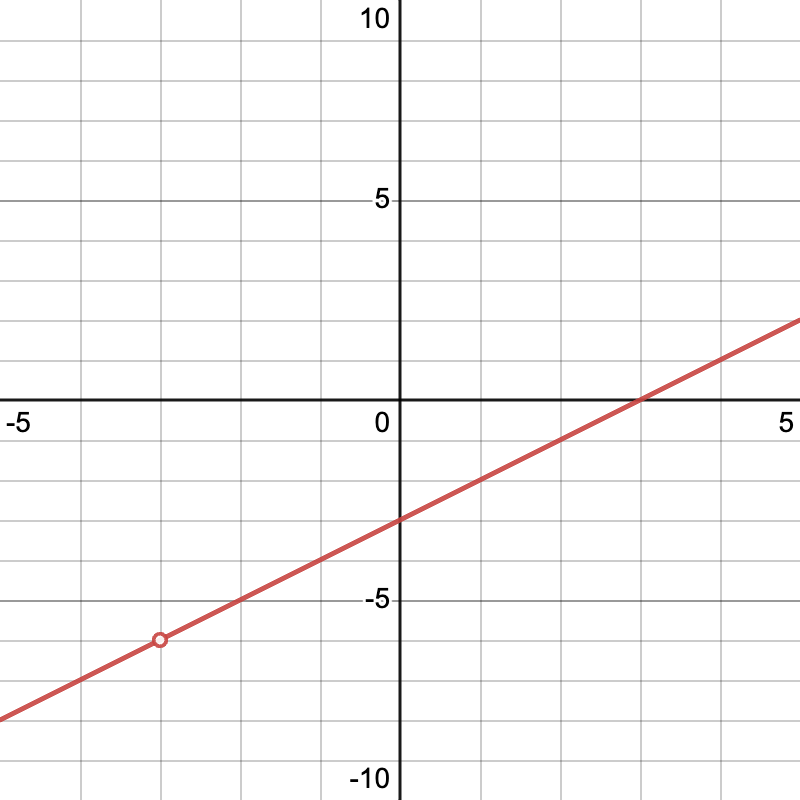
Graph the function over the interval . Is it continuous? Can you make it continuous?
There is a discontinuity at . Remove it by factoring:
Plugging in gives , so defining the function to equal at makes it continuous.
How to Use This on the AP Calculus Exam
MCQ
- When you see a rational function that gives at a point, factor and cancel first, then substitute to find the limit. That limit value is what fills the hole.
- Identify the discontinuity type before deciding if it is removable. Only holes (where the limit exists) can be removed.
- For problems that ask you to "find the constant that makes the function continuous," set the limit equal to the defined value at that point and solve.
Free Response
- Justify continuity by stating that the limit exists and equals the function value, not just by saying the graph "looks connected."
- Show the factoring and cancellation steps clearly, then state the limit value you used to define the point.
- For piecewise boundaries, write out the left-piece value, the right-piece value, and the assigned function value, and show they are equal.
Common Trap
- After canceling a common factor, remember the simplified function is only equal to the original where the original was defined. The hole is still part of the original function until you redefine the point.
Common Misconceptions
- Misconception: Canceling the factor removes the hole automatically.Actually: Canceling simplifies the expression and tells you the limit, but the original function still has a hole until you redefine the value at that point.
- Misconception: Every discontinuity can be removed.Actually: Only removable discontinuities (where the limit exists) can be patched. Jump and infinite discontinuities cannot, because the limit does not exist.
- Misconception: If the limit exists, the function is already continuous.Actually: The function is continuous only if the value at the point also equals that limit. A hole means the limit exists but the function value does not match.
- Misconception: Matching only one side is enough for piecewise functions.Actually: You must match the left limit, the right limit, and the assigned function value at the boundary.
- Misconception: The limit and the function value are the same thing.Actually: They can differ. Removing a discontinuity is exactly the act of forcing the function value to equal the limit.
Related AP Calculus Guides
- 1.2 Defining Limits and Using Limit Notation
- 1.1 Introducing Calculus: Can Change Occur at An Instant?
- 1.6 Determining Limits Using Algebraic Manipulation
- 1.3 Estimating Limit Values from Graphs
- 1.5 Determining Limits Using Algebraic Properties of Limits
- 1.8 Determining Limits Using the Squeeze Theorem
Practice Questions for 1.13
1 of 10
The graph of the rational function is shown above.
To determine if the discontinuity at can be removed, which of the following correctly identifies the required hypothesis and confirms whether it is satisfied?
A.
The hypothesis that is differentiable at must be verified; it is not satisfied because the graph has a hole.
B.
The hypothesis that must be verified; it is not satisfied because is undefined.
C.
The hypothesis that is defined must be verified; it is not satisfied because there is a hole in the graph, so the discontinuity cannot be removed.
D.
The hypothesis that exists must be verified; it is satisfied because the left-hand and right-hand limits both equal 4.
Vocabulary
The following words are mentioned explicitly in the AP® course framework for this topic.Term | Definition |
|---|---|
continuous | A function that has no breaks, jumps, or holes in its graph over a given interval. |
discontinuity | A point where a function is not continuous, often due to a break, jump, or hole in the graph. |
limit | The value that a function approaches as the input approaches some value, which may or may not equal the function's value at that point. |
piecewise-defined function | A function defined by different expressions over different intervals or regions of its domain. |
removable discontinuity | A discontinuity that can be eliminated by defining or redefining the function value at that point to equal the limit. |
Frequently Asked Questions
What is a removable discontinuity?
A removable discontinuity is a hole in a graph where the limit exists but the function is undefined or defined at the wrong value. It is removable because redefining the function at that single point can make it continuous.
How do you remove a discontinuity?
First confirm the limit exists at the discontinuity. Then define or redefine the function value at that point to equal the limit. For rational functions, factor and cancel common factors before substituting.
How do you identify a removable discontinuity from a graph?
Look for a single hole where the left and right sides of the graph approach the same finite y-value. If the graph jumps or heads toward infinity, that discontinuity is not removable.
How do piecewise functions become continuous at a boundary?
At the boundary, the expression on the left, the expression on the right, and the actual function value must all match. Set those values equal and solve for the needed parameter.
Can every discontinuity be removed?
No. Only discontinuities where the limit exists can be removed by changing one function value. Jump discontinuities and infinite discontinuities are not removable because the limit does not exist there.
How does removing discontinuities show up on the AP Calculus exam?
You may be asked to find a function value or parameter that makes a function continuous. Show that the relevant limit exists, then set the function value equal to that limit.
See Fiveable more often in Google
Mark Fiveable as a preferred source and Google is more likely to show you our guides in Top Stories, with a "preferred" badge in AI Mode and AI Overviews.