4.4 Intro to Related Rates

♾️AP Calculus AB/BC Unit 4 Review
4.4 Intro to Related Rates
♾️ AP Calculus AB/BC
4.1
Interpreting the Meaning of the Derivative in Context
4.2
Straight-Line Motion: Connecting Position, Velocity, and Acceleration
4.3
Rates of Change in Applied Contexts other than Motion
4.4
Intro to Related Rates
4.5
Solving Related Rates Problems
4.6
Approximating Values of a Function Using Local Linearity and Linearization
4.7
Using L'Hopitals Rule for Determining Limits in Indeterminate Forms
What are related rates in AP Calculus?
Related rates problems use derivatives to connect how two or more changing quantities move together, usually with respect to time. You write an equation relating the quantities, differentiate both sides with respect to the independent variable using the chain rule, then plug in known values to solve for the unknown rate.
Why This Matters for the AP Calculus Exam
Related rates pull together the chain rule, implicit differentiation, and unit reasoning from earlier units and apply them to word problems. On the AP Calculus exam, you may see these ideas in both multiple-choice and free-response settings, where you translate a real situation into an equation, differentiate with respect to time, and interpret what your rate actually means.
The skill being built here is recognizing that a phrase like "how fast is the area increasing" signals a derivative with respect to time. Clear notation, correct units, and a labeled setup make your work easier to follow and easier to check, which matters for accurate exam responses.
Key Takeaways
- The chain rule is the backbone of related rates: every variable gets differentiated with respect to the same independent variable, usually time .
- Other rules like the product rule and quotient rule may show up when the equation has products or fractions of variables.
- Write the relationship as an equation first (area, volume, Pythagorean theorem, similar triangles, trig relation), then differentiate.
- Differentiate before you substitute. Plug in known numbers only after taking the derivative.
- Track your rates with notation like , , or so you know which rate is given and which is unknown.
- Keep units consistent and state what your answer means in context.
How to Use This on the AP Calculus Exam
Problem Solving
A reliable step-by-step approach:
- Identify the quantities. Note what is given (with units) and what rate you are solving for. Label each rate with proper notation like .
- Model the relationship. Write an equation that ties the quantities together. Common setups include the area of a circle, the volume of a cone or sphere, the Pythagorean theorem, or a trig relation.
- Differentiate with respect to the independent variable. Apply the chain rule to every variable. Use the product or quotient rule if your equation needs it.
- Substitute and solve. Plug in known values after differentiating, then use algebra to find the unknown rate.
Drawing and labeling a picture is one of the most useful habits here. A clear diagram helps you spot the right equation and keep your known and unknown quantities straight. For the derivative rules behind this, see the Unit 2 guides.
Worked Example: Expanding Circle
Suppose an oil spill spreads in a circular pattern. The radius increases at a constant rate of 3 m/s. How fast is the area increasing when the radius is 30 m?
Known quantities: radius m and m/s. You are solving for .
Relate area to radius:
Differentiate both sides with respect to using the chain rule:
So:
Substitute the known values, keeping units:
The area is increasing at .
Worked Example: Sliding Ladder
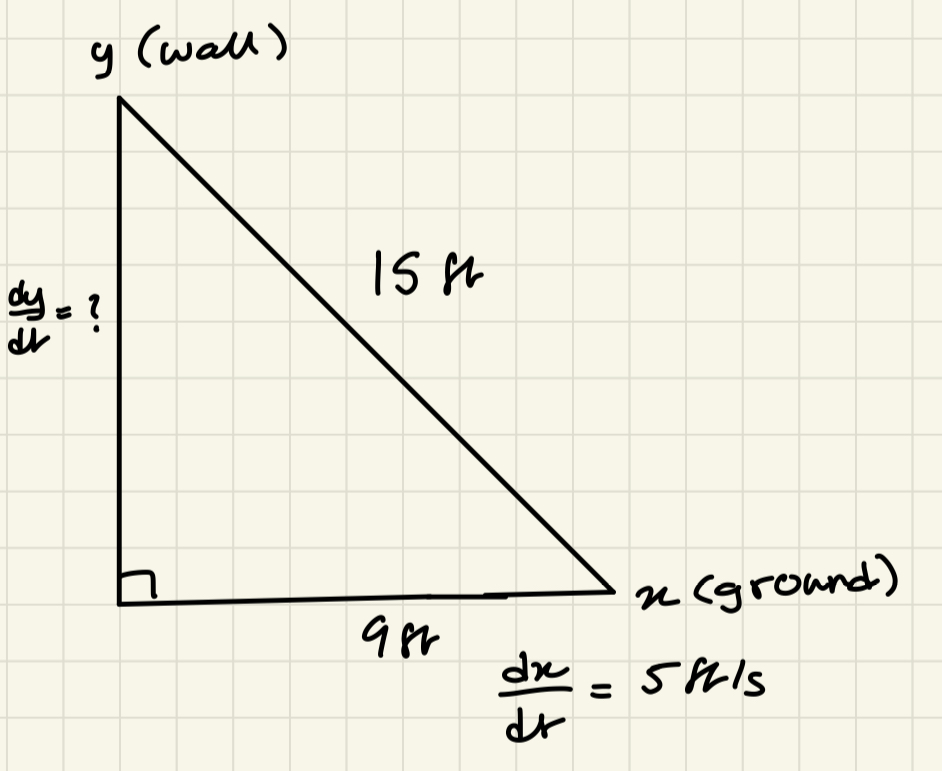
A 15 ft tall ladder rests against a vertical wall. The bottom of the ladder slides away from the wall at 5 ft/s. How fast is the top of the ladder sliding down when the bottom is 9 ft from the wall?
Set the wall along the -axis and the ground along the -axis. The ladder is the hypotenuse, so use the Pythagorean theorem:
You are solving for . Differentiate with respect to :
You still need . Use the original equation with :
Now substitute , , and :
The top of the ladder slides down at ft/s. The negative sign shows the height is shrinking.
Common Trap
Watching for "missing" values like in the ladder problem is part of the work, not a mistake. When a variable you need is not given, solve for it from the original equation before substituting.
Common Misconceptions
- Misconception: You should substitute values before differentiating.Actually: If you plug in a value like before differentiating, you treat a changing quantity as a constant and lose its rate. Differentiate first, then substitute.
- Misconception: You do not need the chain rule when differentiating with respect to .Actually: Differentiating with respect to gives , not just . Every variable carries a factor.
- Misconception: and are the same quantity.Actually: and are different quantities. Label them carefully so you know what is given and what you are solving for.
- Misconception: A rate does not need units.Actually: A rate without units is incomplete. Carry units through and report the answer with them, like or .
- Misconception: A constant means is constant too.Actually: A constant does not make constant, since depends on . In the next topic, you will practice another structured approach to these problems with more examples, so you can find the method that works best for you. AP Calculus 4.5 Solving Related Rates Problems
Related AP Calculus Guides
- Unit 4 Overview: Contextual Applications of Differentiation
- 4.1 Interpreting the Meaning of the Derivative in Context
- 4.2 Straight-Line Motion: Connecting Position, Velocity, and Acceleration
- 4.6 Approximating Values of a Function Using Local Linearity and Linearization
- 4.5 Solving Related Rates Problems
- 4.3 Rates of Change in Applied Contexts other than Motion
Practice Questions for 4.4
1 of 10
A right circular cone with fixed vertex angle and a right circular cylinder with fixed radius of 2 inches are both filled with sand at 12 cubic inches per second. Which statement correctly describes how the heights change in these two situations?
A.
Both have constant height increase rates because both have the same constant volume rate.
B.
The cone's height increases at a decreasing rate; the cylinder's increases at a constant rate.
C.
The cone requires the product rule while the cylinder requires only the chain rule.
D.
The cylinder's height increases at a decreasing rate; the cone's increases at a constant rate.
Vocabulary
The following words are mentioned explicitly in the AP® course framework for this topic.Term | Definition |
|---|---|
chain rule | A differentiation rule that provides a method for finding the derivative of a composite function by multiplying the derivative of the outer function by the derivative of the inner function. |
product rule | A differentiation rule that states the derivative of a product of two functions equals the first function times the derivative of the second plus the second function times the derivative of the first. |
quotient rule | A differentiation rule used to find the derivative of a quotient of two differentiable functions. |
related rates | Problems in which the rates of change of two or more related quantities are connected, and the derivative is used to find an unknown rate of change from known rates. |
Frequently Asked Questions
Why should I not substitute values before differentiating?
Substituting too early can turn a changing variable into a constant and remove its rate. Keep variables symbolic until after differentiating.
See Fiveable more often in Google
Mark Fiveable as a preferred source and Google is more likely to show you our guides in Top Stories, with a "preferred" badge in AI Mode and AI Overviews.