9.3 Finding Arc Lengths of Curves Given by Parametric Equations

♾️AP Calculus AB/BC Unit 9 Review
9.3 Finding Arc Lengths of Curves Given by Parametric Equations
♾️ AP Calculus AB/BC
9.1
Defining and Differentiating Parametric Equations
9.2
Second Derivatives of Parametric Equations
9.3
Finding Arc Lengths of Curves Given by Parametric Equations
9.4
Defining and Differentiating Vector-Valued Functions
9.5
Integrating Vector-Valued Functions
9.6
Solving Motion Problems Using Parametric and Vector-Valued Functions
9.7
Defining Polar Coordinates and Differentiating in Polar Form
9.8
Find the Area of a Polar Region or the Area Bounded by a Single Polar Curve
9.9
Finding the Area of the Region Bounded by Two Polar Curves
The arc length of a curve given by parametric equations and on is . You find both derivatives, plug them under the square root, and evaluate the definite integral. For AP Calculus BC, remember that the bounds are parameter values, not x- or y-values.
Why This Matters for the AP Calculus Exam
Parametric arc length builds directly on the Pythagorean idea behind every arc length formula: tiny pieces of a curve act like hypotenuses of small triangles. On the AP Calculus BC exam, this topic shows up in multiple-choice and free-response questions where you set up or evaluate an arc length integral, often connected to planar motion (the same integral gives total distance traveled when and describe a moving particle).
The exam rewards clean setup. Many questions just ask you to write the correct integral, and on calculator-active sections you can evaluate it numerically. Choosing the right procedure and writing precise notation matters for clear work, since errors in algebra, trig, or derivatives cause most lost points here.
Key Takeaways
- The parametric arc length formula is , where and are values of the parameter .
- Take and separately, then square and add them inside the radical.
- The bounds are values of , not or . Use the parameter interval given in the problem.
- The expression is the speed of a particle, so this same integral gives total distance traveled.
- Watch for trig identities like , which often simplify the integrand.
- On calculator-active questions, you can set up the integral and evaluate it numerically.
Reviewing Arc Length
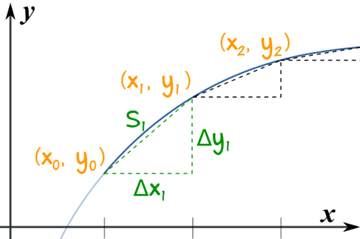
Arc length is the distance along a curve between two points. Picture a paperclip: if you mark two points, bend it, then straighten it out and measure with a ruler, you get the arc length. Calculus does the same thing by adding up many tiny straight pieces.
Where the Formula Comes From (Cartesian)
Each small piece of the curve is the hypotenuse of a right triangle with legs and . By the Pythagorean Theorem, , so each tiny length satisfies:
Factoring out gives the familiar single-variable arc length formula:
This version works for curves written as . Parametric curves need a slightly adjusted version, since both and depend on .
Arc Length of Parametric Curves
Connecting Parametric and Cartesian Forms
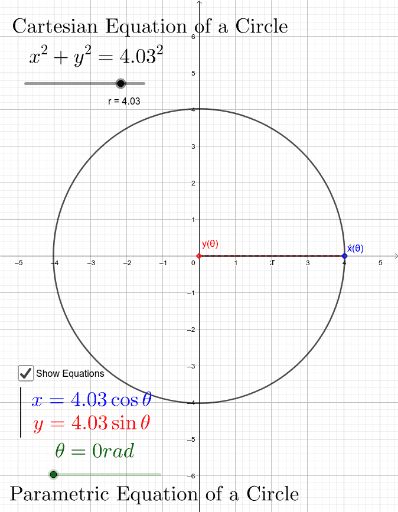
Before adapting the formula, it helps to see how parametric and Cartesian forms describe the same curve. A circle of radius can be written parametrically as and .
Building the Parametric Formula
Start from . When the curve is parametric, both and change with , so replace with and with :
Adding these up over the parameter interval gives the parametric arc length formula:
It looks like the Cartesian version, but now you account for how both and change as moves.
Worked Examples
Example 1
Find the arc length over for the parametric curve and .
Start by finding both derivatives:
Substitute into the formula with and :
Since , the integrand simplifies to :
The arc length is . That makes sense: this is half of a unit circle, which has circumference .
Example 2
Find the arc length over for the parametric curve and .
Take the derivatives:
Substitute with and :
Since on this interval, :
The arc length is .
How to Use This on the AP Calculus Exam
Problem Solving
- Read off and , then compute and before anything else.
- Square each derivative, add them, and place the sum under the radical.
- Confirm your bounds are -values from the parameter interval.
- Check whether a trig identity collapses the integrand. Many AP problems are designed so appears.
Free Response
- If the integral is messy, write the correct setup first. A correct unevaluated integral shows you chose the right procedure.
- On calculator-active questions, evaluate numerically and round as the problem directs.
- When the curve represents motion, state that this integral equals the total distance the particle travels, since the integrand is the speed.
Common Trap
- Pulling a constant out of the square root incorrectly, or forgetting to square the derivatives, are frequent errors. Keep each step written out.
Common Misconceptions
- Misconception: Using or bounds instead of bounds.Actually: The limits of integration are values of the parameter . Do not substitute endpoints in terms of or .
- Misconception: Adding the derivatives before squaring.Actually: You need , not . Square first, then add.
- Misconception: Dropping a derivative when one is zero.Actually: If , you still keep under the radical. A zero term just means that coordinate is not changing at that moment.
- Misconception: Forgetting that .Actually: On an interval where could be negative, the absolute value matters. Check the sign of before simplifying.
- Misconception: Confusing arc length with displacement.Actually: Arc length (and total distance traveled) uses speed under the radical and is always nonnegative. Displacement is a separate net-change idea.
Related AP Calculus Guides
- 9.1 Defining and Differentiating Parametric Equations
- 9.4 Defining and Differentiating Vector-Valued Functions
- Unit 9 Overview: Parametric Equations, Polar Coordinates, and Vector-Valued Functions
- 9.2 Second Derivatives of Parametric Equations
- 9.7 Defining Polar Coordinates and Differentiating in Polar Form
- 9.8 Find the Area of a Polar Region or the Area Bounded by a Single Polar Curve
Practice Questions for 9.3
1 of 10
A particle moves along a parametric curve in the -plane. The graph above shows the particle's speed, , for .
What is the total length of the particle's path from to ?
A.
B.
C.
D.
Vocabulary
The following words are mentioned explicitly in the AP® course framework for this topic.Term | Definition |
|---|---|
arc length | The distance along a curve between two points, calculated using a definite integral. |
definite integral | The integral of a function over a specific interval [a, b], representing the net signed area between the curve and the x-axis. |
parametric function | Functions where x and y coordinates are each expressed as separate functions of a third variable, typically time (t), rather than y as a function of x. |
Frequently Asked Questions
How do I find the arc length of a parametric curve?
For parametric equations x(t) and y(t) on a <= t <= b, use S = integral from a to b of sqrt((dx/dt)^2 + (dy/dt)^2) dt. Find both derivatives, square them, add them under the radical, and evaluate the definite integral.
What is the parametric arc length formula for AP Calculus BC?
The formula is S = integral from a to b of sqrt((dx/dt)^2 + (dy/dt)^2) dt. The bounds a and b are parameter values, not x-values or y-values.
Why does the parametric arc length formula use dx/dt and dy/dt?
Both x and y change as t changes, so the small distance traveled depends on horizontal and vertical rates together. The expression sqrt((dx/dt)^2 + (dy/dt)^2) is the particle's speed.
Are the bounds for parametric arc length t-values?
Yes. The limits of integration are values of the parameter t from the interval given in the problem. Do not switch them to x- or y-values unless the problem specifically changes the setup.
Is parametric arc length a BC-only AP Calculus topic?
Yes. Finding arc lengths of curves given by parametric equations is listed as a BC-only topic in AP Calculus Unit 9.
What mistakes should I avoid on AP Calculus BC arc length problems?
Do not add derivatives before squaring, do not use x- or y-bounds in place of t-bounds, and do not simplify square roots like sqrt(4t^2) without checking whether an absolute value is needed.
See Fiveable more often in Google
Mark Fiveable as a preferred source and Google is more likely to show you our guides in Top Stories, with a "preferred" badge in AI Mode and AI Overviews.