7.3 Sketching Slope Fields

♾️AP Calculus AB/BC Unit 7 Review
7.3 Sketching Slope Fields
♾️ AP Calculus AB/BC
7.1
Modeling Situations with Differential Equations
7.2
Verifying Solutions for Differential Equations
7.3
Sketching Slope Fields
7.4
Reasoning Using Slope Fields
7.5
Approximating Solutions Using Euler’s Method
7.6
Finding General Solutions Using Separation of Variables
7.7
Finding Particular Solutions Using Initial Conditions and Separation of Variables
7.8
Exponential Models with Differential Equations
7.9
Logistic Models with Differential Equations
A slope field is a picture of a differential equation. Instead of solving for an exact function, you draw short line segments at a grid of points, where each segment's slope equals the value of at that point. For AP Calculus, plug each grid point into the differential equation before sketching the segment slope.
Why This Matters for the AP Calculus Exam
Slope fields show up in both AB and BC because they connect a differential equation to the behavior of its solutions without doing any integration. On the exam you may need to sketch part of a slope field, match a slope field to its differential equation, or read a slope field to describe how solutions behave. This builds the same representation-switching skill that runs through all of Unit 7: turning a symbolic equation into a graph and back again. Getting comfortable here sets you up for reasoning about solution curves in 7.4 and for Euler's method (BC) in 7.5.
Key Takeaways
- A slope field shows the slope of a solution curve at a finite set of points, found by plugging each into .
- Each line segment is short and centered on its grid point; only the slope matters, not the length.
- Where is undefined (like dividing by zero), you leave that point blank.
- The same value gives the same segment slope, so points can repeat slopes across the grid.
- A slope field represents a whole family of solutions, since there may be infinitely many solutions to a differential equation that differ by a constant.
Sketching a Slope Field Step by Step
A slope field draws short line segments at chosen points. The slope of each segment is the value of at that point. You do not solve the equation; you just evaluate it.
Example 1
Consider this differential equation:
The slope at point is just . Build a table for several coordinates:
Draw a short segment through each point with the matching slope. A segment with is flat, and steeper slopes tilt more sharply. The result approximates how solution curves move through the plane.
Example 2
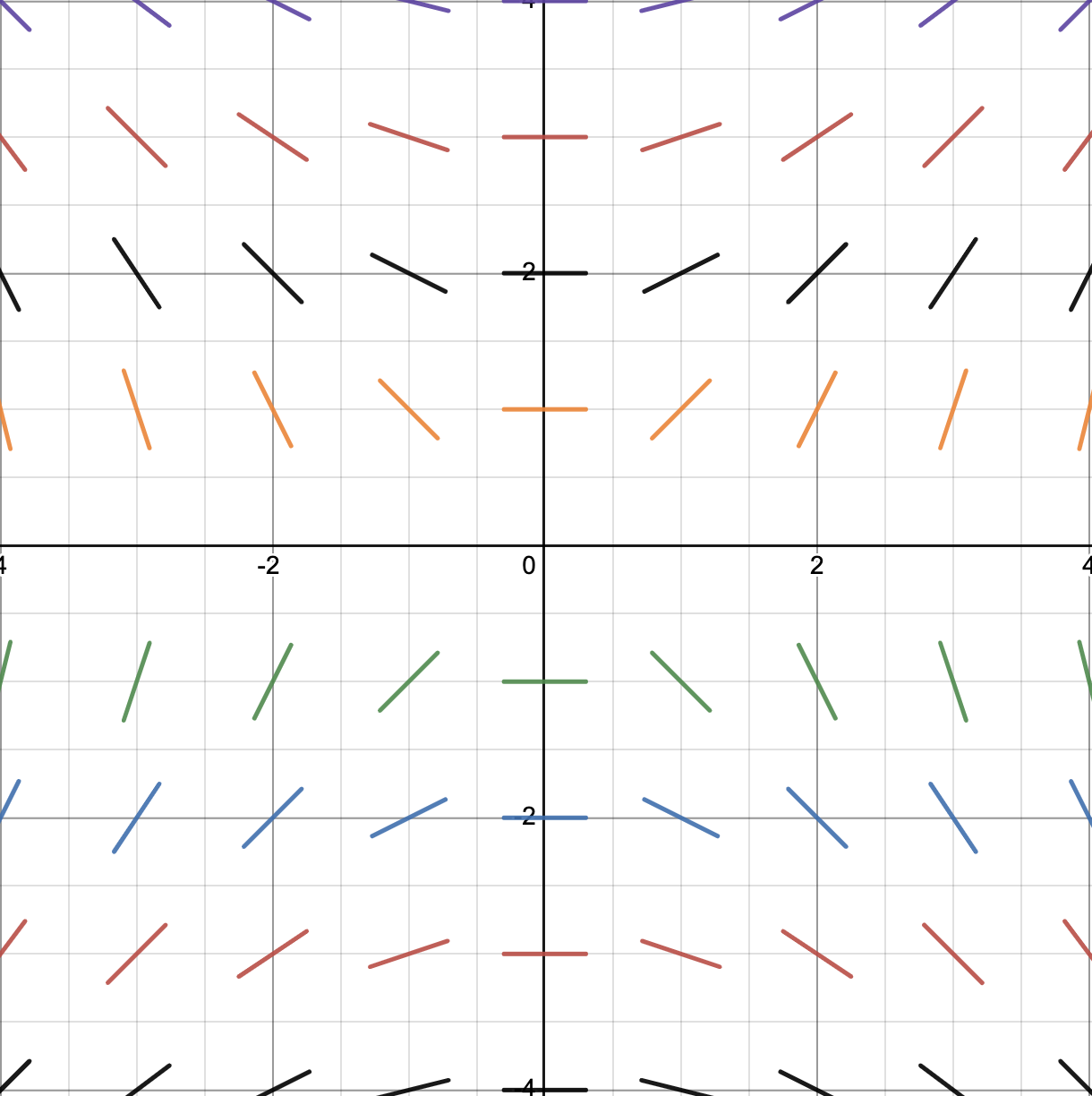
Now consider:
The slope at point is . Build the table:
| undefined | ||||
| undefined | ||||
| undefined | ||||
| undefined |
Notice the entire row is undefined because you cannot divide by zero. Leave those grid points blank. Draw the rest as short segments with the matching slopes.
How to Use This on the AP Calculus Exam
MCQ
- Match a slope field to its differential equation by testing a few easy points. Pick a point where the slope is obvious (like or ) and check which equation produces that segment.
- Watch for points where the slope is (horizontal segments) or undefined (no segment). These give you fast clues for elimination.
- For autonomous equations like , the segment slope depends only on , so each horizontal row looks the same. Use that pattern to match.
Free Response
- If asked to sketch on a given grid, draw short segments only at the points shown. Keep them centered on the dots and make the slope clear and consistent.
- Plug each point into carefully and keep your slopes neat. Clear, consistent segments are important for clear exam work.
- A slope field question often leads into following a solution curve or finding a particular solution later, so set up the field accurately.
Common Trap
- Do not try to solve the differential equation first. Just evaluate at each point.
- The length of a segment carries no meaning. Only the slope (the tilt) matters.
Common Misconceptions
- Misconception: A slope field is the graph of a single solution.Actually: A slope field is not the graph of a single solution. It represents a whole family of solution curves that differ by a constant.
- Misconception: An undefined slope means slope zero.Actually: An undefined slope does not mean slope zero. If is undefined at a point, you leave that point blank, not flat.
- Misconception: Different points cannot share the same slope.Actually: Equal slope values are normal. Different points can share the same slope, so seeing repeated segments is expected, not an error.
- Misconception: You need an initial condition to draw a slope field.Actually: You do not need an initial condition to draw a slope field. A point or initial condition only picks out one particular curve to follow through the field.
- Misconception: Segment length is part of the information.Actually: Segment length is not part of the information. Two segments with the same slope mean the same thing even if you draw them slightly different sizes. To be continued in 7.4 Reasoning Using Slope Fields.
Related AP Calculus Guides
- Unit 7 Overview: Differential Equations
- 7.2 Verifying Solutions for Differential Equations
- 7.6 Finding General Solutions Using Separation of Variables
- 7.5 Approximating Solutions Using Euler’s Method
- 7.7 Finding Particular Solutions Using Initial Conditions and Separation of Variables
- 7.4 Reasoning Using Slope Fields
Practice Questions for 7.3
1 of 10
Shown above is a slope field for a differential equation.
Let be the particular solution with . A student estimates using the tangent line at . Based on the slope field, which of the following statements about this estimate is correct?
A.
The estimate is an underestimate because the slopes of the line segments increase along the solution curve passing through .
B.
The estimate is an overestimate because the slopes of the line segments decrease along the solution curve passing through .
C.
The estimate is an overestimate because the slopes of the line segments increase along the solution curve passing through .
D.
The estimate is an underestimate because the slopes of the line segments decrease along the solution curve passing through .
Vocabulary
The following words are mentioned explicitly in the AP® course framework for this topic.Term | Definition |
|---|---|
differential equation | An equation that relates a function to its derivatives, describing how a quantity changes in relation to one or more variables. |
first-order differential equations | Differential equations that involve only the first derivative of a function. |
slope field | A graphical representation of a differential equation showing the slope of solution curves at a finite set of points in the plane. |
solutions to differential equations | Functions that satisfy a given differential equation when substituted into it. |
Frequently Asked Questions
What is a slope field in AP Calculus?
A slope field is a graphical representation of a differential equation on a finite set of points. Each short segment shows the value of dy/dx at that point.
How do I sketch a slope field?
Choose points in the plane, plug each point into the differential equation, and draw a small line segment with that slope. Points with the same slope should have matching segment directions.
What does a slope field tell me about solutions?
A slope field shows the behavior of solution curves to a first-order differential equation. A solution curve follows the local direction of the small slope segments.
How do I sketch a solution curve on a slope field?
Start at the given initial condition and draw a smooth curve that follows the direction of nearby segments without jumping across the field.
What is the most common slope field mistake?
Students often calculate slopes correctly but draw segments with inconsistent steepness or direction. Keep positive, negative, zero, and undefined-looking slopes visually distinct.
How do slope fields show up on AP Calculus FRQs?
You may be asked to sketch a slope field, draw a solution through an initial condition, or estimate qualitative behavior of solutions from the field.
See Fiveable more often in Google
Mark Fiveable as a preferred source and Google is more likely to show you our guides in Top Stories, with a "preferred" badge in AI Mode and AI Overviews.