2.4 Connecting Differentiability and Continuity: Determining When Derivatives Do and Do Not Exist

♾️AP Calculus AB/BC Unit 2 Review
2.4 Connecting Differentiability and Continuity: Determining When Derivatives Do and Do Not Exist
♾️ AP Calculus AB/BC
2.1
Defining Average and Instantaneous Rates of Change at a Point
2.2
Defining the Derivative of a Function and Using Derivative Notation
2.3
Estimating Derivatives of a Function at a Point
2.4
Connecting Differentiability and Continuity: Determining When Derivatives Do and Do Not Exist
2.5
Applying the Power Rule
2.6
Derivative Rules: Constant, Sum, Difference, and Constant Multiple
2.7
Derivatives of cos x, sinx, e^x, and ln x
2.8
The Product Rule
2.9
The Quotient Rule
2.10
Finding the Derivatives of Tangent, Cotangent, Secant, and/or Cosecant Functions
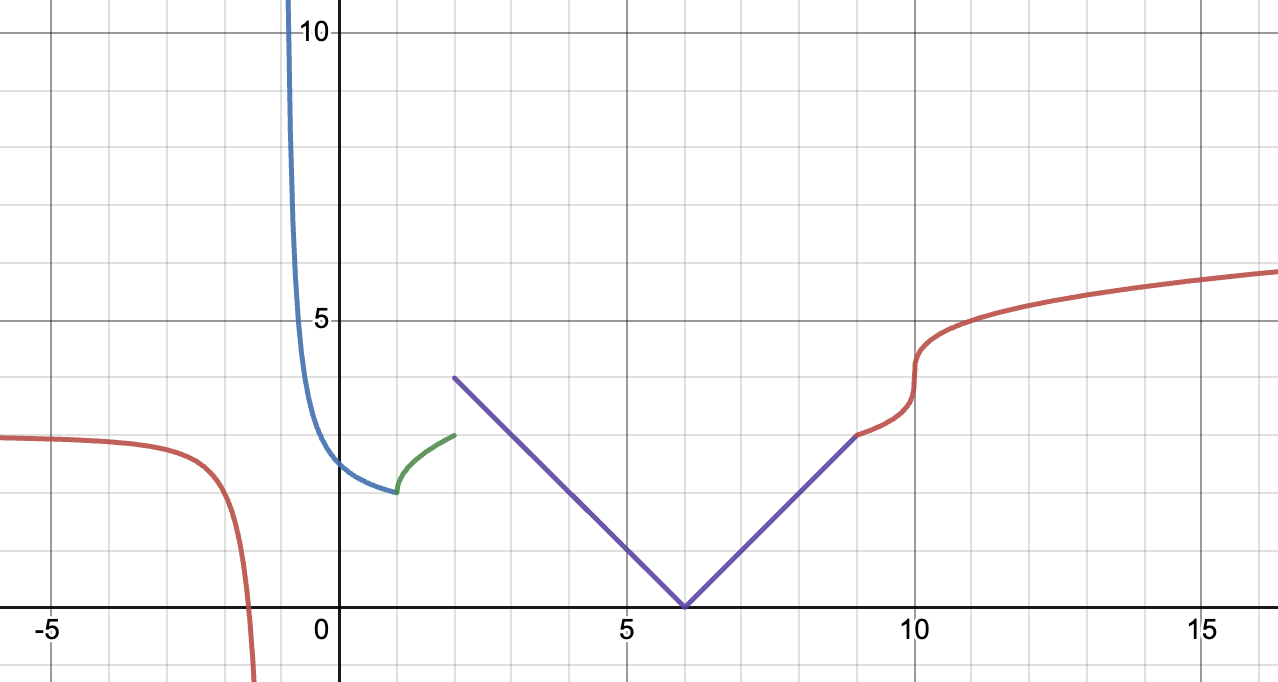
If a function is differentiable at a point, it must be continuous there, but a continuous function is not always differentiable. Derivatives fail to exist at corners, cusps, vertical tangents, and any discontinuity. For AP Calculus, justify non-differentiability with a specific reason instead of only naming the point.
Why This Matters for the AP Calculus Exam
This topic connects continuity from Unit 1 to the idea of the derivative, and it shows up in both multiple-choice and free-response work. You will be asked to explain why a derivative does or does not exist, read graphs of functions to spot non-differentiable points, and test piecewise functions algebraically at a join. The skill of presenting a clear difference quotient or one-sided derivative structure is important for clear exam work, since a correct conclusion without supporting reasoning often will not support a stronger score. Getting comfortable with this now also sets up graph analysis in Unit 5, where you move between a function, its first derivative, and its second derivative.
Key Takeaways
- Differentiable at a point means continuous at that point. The reverse is not guaranteed.
- If a point is not in the domain of , it cannot be in the domain of .
- A derivative exists at a point only when the one-sided limits of the difference quotient agree.
- Common ways differentiability fails: corners, cusps, vertical tangents, and discontinuities (jump, removable, or infinite).
- For piecewise functions, check continuity at the join first, then check that the left and right derivatives match.
- The absolute value function at and the cube root function at are the classic examples of continuous but non-differentiable points.
Continuity and Differentiability
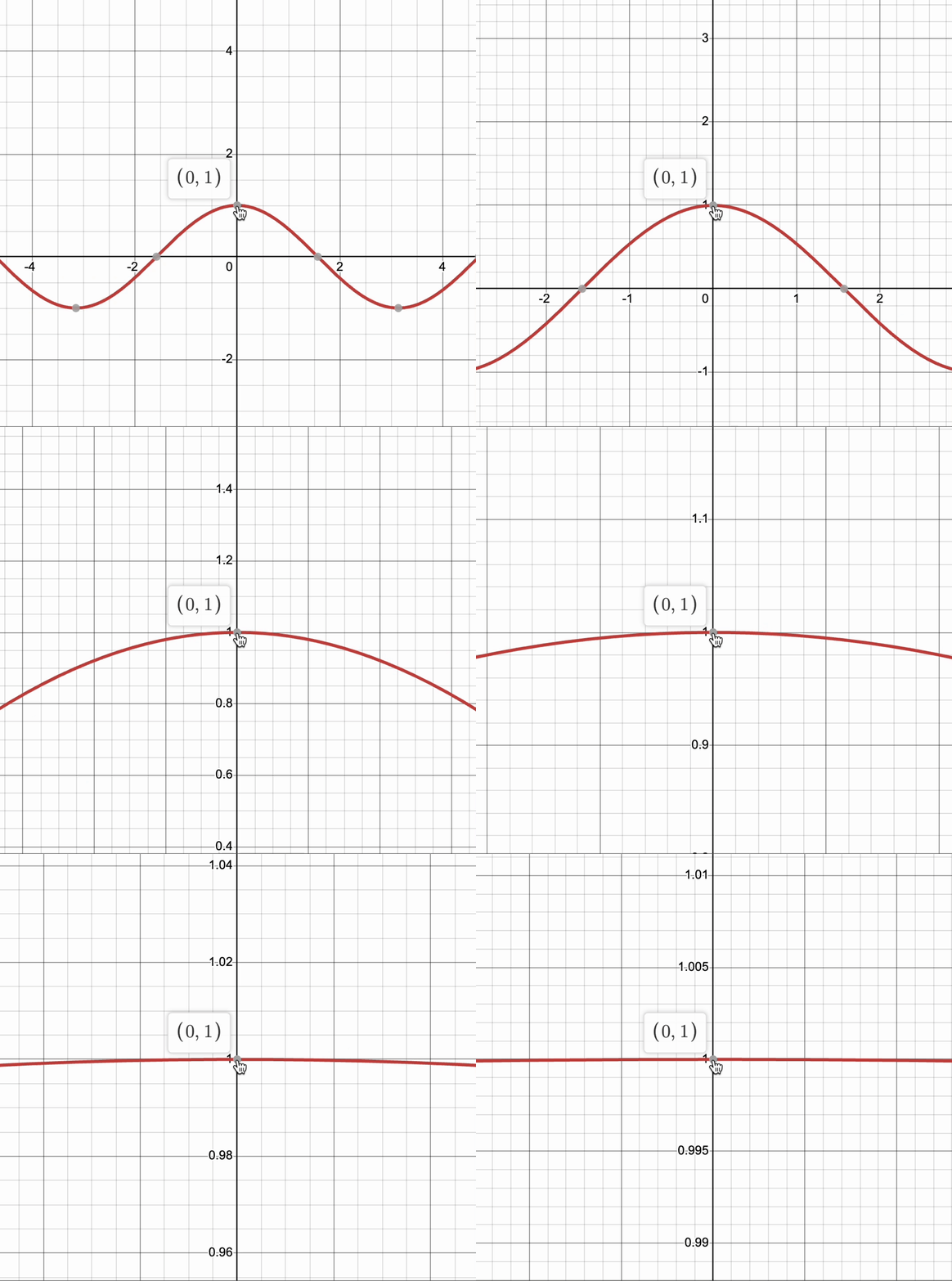
Most curves you meet in AP Calculus are both continuous and differentiable, but some points break one or both conditions. If you need a refresher on continuity, check this guide: Confirming Continuity over an Interval.
For a function to be differentiable at a point, it must have a derivative there. Visually, if you zoom in close enough, the graph looks like a straight line. That line does not have to be horizontal.
Look at the graph of . As you zoom into the point , the curve starts to look like a line.
Zooming into graph ofFor a function to be differentiable at a point , the slope of the tangent line must approach the same value from the left and the right:
Here is the key relationship: if a function is differentiable at a point, then it is continuous there. The reverse does not hold. A function can be continuous at a point and still fail to be differentiable. A function is not differentiable at a point if it is discontinuous, has a sharp change in slope (a corner or cusp), or has a vertical tangent.
A useful consequence: if a point is not in the domain of , then it is not in the domain of . You cannot have a derivative where the function itself does not exist.
Discontinuous Graphs
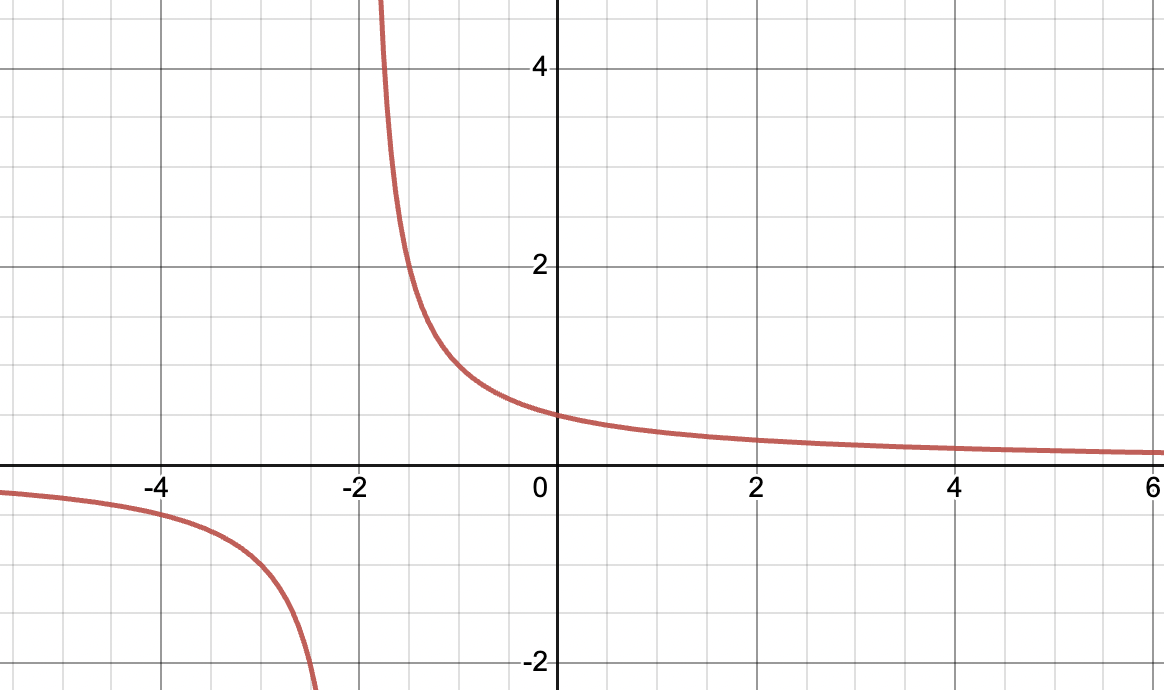
Unequal One-Sided Slopes
At most discontinuities, the slopes approaching from each side do not match.
For example, has a domain of because the denominator cannot be zero.
Graph ofSince this function is not continuous at (it is not even defined there), it cannot be differentiable at .
Jump Discontinuity
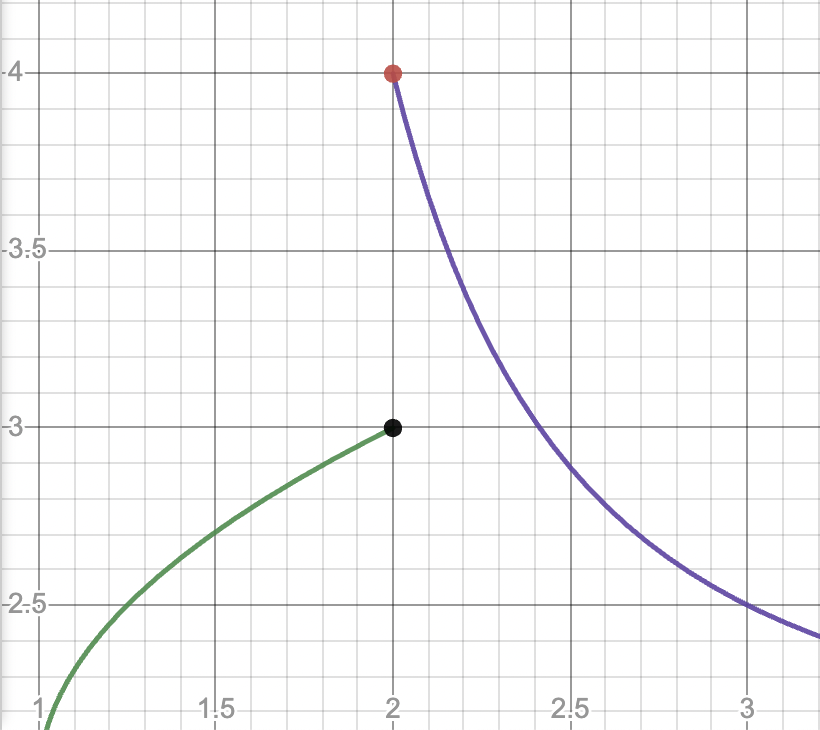
The same reasoning applies to a jump discontinuity. The function value jumps from one level to another, so it is not continuous at that point and therefore not differentiable there.
Graph of a jump discontinuityRemovable Discontinuity
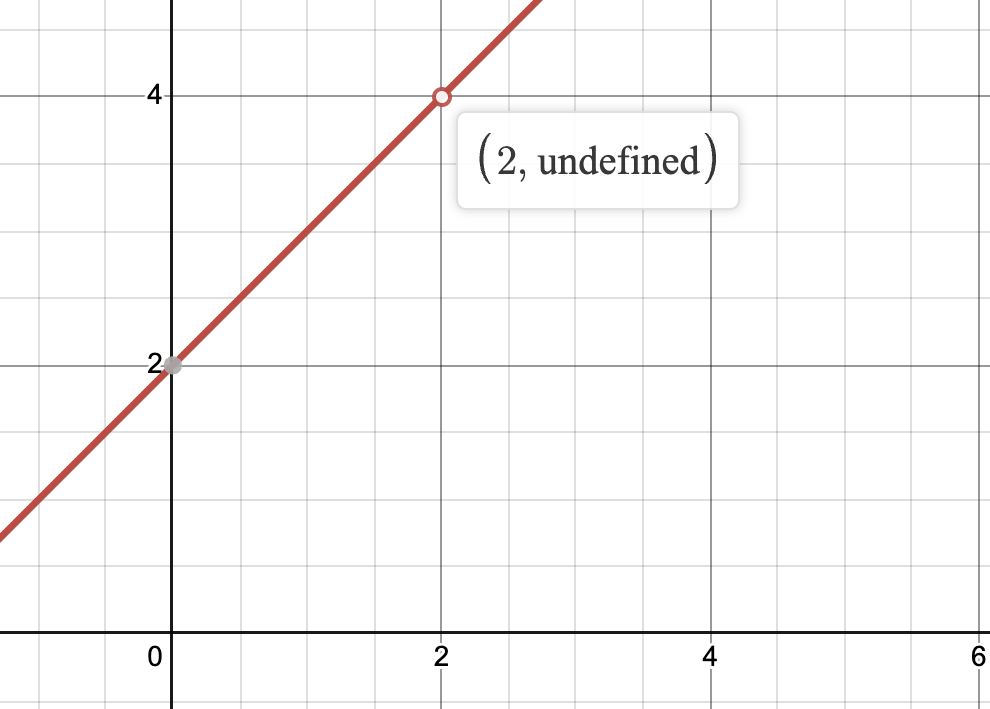
Removable discontinuities need a closer look. Consider . This simplifies to everywhere except , where there is a hole.
Graph of a removable discontinuityThe derivative equals at every point except . At the function is not defined, so the derivative does not exist there. Even though the slopes from both sides agree, the point is missing from the domain, so is not differentiable at .
The takeaway: any kind of discontinuity at a point rules out differentiability at that point.
Vertical Tangents
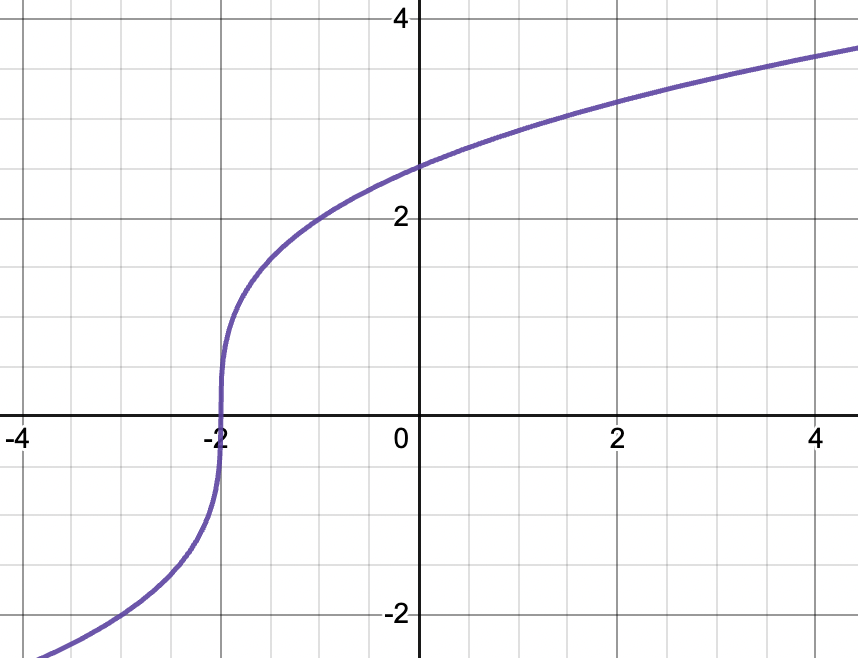
Look at the graph of .
Graph with a vertical tangentWhat is the derivative at ? Think about the slope of the tangent line there. As you approach the point, the slope grows without bound toward , because the change in stays nonzero while the change in shrinks toward . A vertical line has no defined slope, so the derivative at does not exist, and the curve is not differentiable there.
This matches the classic example at , where the tangent line is vertical.
Corners and Cusps
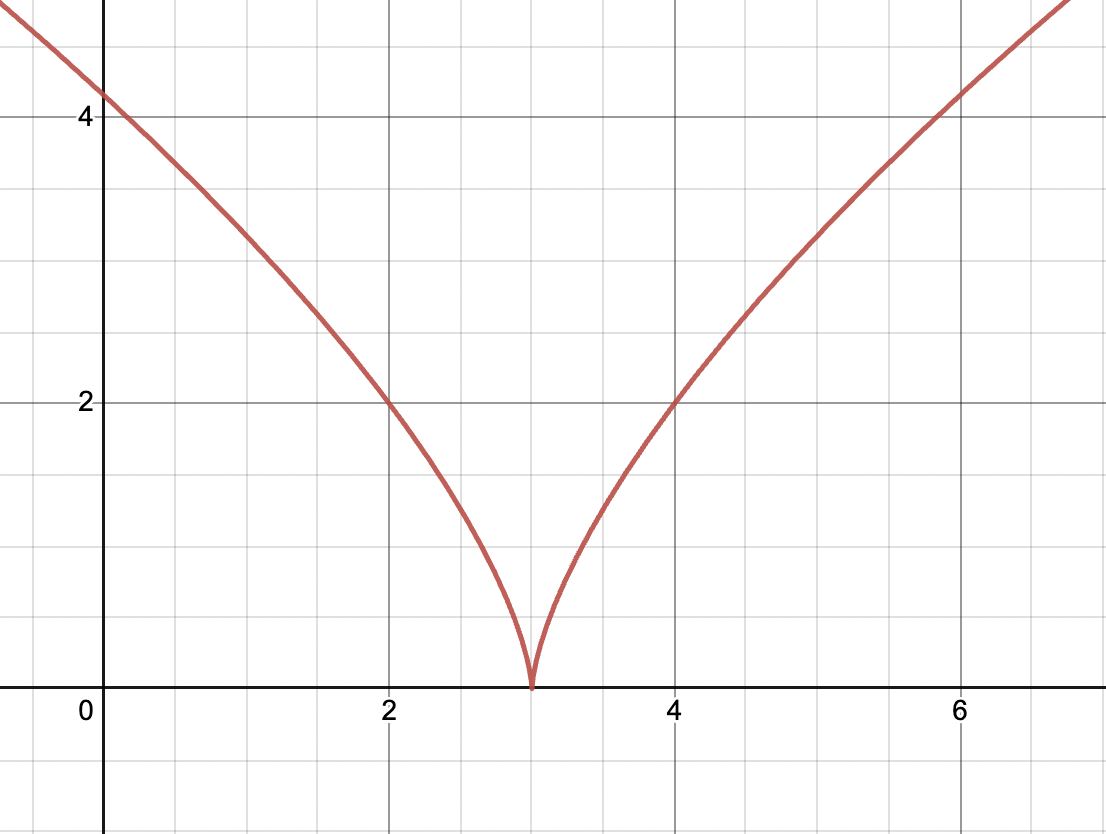
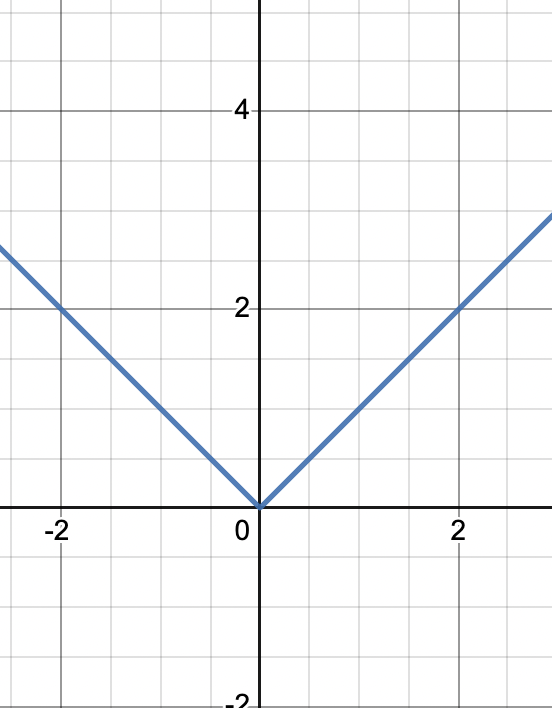
A function is not differentiable at a corner or a cusp because the slope does not approach the same value from both sides. Sometimes a cusp also involves a vertical tangent.
Look at the graph of . This function has a corner at . Approaching from the left, the slope is ; approaching from the right, the slope is . Since the one-sided slopes do not match, is not differentiable at , even though it is continuous there.
Graph of with a corner at the originThis is one of the two classic examples worth memorizing: at (a corner) and at (a vertical tangent).
How to Use This on the AP Calculus Exam
MCQ
Many multiple-choice questions hand you a graph and ask where a function is not differentiable. Scan for:
- Breaks in the curve (jump, removable, or infinite discontinuities)
- Sharp corners where the slope flips suddenly
- Cusps where the curve comes to a point
- Vertical tangents where the slope blows up
Each of these spots fails differentiability, even if the function looks connected.
Free Response
When a free-response part gives a piecewise function and asks whether it is differentiable at the join, use a clear two-step structure:
- Check continuity at the join by matching the two pieces' values.
- Check that the left-hand derivative and right-hand derivative are equal.
Showing this structure clearly is important for full credit. A correct yes or no with no supporting work usually will not earn the point.
Problem Solving
Try this example. The function is
Given that is continuous at , is it differentiable there?
Check the left-hand derivative. Differentiate the piece for :
So .
Check the right-hand derivative. Differentiate the piece for :
So .
Compare. Both one-sided derivatives equal , and the function is already continuous at , so
The function is differentiable at . The graph is smooth at that point, which confirms the result.
Common Trap
Continuity does not prove differentiability. A piecewise function can match perfectly at the join (so it is continuous) but still have a corner there if the slopes do not match. Always check both conditions.
Common Misconceptions
- Misconception: Continuous means differentiable.Actually: Not true. is continuous everywhere but not differentiable at .
- Misconception: If the slopes match, the function must be differentiable.Actually: Only if the function is also continuous and the point is in its domain. A removable discontinuity can have matching one-sided slopes yet still fail because the point is missing.
- Misconception: A vertical tangent means the derivative is a huge number.Actually: A vertical tangent means the derivative does not exist, because a vertical line has no defined slope.
- Misconception: The derivative can exist wherever I want it to.Actually: If a point is not in the domain of , it cannot be in the domain of .
- Misconception: Corners are differentiable as long as the graph is connected.Actually: A corner has different left and right slopes, so the derivative does not exist there even though the graph is continuous.
- Misconception: Removable discontinuities are fine for derivatives.Actually: The function is not defined at that hole, so it is not differentiable there.
Related AP Calculus Guides
- Unit 2 Overview: Differentiation
- 2.1 Defining Average and Instantaneous Rates of Change at a Point
- 2.10 Finding the Derivatives of Tangent, Cotangent, Secant, and/or Cosecant Functions
- 2.2 Defining the Derivative of a Function and Using Derivative Notation
- 2.3 Estimating Derivatives of a Function at a Point
- 2.7 Derivatives of cos x, sinx, e^x, and ln x
Practice Questions for 2.4
1 of 10
Let for . The Fundamental Theorem of Calculus guarantees that on provided that is continuous on . If , which of the following confirms whether the hypotheses are satisfied?
A.
The hypotheses are not satisfied because is not continuous at , as the left and right derivatives are unequal.
B.
The hypotheses are not satisfied because has a sharp corner at , making it non-differentiable on .
C.
The hypotheses are satisfied because is differentiable on , which guarantees continuity on the interval.
D.
The hypotheses are satisfied because is continuous on , even though it is not differentiable at .
Vocabulary
The following words are mentioned explicitly in the AP® course framework for this topic.Term | Definition |
|---|---|
continuity | A property of a function at a point where the function is defined, the limit exists, and the limit equals the function value at that point. |
derivative | The instantaneous rate of change of a function at a specific point, representing the slope of the tangent line to the function at that point. |
difference quotient | The expression [f(x+h) - f(x)]/h used to calculate the average rate of change and find the derivative as a limit. |
differentiability | A property of a function at a point where the derivative exists; a function is differentiable at a point if the limit of the difference quotient exists at that point. |
domain | The set of all input values (x-values) for which a function is defined. |
left hand limit | The value that a function approaches as the input approaches a point from values less than that point. |
right hand limit | The value that a function approaches as the input approaches a point from values greater than that point. |
slope | The steepness or rate of change of a line, calculated as the change in y-values divided by the change in x-values. |
tangent line | A line that touches a curve at a single point and has a slope equal to the derivative of the function at that point. |
Frequently Asked Questions
What is the relationship between differentiability and continuity?
If a function is differentiable at a point, it must be continuous there. A continuous function, however, may still fail to be differentiable.
When does a derivative not exist?
A derivative does not exist at discontinuities, corners, cusps, vertical tangents, or points where one-sided derivative limits do not agree.
Can a function be continuous but not differentiable?
Yes. A function can be continuous but not differentiable at a corner, cusp, or vertical tangent, such as |x| at x = 0.
How do you check differentiability of a piecewise function?
First check continuity at the join. Then compare the left-hand derivative and right-hand derivative. Both conditions must work.
Why does a vertical tangent make the derivative fail?
A vertical tangent has no finite slope, so the derivative does not exist at that point.
Does a removable discontinuity have a derivative?
No. If the function is not defined at the point, it is not differentiable there, even if nearby slopes appear to match.
See Fiveable more often in Google
Mark Fiveable as a preferred source and Google is more likely to show you our guides in Top Stories, with a "preferred" badge in AI Mode and AI Overviews.