9.9 Finding the Area of the Region Bounded by Two Polar Curves

Welcome to the last topic of the 9th unit! In this key topic, we’ll be learning more about polar functions and how to find the area between two polar curves and how it’s different from finding the area between two normal curves plotted on the x-y plane. 📈
For a review of how to find the area of a polar region with one curve, see topic 9.8!
🚧 This is an AP Calculus BC topic only! If you are taking Calculus AB, you can skip this material. If you’re taking AP Calculus BC, here you go! ⬇️

⭕ Equation for Area of One vs. Two Curves
The equation for area for one curve, as mentioned in 9.8, was the following:
Where and represent your polar interval and represents the radius of the curve which will be given.
How will you edit this formula to account for two curves 🤔? Just include the difference of the radii! Here is the updated formula:
In this case, is the outside radius and is the inside radius. Your boundaries will be where .
📝 Area Between 2 Polar Curves Example Walkthrough
Here’s the question! Let be the region bounded between and in the second quadrant. Find the area between the two functions pictured in the graph below.

1️⃣ Define your and functions!
This is very important as you want to determine which function is the inside function and the outside function to simplify your calculations as much as possible! 😊
For a hint on how to determine the outside and inside function, picture yourself at the origin. What function do you see first from the origin? That’s your inside function! What function do you see past that first function? That’s your outside function!
Since we are trying to find the area in the second quadrant, from the origin, the circle is seen first and is the inner ⬅️ function. The other function is therefore the outer ➡️ function!
2️⃣ Determine the bounds for the area.
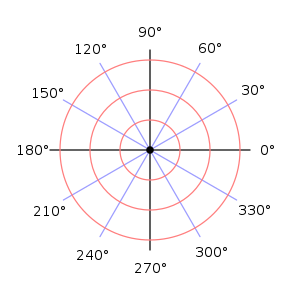
Remember the polar coordinate system? Here it is below for your reference.

Basically, the distance from the origin is your radius and the angle from the positive x-axis is your θ value.
💡 Note: Make sure to use radian values for the angle and not degree values!
On the original graph, we can see that the region can be one of two sections.
First we have to determine what section of the graph we have to focus on. The question says second quadrant, therefore your bounds will be from to !
For a more systematic way to determine bounds, set the two equations equal to each other and determine your angles.
Again, since the problem mentions the second quadrant, you only need to choose the bounds of the second quadrant and again we get to !
3️⃣ Set up your integral and evaluate!
Now that you have your bounds and your functions, all that’s left is to plug in values to your formula and evaluate!
For this part, if it is a tough integral, you will usually just have to set up the integral on a non-calculator question or evaluate the integral in your calculator for the calculator section 🔢!
📕 Closing Thoughts
For a non-calculator question, you will most likely be exposed to simple integrals that involve some theorems, such as double angle theorem, etc.! Keep practicing those and you’ll be a total pro at the polar coordinate system ⭕!
So hey, you’ve made it to the end of this unit and you only have one more unit to go! Woohoo! 🥳 Keep working hard and staying amazing! 😊
Vocabulary
The following words are mentioned explicitly in the College Board Course and Exam Description for this topic.
| Term | Definition |
|---|---|
| areas of regions | The measure of the two-dimensional space enclosed by one or more curves. |
| definite integral | The integral of a function over a specific interval [a, b], representing the net signed area between the curve and the x-axis. |
| polar curve | Curves defined by equations in polar coordinates, where points are located by a distance r from the origin and an angle θ from the positive x-axis. |
Frequently Asked Questions
How do I find the area between two polar curves?
Use the polar area formula: area of a region traced by r = f(θ) from θ = a to b is (1/2)∫_a^b [r(θ)]^2 dθ. To get the area between two polar curves r_outer(θ) and r_inner(θ), first find the θ-values where they intersect (solve r1(θ)=r2(θ)) and choose intervals where one is consistently outer. Then compute Area = (1/2) ∫_{θ=a}^{θ=b} [r_outer(θ)^2 − r_inner(θ)^2] dθ. Steps: (1) Sketch or use symmetry to reduce work (many roses/cardioids have symmetry). (2) Solve for intersection θ’s (sometimes convert r cosθ, r sinθ to x,y if messy). (3) Determine which r is outer on each subinterval (check a sample θ). (4) Integrate and add any pieces. Watch sign and orientation—θ-limits must cover exactly the region once. This is exactly what AP Topic 9.9 (CHA-5.D) tests; practice these on the Topic 9.9 study guide (https://library.fiveable.me/ap-calculus/unit-9/finding-area-region-bounded-by-two-polar-curves/study-guide/0yrxLHNF6HhWcnmeBWVO) and try problems from the Unit 9 page (https://library.fiveable.me/ap-calculus/unit-9).
What's the formula for area bounded by polar curves?
For a polar curve r = f(θ), the area of a region traced from θ = a to θ = b is A = 1/2 ∫[a to b] (r(θ))^2 dθ. When two polar curves r = r1(θ) and r = r2(θ) bound a region (one is outer, one is inner on the θ-interval), the area between them is A = 1/2 ∫[α to β] (r_outer(θ)^2 − r_inner(θ)^2) dθ, where α and β are the θ-values of intersection (solve r1(θ)=r2(θ)) and r_outer ≥ r_inner on [α,β]. Tips for AP-Calc BC (CED CHA-5.D): - Express both curves as r = f(θ); find intersection θ by solving r1 = r2 (convert to x,y only if needed). - Choose limits so each curve doesn’t “cross” unpredictably; use symmetry when possible. - Watch sign/tracing: r can be negative for some θ, so sketch or test points to pick outer vs inner. Study this Topic 9.9 guide for examples and practice (https://library.fiveable.me/ap-calculus/unit-9/finding-area-region-bounded-by-two-polar-curves/study-guide/0yrxLHNF6HhWcnmeBWVO). For more review and 1000+ practice problems, see the Unit 9 page (https://library.fiveable.me/ap-calculus/unit-9) and the practice hub (https://library.fiveable.me/practice/ap-calculus).
When do I use 1/2 times integral of r squared vs just integral of r?
Always use the 1/2·∫ r^2 dθ formula when you’re computing area in polar coordinates. The area element for polar is dA = (1/2) r^2 dθ, so - Area of a region traced by a single polar curve r = f(θ) from θ = a to b: A = (1/2) ∫_a^b [f(θ)]^2 dθ. - Area between two polar curves r = r_outer(θ) and r = r_inner(θ): A = (1/2) ∫_a^b (r_outer(θ)^2 − r_inner(θ)^2) dθ, where a and b come from intersections (solve r1 = r2 or convert to Cartesian if needed). If you see just ∫ r dθ, that’s not the polar area formula—it’s used in other contexts (for example, certain line integrals or in derivations), but not for area. Always check which quantity the problem asks for and set your limits in θ from actual intersections or by using symmetry. For a focused review and examples aligned with the CED, see the Topic 9.9 study guide (https://library.fiveable.me/ap-calculus/unit-9/finding-area-region-bounded-by-two-polar-curves/study-guide/0yrxLHNF6HhWcnmeBWVO). For extra practice, try problems at https://library.fiveable.me/practice/ap-calculus.
I'm confused about polar area - why is there a 1/2 in the formula?
Think of a polar curve r = f(θ) as tracing lots of tiny circular sectors as θ changes. The area of a sector of radius r and angle Δθ is (1/2) r^2 Δθ (because full circle area πr^2 times fraction Δθ/(2π) gives (1/2)r^2Δθ). Let Δθ → 0 and sum (integrate) those sectors: area = ∫(1/2) r(θ)^2 dθ. That’s why the 1/2 is there—it comes from the sector-area formula. For the area between two polar curves, you subtract their sector areas: Area = (1/2) ∫(r_outer^2 − r_inner^2) dθ, using θ-limits where the curves enclose the region (find intersections, watch tracing). This is exactly the AP CED idea (CHA-5.D.2). For a quick refresher and examples, check the Topic 9.9 study guide (https://library.fiveable.me/ap-calculus/unit-9/finding-area-region-bounded-by-two-polar-curves/study-guide/0yrxLHNF6HhWcnmeBWVO). For lots of practice problems, use Fiveable’s practice bank (https://library.fiveable.me/practice/ap-calculus).
How do I know which curve is on the outside when finding polar area?
You find the “outside” curve by comparing r-values for the same θ over the interval that actually traces the region. Steps: (1) Find intersection θ-values by solving r1(θ)=r2(θ) (convert to x,y if that’s easier). Those intersections give your θ-limits or where you must split the integral. (2) On each subinterval between intersections, plug a sample θ into r1(θ) and r2(θ); the larger r is the outer curve, the smaller is the inner. (3) Set up area = (1/2)∫(r_outer^2 − r_inner^2) dθ on each subinterval and add. Watch for curves that loop or retrace (trace/orientation matters), so you may need multiple θ-intervals where roles switch. For surgery on common polar shapes (roses, cardioids, limaçons), symmetry can reduce work. See the AP Topic 9.9 study guide for examples and practice (https://library.fiveable.me/ap-calculus/unit-9/finding-area-region-bounded-by-two-polar-curves/study-guide/0yrxLHNF6HhWcnmeBWVO). For extra practice, check Fiveable’s unit resources (https://library.fiveable.me/practice/ap-calculus).
What's the difference between finding area inside one polar curve vs between two polar curves?
Short answer: finding area inside one polar curve uses A = 1/2 ∫ r(θ)^2 dθ over the θ-interval that traces the region; finding the area between two polar curves uses A = 1/2 ∫ [r_outer(θ)^2 − r_inner(θ)^2] dθ, where you must determine which r is outer for each θ and the correct θ-limits (usually intersection angles). How to do it on AP BC (Topic 9.9 / CHA-5.D): - Find intersections by solving r1(θ)=r2(θ) (convert to Cartesian only if that’s easier). Those θ values give candidate limits. - On each subinterval between intersections, decide which curve is outer by comparing r-values (or sketch/tracing behavior). Outer = larger r from the pole in that θ-direction. - Set up A = 1/2 ∫_{θ1}^{θ2} (r_outer^2 − r_inner^2) dθ. If symmetry applies (roses, cardioids, etc.), use it to reduce work. - Watch tracing/orientation: sometimes a polar curve retraces or goes negative, so pick θ-intervals that correctly trace the intended region. For worked examples and AP-style practice, see the Topic 9.9 study guide (https://library.fiveable.me/ap-calculus/unit-9/finding-area-region-bounded-by-two-polar-curves/study-guide/0yrxLHNF6HhWcnmeBWVO) and the Unit 9 overview (https://library.fiveable.me/ap-calculus/unit-9). For more practice questions, check Fiveable’s practice page (https://library.fiveable.me/practice/ap-calculus).
Can someone explain step by step how to set up the integral for polar area between curves?
Think of a small sector of angle dθ: its area ≈ 1/2 r^2 dθ. To get the area between two polar curves r = r1(θ) and r = r2(θ): 1. Draw/sketch both curves (or use symmetry). That helps see which curve is farther from the origin on each θ-interval. 2. Find intersection angles by solving r1(θ) = r2(θ). If solving is hard, convert to Cartesian x = r cosθ, y = r sinθ only to help find intersections. 3. Determine the θ-limits: use the intersection θ-values (and any symmetry to shorten work). The region’s full θ-interval may be one or multiple pieces. 4. On each interval pick r_outer(θ) = the larger r and r_inner(θ) = the smaller r. The area formula: A = (1/2) ∫_{θ=a}^{b} [r_outer(θ)^2 − r_inner(θ)^2] dθ. 5. Evaluate each integral; if the region splits across intervals where outer/inner swap, break the integral at those θ-values. Remember this is a BC-only Topic (CED CHA-5.D). For examples and guided problems see the Topic 9.9 study guide (https://library.fiveable.me/ap-calculus/unit-9/finding-area-region-bounded-by-two-polar-curves/study-guide/0yrxLHNF6HhWcnmeBWVO) and practice problems (https://library.fiveable.me/practice/ap-calculus).
How do I find the intersection points of two polar equations?
Solve r1(θ) = r2(θ) for θ, but watch the quirks of polar form. Steps: - Set f(θ) = g(θ) and solve for θ on the domain you care about (often 0 ≤ θ < 2π). Those θ give intersections where the same ray from the origin has equal r. - Check r = 0 separately: if one curve has r = 0 at θ0, that point is the origin and may be an intersection even if the other curve’s r ≠ 0 for the same θ (because r = 0 maps to the origin for any θ). - Remember that polar coordinates aren’t unique: r can be negative. If r1(θ1) = −r2(θ2) and θ1 = θ2 ± π, the two points can coincide. So also check solutions where f(θ) = −g(θ + π). - Convert to Cartesian (x = r cosθ, y = r sinθ) when algebra is messy—solve the resulting system x^2 + y^2 and angle relations to catch hidden intersections. - Finally, verify each candidate θ by plugging back into both equations and consider the correct θ-interval when setting integration limits for area: pick consecutive intersection θ-values that trace the region. For worked examples and AP-aligned guidance on setting θ-limits and area integrals 1/2∫(r_outer^2 − r_inner^2) dθ, see the Topic 9.9 study guide (https://library.fiveable.me/ap-calculus/unit-9/finding-area-region-bounded-by-two-polar-curves/study-guide/0yrxLHNF6HhWcnmeBWVO). For extra practice, try problems at (https://library.fiveable.me/practice/ap-calculus).
Why do I need to split the integral into different parts for some polar area problems?
You split the integral whenever the identity of the outer and inner curve changes as θ varies. The polar area formula is 1/2 ∫ r^2 dθ, and the area between two polar curves is 1/2 ∫(r_outer^2 − r_inner^2) dθ (CED CHA-5.D.2). To use that you must: - find intersection θ-values (solve r1(θ)=r2(θ); convert to x,y if needed), - determine on each subinterval which r is outer (larger r^2) and which is inner, and - integrate separately over intervals where the ordering is constant, then sum. Why this matters: many polar graphs (roses, limaçons, cardioids) change which curve is outside as the curves trace petals or loops, and r can be negative which affects tracing/orientation. If you don’t split, you’ll subtract the wrong radii and get sign/area errors. Use symmetry when possible to reduce work. More practice and examples are in the Topic 9.9 study guide (https://library.fiveable.me/ap-calculus/unit-9/finding-area-region-bounded-by-two-polar-curves/study-guide/0yrxLHNF6HhWcnmeBWVO) and the Unit 9 overview (https://library.fiveable.me/ap-calculus/unit-9). For tons of problems, try the AP practice bank (https://library.fiveable.me/practice/ap-calculus).
I don't understand when theta goes from 0 to 2pi vs some other interval for polar area
Think of θ-limits as the slice of angles that trace the region exactly once. The area formula is 1/2 ∫ (r_outer^2 − r_inner^2) dθ, so your job is to pick θ-intervals where: - each curve’s r(θ) values are defined and continuous, - the correct curve is outer vs inner on that interval, - together the intervals trace the entire bounded region once (no double counting). Why not always 0 to 2π? Sometimes a curve only makes one loop for a smaller interval (rose petals, lemniscates), or intersections occur at angles a and b with the region lying between a and b. So find intersection angles by solving r1(θ)=r2(θ) (or convert to x,y if needed), sketch or test sample θ-values to see which r is larger, and split into subintervals if outer/inner switch. Use symmetry (even/odd, periodicity) to reduce work when possible. For AP BC, be ready to justify your limits and show you used 1/2∫(r_outer^2−r_inner^2)dθ. The Fiveable study guide on this topic has examples of finding intersections and choosing limits (https://library.fiveable.me/ap-calculus/unit-9/finding-area-region-bounded-by-two-polar-curves/study-guide/0yrxLHNF6HhWcnmeBWVO). For extra practice, try problems at (https://library.fiveable.me/practice/ap-calculus).
What's the deal with symmetry in polar curves - can I just multiply by 2 or 4?
Short answer: sometimes—but only when the symmetry is exact for the region you care about. Don’t multiply blindly. Why: area in polar uses A = 1/2 ∫ r^2 dθ, so symmetry helps only if (a) the graph truly repeats the same r^2-values on disjoint θ-intervals that cover the whole region and (b) the “piece” you compute does not overlap other parts of the region or change sign (r can be negative in polar and that changes tracing). How to use symmetry safely: - Identify symmetry (about θ = 0, θ = π/2, or rotation by 2π/n). For a rose r = a cos(kθ) or r = a sin(kθ), one petal area times number of petals works, but note: if k is even petals = 2k, if k is odd petals = k. - Always find intersection points and the θ-limits for the exact region (use conversion or solve r1=r2). AP problems expect you to show intersection work and correct θ-limits (CED CHA-5.D). - If symmetry is only about an axis, you can compute one half and double it—only after confirming the half contains the entire region once with no overlap. Want examples and practice? See the Topic 9.9 study guide (https://library.fiveable.me/ap-calculus/unit-9/finding-area-region-bounded-by-two-polar-curves/study-guide/0yrxLHNF6HhWcnmeBWVO) and try problems at Fiveable practice (https://library.fiveable.me/practice/ap-calculus).
How do I solve for theta when two polar curves intersect?
Solve intersections by finding θ that give the same point (r, θ) on both curves—but watch polar quirks. Steps: 1. Try the direct method: set r1(θ) = r2(θ) and solve for θ in the interval you’ll use for the area integral. This is the usual approach for 1/2 ∫(r_outer^2 − r_inner^2) dθ (CED CHA-5.D). 2. Remember polar ambiguity: (r, θ) and (−r, θ+π) represent the same point. So if r1(θ) = −r2(θ+π) (or vice versa), that can be an intersection you’d miss by only equating r’s. 3. If equating r’s is messy, convert to Cartesian: x = r cosθ, y = r sinθ, so solve r1(θ) cosθ = r2(φ) cosφ and r1(θ) sinθ = r2(φ) sinφ—usually you keep φ = θ and solve for θ, but conversion helps when curves trace differently (loops/petals). 4. Check the curve tracing and domain: some polar curves retrace or have extra petals; pick the correct θ-interval(s) that actually trace the boundary for the area problem. 5. Use symmetry (even/odd, period) to reduce work. For worked examples and AP-style practice on intersection points and limits of integration, see the Topic 9.9 study guide (https://library.fiveable.me/ap-calculus/unit-9/finding-area-region-bounded-by-two-polar-curves/study-guide/0yrxLHNF6HhWcnmeBWVO) and more problems at (https://library.fiveable.me/practice/ap-calculus).
I keep getting negative area when I calculate polar regions - what am I doing wrong?
You’re almost certainly making one of three mistakes: 1) Using r instead of r^2. The polar area element is (1/2) r^2 dθ (and for area between curves use (1/2)∫(r_outer^2 − r_inner^2) dθ). If you integrate (1/2)r dθ or forget the square, your sign/units will be wrong. 2) Swapping outer and inner or using wrong θ-limits. Make sure r_outer^2 − r_inner^2 ≥ 0 on each subinterval. Find intersection points r1(θ)=r2(θ) (convert to Cartesian if needed) and split the integral where the “outer” curve changes. 3) Not handling negative r correctly. r can be negative, but r^2 is always nonnegative—so negative r doesn’t make area negative. If your integrand becomes negative, you’ve got the wrong order or wrong limits. Quick checklist: draw/graph the curves, solve intersections for θ, determine which r is outer on each interval, set up (1/2)∫(r_outer^2 − r_inner^2) dθ and evaluate. For examples and step-by-step practice, see the Topic 9.9 study guide (https://library.fiveable.me/ap-calculus/unit-9/finding-area-region-bounded-by-two-polar-curves/study-guide/0yrxLHNF6HhWcnmeBWVO) and try problems on Fiveable’s practice page (https://library.fiveable.me/practice/ap-calculus).
When finding area between r1 and r2 in polar, which one goes first in the integral?
Use the curve that’s farther from the origin for each θ as r_outer, and the nearer one as r_inner. The area element is 1/2(r_outer^2 − r_inner^2) dθ, so your integrand should be 1/2[f_outer(θ)^2 − f_inner(θ)^2]. To do this correctly: - Solve f1(θ)=f2(θ) (or convert to x,y if needed) to get the θ–limits (intersection points). - On each subinterval between intersections determine which r is larger (graph, test θ-values, or compare values). If a curve crosses through the origin or has negative r, be careful about tracing and possibly split the interval. - Integrate 1/2(r_outer^2 − r_inner^2) over those θ-intervals and add. This follows the CED CHA-5.D idea: use r = f(θ), intersection points, and correct θ-limits. For a focused walkthrough, see the Topic 9.9 study guide (https://library.fiveable.me/ap-calculus/unit-9/finding-area-region-bounded-by-two-polar-curves/study-guide/0yrxLHNF6HhWcnmeBWVO). For extra practice, try problems at (https://library.fiveable.me/practice/ap-calculus).
How do I know if I need to use multiple integrals for one polar area problem?
You need multiple integrals when the identity of the “outer” and “inner” curve changes as θ runs through the region—or when the region is made of separate petals/loops that aren’t covered by a single θ-interval. Steps to decide quickly: - Find intersections (solve r1(θ)=r2(θ); convert to Cartesian if needed) to get θ-values that bound pieces. - For each subinterval between consecutive intersection angles, determine which r is larger (r_outer) and use A = (1/2) ∫ (r_outer^2 − r_inner^2) dθ on that interval. - Also split where a curve passes through r = 0 or switches sign/tracing direction (loops/petals). - Use symmetry (roses, cardioids, limaçons) to reduce work when possible. If outer/inner stays the same for all θ between two intersections you can use one integral; if it swaps or there are disjoint loops, sum separate integrals. This is BC-only content (CHA-5.D). For worked examples and reminders on finding intersection angles and using symmetry, see the Topic 9.9 study guide (https://library.fiveable.me/ap-calculus/unit-9/finding-area-region-bounded-by-two-polar-curves/study-guide/0yrxLHNF6HhWcnmeBWVO). For extra practice problems, try the Fiveable practice bank (https://library.fiveable.me/practice/ap-calculus).