2.8 The Product Rule

♾️AP Calculus AB/BC Unit 2 Review
2.8 The Product Rule
♾️ AP Calculus AB/BC
2.1
Defining Average and Instantaneous Rates of Change at a Point
2.2
Defining the Derivative of a Function and Using Derivative Notation
2.3
Estimating Derivatives of a Function at a Point
2.4
Connecting Differentiability and Continuity: Determining When Derivatives Do and Do Not Exist
2.5
Applying the Power Rule
2.6
Derivative Rules: Constant, Sum, Difference, and Constant Multiple
2.7
Derivatives of cos x, sinx, e^x, and ln x
2.8
The Product Rule
2.9
The Quotient Rule
2.10
Finding the Derivatives of Tangent, Cotangent, Secant, and/or Cosecant Functions
The product rule lets you find the derivative of two functions multiplied together. The formula is , which you can remember as "first times derivative of second, plus second times derivative of first." You cannot just multiply the two derivatives together, which is the most common mistake. For AP Calculus, write both terms before simplifying.
Why This Matters for the AP Calculus Exam
The product rule is one of the core differentiation tools you need for AP Calculus. Once functions get more complicated than simple polynomials, you will run into products like or that cannot be handled by the power rule or sum rule alone.
You can expect product rule questions in both multiple-choice and free-response sections. Free-response questions sometimes give you a table of values for two functions and ask you to find the derivative of their product at a specific point. In that case, showing the product rule structure clearly is important for earning full credit, even when the final number is correct. The product rule also sets up the quotient rule and combines with the chain rule in later units, so getting comfortable with it now pays off across the whole course.
Key Takeaways
- The product rule formula is .
- The derivative of a product is not the product of the derivatives.
- Differentiate both factors, but only one factor at a time in each term, then add the results.
- Both functions must be differentiable for the product rule to apply.
- On the AP exam you usually do not need to simplify your answer unless the problem asks for it.
- When a question gives values in a table, write out the full product rule structure like for before plugging in numbers.
The Product Rule
To differentiate a product of functions, multiply the first function by the derivative of the second and add the second function times the derivative of the first.
A simple way to remember it:
"First d second" (first function times the derivative of the second)
Plus "second d first" (second function times the derivative of the first).
This rule is necessary because the product of the derivatives of two functions does not equal the derivative of their product.
Product Rule Walkthrough
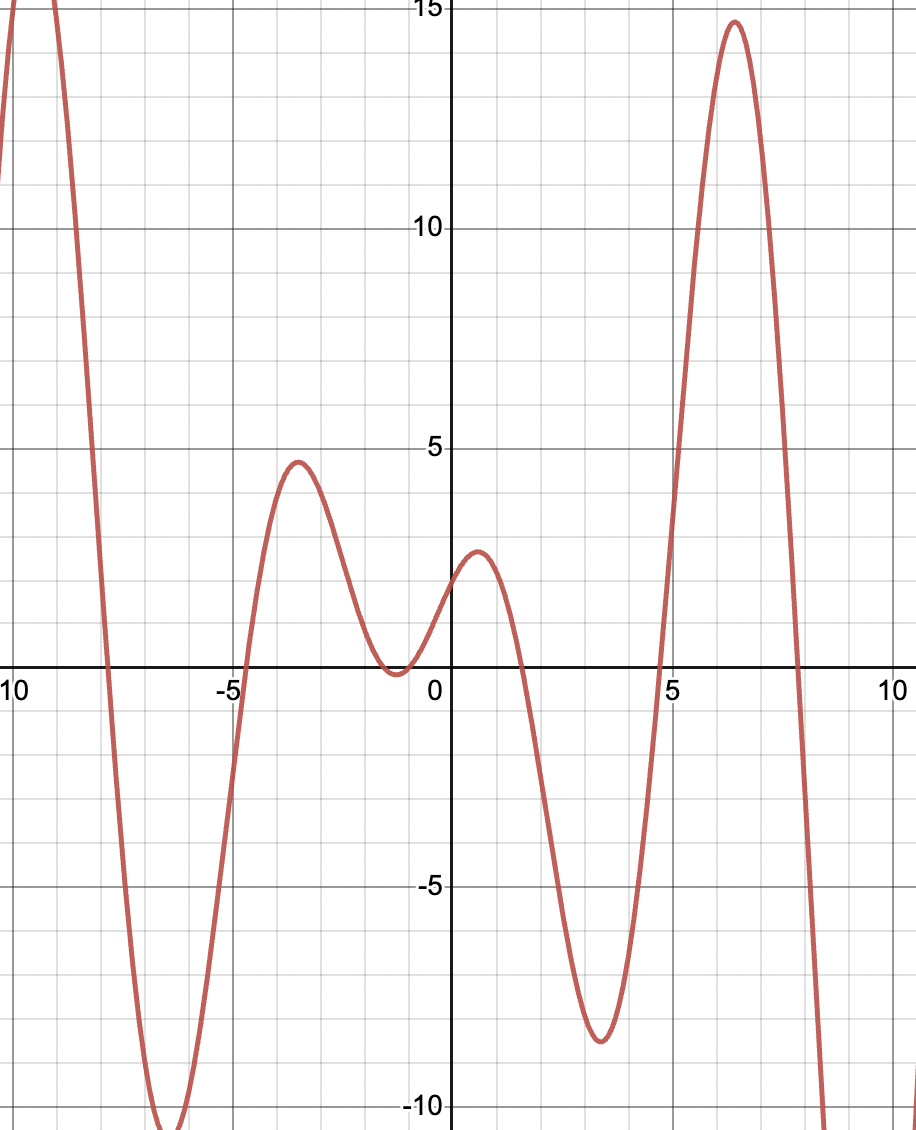
Find the derivative of:
Using the product rule:
If you incorrectly tried to multiply the derivatives, you would get:
But .
The graphs below show why. The correct matches the original function because its critical points and its positive and negative regions line up with where rises and falls.
How to Use This on the AP Calculus Exam
Problem Solving
Work through these to build fluency with the product rule.
Example 1. Find for both with and without the product rule.
Without the product rule: expand first.
Now take the derivative using the sum and difference rules:
With the product rule:
Both methods give the same answer once expanded. Unless a problem says to simplify, this form is perfectly acceptable.
Example 2. Find if .
Remember, the derivative of is . For a refresher, see Derivatives of cos x, sin x, e^x, and ln x.
Example 3. Find if .
The derivative of is still , so:
Common Trap
When a free-response question gives a table of values for and and asks for the derivative of at a point, write the product rule structure first. For example, , then substitute the values from the table. Showing this structure is important for clear exam work, even if your final number is right.
Common Misconceptions
- Misconception: The derivative of a product is the product of the derivatives.Actually: The derivative of a product is not the product of the derivatives. . This is the single most common product rule error.
- Misconception: You only differentiate one function.Actually: You still differentiate both factors. Some students only differentiate one function. Each term in the result keeps one factor undifferentiated and differentiates the other.
- Misconception: Order of terms matters for adding.Actually: Order of terms does not matter for adding. Since you are adding two products, and are the same. Just make sure each term pairs an original function with the derivative of the other.
- Misconception: Expanding is required.Actually: Expanding is an option, not a requirement. For simple polynomial products you can multiply out and use the power rule, but for products like the product rule is the practical choice.
- Misconception: You always need to simplify.Actually: You usually do not need to simplify. A correct unsimplified answer earns credit unless the problem specifically asks for a simplified form.
Related AP Calculus Guides
- Unit 2 Overview: Differentiation
- 2.1 Defining Average and Instantaneous Rates of Change at a Point
- 2.10 Finding the Derivatives of Tangent, Cotangent, Secant, and/or Cosecant Functions
- 2.2 Defining the Derivative of a Function and Using Derivative Notation
- 2.4 Connecting Differentiability and Continuity: Determining When Derivatives Do and Do Not Exist
- 2.3 Estimating Derivatives of a Function at a Point
Practice Questions for 2.8
1 of 10
Let , where is a differentiable function. The line tangent to the graph of at is given by the equation . What is the instantaneous rate of change of at ?
A.
The instantaneous rate of change is , found by evaluating at .
B.
The instantaneous rate of change is , found by evaluating at .
C.
The instantaneous rate of change is , found by evaluating .
D.
The instantaneous rate of change is , found by evaluating .
Vocabulary
The following words are mentioned explicitly in the AP® course framework for this topic.Term | Definition |
|---|---|
derivative | The instantaneous rate of change of a function at a specific point, representing the slope of the tangent line to the function at that point. |
differentiable function | Functions that have a derivative at every point in their domain, meaning they are smooth and continuous without sharp corners or breaks. |
product rule | A differentiation rule that states the derivative of a product of two functions equals the first function times the derivative of the second plus the second function times the derivative of the first. |
quotient | The result of dividing one function by another. |
Frequently Asked Questions
What is the product rule in AP Calculus?
The product rule says the derivative of f(x)g(x) is f(x)g'(x) + g(x)f'(x), assuming both functions are differentiable.
When should you use the product rule?
Use the product rule when a function is written as the product of two differentiable functions and expanding or rewriting would not be simpler.
Is the derivative of a product the product of the derivatives?
No. The derivative of f(x)g(x) is not f'(x)g'(x). You need one term for each factor being differentiated.
How do product rule table problems work?
If h(x) = f(x)g(x), write h'(a) = f(a)g'(a) + g(a)f'(a), then substitute the table values.
Do you have to simplify product rule answers?
Usually no. A correct unsimplified product rule setup can earn credit unless the problem specifically asks for a simplified form.
How does the product rule connect to other derivative rules?
The product rule often combines with trig, exponential, quotient, and chain rules when functions have multiple layers or factors.
See Fiveable more often in Google
Mark Fiveable as a preferred source and Google is more likely to show you our guides in Top Stories, with a "preferred" badge in AI Mode and AI Overviews.