5.1 Using the Mean Value Theorem

In the previous unit, we learned all about applying derivatives to different real-world contexts. What else are derivatives useful for? Turns out, we can also use derivatives to determine and analyze the behaviors of functions! đ

đ Mean Value Theorem
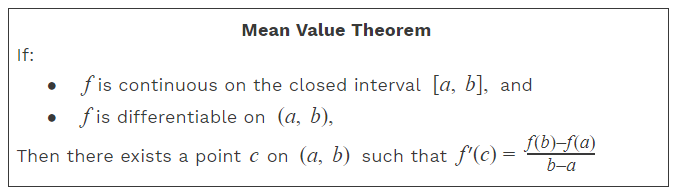
The Mean Value Theorem states that if a function is continuous over the interval and differentiable over the interval , then there exists a point within that open interval where the instantaneous rate of change of the function at equals the average rate of change of the function over the interval .
In other words, if a function is continuous over the interval and differentiable over the interval , there exists some on such that .

Yet another way to phrase this theorem is that if the stated conditions of continuity and differentiability are satisfied, there is a point where the slope of the tangent line is equivalent to the slope of the secant line between and .

Remember from Unit 1, to be continuous over means that there are no holes, asymptotes, or jump discontinuities between points a and b. Because the interval contains closed brackets, the graph must also be continuous at points and .
Additionally, if we recall from previous guides, to be differentiable over means that the function is continuous over the interval and that for any point over the interval, exists.
âď¸ Mean Value Theorem: Walkthrough
We can use the Mean Value Theorem to justify conclusions about functions by applying it over an interval. For example:
Let be a differentiable function. The table gives its selected values:
| x | 3 | 9 | 11 |
|---|---|---|---|
| f(x) | 20 | 44 | 67 |
Can we use the Mean Value Theorem to say the equation has a solution where ?
Since it is given that is differentiable, we can apply the Mean Value Theorem (MVT) on the interval . This is what we should write out!
Since is continuous and differentiable on , MVT can be applied. The MVT states that there exists a on such that
so MVT cannot be used to say that has a solution.
đ Mean Value Theorem: Practice Problems
Now, itâs time for you to do some practice on your own! đ
â Mean Value Theorem: Practice
Question 1: Mean Value Theorem
Let and let be the number that satisfies the Mean Value Theorem for on the interval .
What is ?
Question 2: Mean Value Theorem
Let be a differentiable function. The table gives its selected values:
| x | 2 | 7 | 9 |
|---|---|---|---|
| f(x) | 14 | 43 | 35 |
Can we use the Mean Value Theorem to say the equation has a solution where ?
â Â Mean Value Theorem: Answers and Solutions
Question 1: Mean Value Theorem
Since is a polynomial, is continuous on and differentiable on . Therefore, the Mean Value Theorem can be applied. By the Mean Value Theorem, there exists a on such thatâŚ
.
To find , we need to differentiate and find such that .
By the quadratic formula, we have .
Since only is in the interval , . Great work! Make sure you remember to check if the value(s) you get are in the given interval.
Question 2: Mean Value Theorem
Since it is given that is differentiable, we can apply the Mean Value Theorem (MVT) on the interval .
The MVT states that there exists a on such that . so MVT cannot be used to say that has a solution.
đŤ Closing
The Mean Value Theorem states that for any continuous function on a closed interval, there exists a value c in the interval such that the value of the derivative of the function at c is equal to the average rate of change of the function over the interval. By using this theorem, we can find the mean value of a function on a given interval, which can provide useful information about the behavior of the function. đ§
Vocabulary
The following words are mentioned explicitly in the College Board Course and Exam Description for this topic.Term | Definition |
|---|---|
average rate of change | The change in the value of a function divided by the change in the input over an interval [a, b], calculated as (f(b) - f(a))/(b - a). |
continuous | A function that has no breaks, jumps, or holes in its graph over a given interval. |
differentiable | A property of a function that has a derivative at every point in an interval, meaning the function is smooth with no sharp corners or cusps. |
instantaneous rate of change | The rate at which a function is changing at a specific point, represented by the derivative at that point. |
Mean Value Theorem | A theorem stating that if a function is continuous on a closed interval and differentiable on the open interval, there exists at least one point where the instantaneous rate of change equals the average rate of change over that interval. |
Frequently Asked Questions
How do I know when to use the Mean Value Theorem on a problem?
Use the Mean Value Theorem (MVT) when the problem asks you to justify that there's at least one point c in (a,b) where the instantaneous rate (fâ˛(c)) equals the average rate over [a,b] (the secant slope). Before applying it check the two CED conditions: f is continuous on [a,b] and differentiable on (a,b). If both hold, MVT guarantees a c with fâ˛(c) = (f(b)âf(a))/(bâa). Rolleâs Theorem is the special case when f(a)=f(b) (so the average slope is 0). Donât use MVT if the function has a jump, cusp, or vertical tangent inside (a,b)âgive a counterexample or say the theorem doesnât apply. Common AP prompts: âshow there exists câŚ,â âjustify that the slope of a tangent equals the secant slope,â or use it to bound average/instantaneous change. For more examples and exam-style practice, see the Topic 5.1 study guide (https://library.fiveable.me/ap-calculus/unit-5/using-mean-value-theorem/study-guide/79sP2PXcyvRvBsjb3HRq) and Unit 5 review (https://library.fiveable.me/ap-calculus/unit-5). For extra practice, try problems at (https://library.fiveable.me/practice/ap-calculus).
What's the formula for the Mean Value Theorem and how do I apply it?
Mean Value Theorem (MVT)âformula and how to use it: Formula/statement: If f is continuous on [a,b] and differentiable on (a,b), then there exists at least one c in (a,b) such that fâ'(c) = (f(b) â f(a)) / (b â a). (Left side = instantaneous rate; right side = average/secant slope.) How to apply (step-by-step): 1. Verify hypotheses: check continuity on [a,b] and differentiability on (a,b). If either fails, MVT may not apply. 2. Compute the average rate (f(b) â f(a)) / (b â a). 3. Set fâ'(x) equal to that value and solve for x in (a,b). Any solution(s) are the guaranteed câs. 4. If solving algebraically is hard, justify existence using MVT (you donât always need the exact c on the examâsometimes just the existence is enough). Quick example: If f(x)=x^2 on [1,3], average slope = (9â1)/(2)=4, solve 2x=4 â x=2 (in (1,3)), so fâ'(2)=4. For AP practice and CED alignment see the Topic 5.1 study guide (https://library.fiveable.me/ap-calculus/unit-5/using-mean-value-theorem/study-guide/79sP2PXcyvRvBsjb3HRq). More unit review (https://library.fiveable.me/ap-calculus/unit-5) and lots of practice problems (https://library.fiveable.me/practice/ap-calculus).
I'm confused about the difference between continuous on [a,b] and differentiable on (a,b) - why are the intervals different?
Good questionâthe intervals differ because continuity and differentiability are different kinds of conditions, and endpoints behave differently. - Continuity on [a,b] means f has no jumps or holes anywhere on the closed interval, including at a and b. The secant slope (average rate of change) uses the actual values f(a) and f(b), so endpoints must be defined and continuous. - Differentiability requires a two-sided limit for fâ˛(x) to exist. That only makes sense for interior points, since at an endpoint you can only take a one-sided derivative. So the MVT only needs fⲠto exist for x strictly between a and b (the open interval) where tangent slopes are well defined. Intuition/example: f(x)=âx is continuous on [0,1] but you canât take a two-sided derivative at x=0, so we donât require differentiability there. The Mean Value Theorem (CED FUN-1.B.1) therefore asks for continuity on [a,b] and differentiability on (a,b), and guarantees a c in (a,b) where the instantaneous rate equals the average rate. For a quick review, see the Topic 5.1 study guide (https://library.fiveable.me/ap-calculus/unit-5/using-mean-value-theorem/study-guide/79sP2PXcyvRvBsjb3HRq). For more practice problems, check https://library.fiveable.me/practice/ap-calculus.
How do I solve Mean Value Theorem problems step by step?
Step-by-step for Mean Value Theorem (MVT) problemsâwhat to do and why: 1. Check hypotheses (required on AP): is f continuous on [a,b] and differentiable on (a,b)? If not, MVT doesnât apply (use a counterexample). 2. Compute average rate of change (secant slope): (f(b) â f(a)) / (b â a). This is the slope guaranteed somewhere. 3. Differentiate: find fâ˛(x). 4. Solve fâ˛(c) = (f(b) â f(a)) / (b â a) for c in (a,b). Show at least one solution exists in that open interval. If you get no real solution, revisit step 1 (maybe conditions fail). 5. Interpret: state that by MVT there exists c in (a,b) where instantaneous rate = average rate; if needed, give units and contextual meaning. Quick tips: if endpoints or nonsmooth points appear, mention Rolleâs Theorem as a special case (when f(a)=f(b)). On the AP, explicitly verify continuity/differentiability (CED FUN-1.B). For extra practice see the Topic 5.1 study guide (https://library.fiveable.me/ap-calculus/unit-5/using-mean-value-theorem/study-guide/79sP2PXcyvRvBsjb3HRq) and more problems at https://library.fiveable.me/practice/ap-calculus.
When does the Mean Value Theorem not apply to a function?
The Mean Value Theorem (MVT) fails when its two hypotheses arenât both met. Specifically, MVT requires: - f is continuous on the closed interval [a,b], and - f is differentiable on the open interval (a,b). So MVT does NOT apply if: - f has a discontinuity anywhere on [a,b] (jump, removable, or infinite). - f isnât differentiable at some interior point (a cusp, corner, vertical tangent, or a point where the derivative doesnât exist). (You donât need differentiability at the endpointsâonly on (a,b).) Examples: f(x)=|x| on [â1,1] is continuous but not differentiable at 0, so MVT doesnât guarantee a c. f(x)=1/x on [â1,1] is discontinuous, so MVT doesnât apply. On the AP exam you should always check continuity on [a,b] and differentiability on (a,b) before invoking MVT (this is FUN-1.B in the CED). For a quick review, see the Topic 5.1 study guide (https://library.fiveable.me/ap-calculus/unit-5/using-mean-value-theorem/study-guide/79sP2PXcyvRvBsjb3HRq). For extra practice, try problems at (https://library.fiveable.me/practice/ap-calculus).
What's the difference between average rate of change and instantaneous rate of change in MVT problems?
Average rate of change over [a,b] is the secant slope: (f(b) â f(a)) / (b â a). It tells you how much f changes per unit x on average across the whole interval (think average speed). Instantaneous rate of change is the derivative fâ˛(x)âthe tangent slope at a single pointâtelling you how fast f is changing right then. The Mean Value Theorem (CED FUN-1.B) links them: if f is continuous on [a,b] and differentiable on (a,b), MVT guarantees at least one c in (a,b) with fâ˛(c) = (f(b) â f(a)) / (b â a). So the theorem says some instantaneous rate equals the average rate. On the AP exam youâll often compute the average slope, check continuity/differentiability, then cite MVT to justify existence of c (or give/estimate c). For more review, see the Topic 5.1 study guide (https://library.fiveable.me/ap-calculus/unit-5/using-mean-value-theorem/study-guide/79sP2PXcyvRvBsjb3HRq) or the Unit 5 overview (https://library.fiveable.me/ap-calculus/unit-5). Practice problems: (https://library.fiveable.me/practice/ap-calculus).
How do I find the c value that the Mean Value Theorem guarantees exists?
First check the hypotheses: make sure f is continuous on [a,b] and differentiable on (a,b). Then: 1. Compute the average rate of change (secant slope): m = (f(b) â f(a)) / (b â a). 2. The MVT guarantees at least one c in (a,b) with fâ˛(c) = m. So set fâ˛(x) = m and solve for x on (a,b). 3. Any solution x in (a,b) is a valid c. If you get no real solution algebraically, re-check the conditions (maybe f isnât differentiable/continuous)âMVT only guarantees existence when conditions hold. If fâ˛(x) is complicated, you may need numerical methods to find c. Example: if f(x)=x^2 on [1,3], m=(9â1)/2=4, solve fâ˛(x)=2x=4 â x=2 (which lies in (1,3)). Thatâs your c. For more review and examples tied to the AP CED (FUN-1.B, secant vs tangent slope), see the Topic 5.1 study guide (https://library.fiveable.me/ap-calculus/unit-5/using-mean-value-theorem/study-guide/79sP2PXcyvRvBsjb3HRq). For extra practice, try problems at (https://library.fiveable.me/practice/ap-calculus).
I don't understand what "instantaneous rate of change equals average rate of change" actually means - can someone explain?
âInstantaneous rate = average rateâ means thereâs at least one moment inside [a, b] where the functionâs slope right then (the derivative fâ˛(c)) equals the overall slope from a to b (the secant slope [f(b)âf(a)]/(bâa)). Intuition: - If f models position, the average rate over [a,b] is the average velocity on that trip. The Mean Value Theorem (MVT) says at some instant c your instantaneous velocity equals that average velocity. - Graphically, thereâs at least one tangent line inside (a,b) thatâs parallel to the secant line joining (a,f(a)) and (b,f(b)). Important conditions (from the CED FUN-1.B): f must be continuous on [a,b] and differentiable on (a,b). If those fail (a jump, cusp, vertical tangent), MVT doesnât apply. The theorem guarantees existence of some c but doesnât tell you whereâsometimes you find c by solving fâ˛(x) = [f(b)âf(a)]/(bâa). For an AP review, see the Topic 5.1 study guide (https://library.fiveable.me/ap-calculus/unit-5/using-mean-value-theorem/study-guide/79sP2PXcyvRvBsjb3HRq) and Unit 5 overview (https://library.fiveable.me/ap-calculus/unit-5). For more practice, try problems at (https://library.fiveable.me/practice/ap-calculus).
Do I need to check if a function is continuous and differentiable before using MVT?
Yesâalways check the hypotheses before you invoke the Mean Value Theorem. The CEDâs FUN-1.B says MVT only applies when - f is continuous on the closed interval [a,b], and - f is differentiable on the open interval (a,b). If those two conditions hold, MVT guarantees at least one c in (a,b) with fâ˛(c) = (f(b)âf(a))/(bâa). If either condition fails, MVT doesnât apply (so you canât claim a guaranteed c). Example: f(x)=|x| on [â1,1] is continuous but not differentiable at 0, so MVT gives no guarantee even though the average slope is 0. Remember differentiability at the endpoints isnât requiredâonly on (a,b). This checking/justification is exactly what AP expects when you âjustify conclusions about functionsâ (FUN-1.B). For a quick refresher, see the Topic 5.1 study guide (https://library.fiveable.me/ap-calculus/unit-5/using-mean-value-theorem/study-guide/79sP2PXcyvRvBsjb3HRq). For more practice, try problems at the Unit 5 page (https://library.fiveable.me/ap-calculus/unit-5) or the practice bank (https://library.fiveable.me/practice/ap-calculus).
How do I set up the equation f'(c) = [f(b) - f(a)]/(b - a) correctly?
First check the hypotheses: make sure f is continuous on [a,b] and differentiable on (a,b). The Mean Value Theorem (FUN-1.B.1) then guarantees some c in (a,b) with f'(c) = [f(b) â f(a)] / (b â a). How to set it up and solve: 1. Compute the secant (average) slope S = (f(b) â f(a)) / (b â a). 2. Write the equation f'(c) = S. 3. Solve that equation for c, and keep only solutions with a < c < b (MVT guarantees at least one such c if the hypotheses hold). Quick example: f(x) = x^2 on [1,3]. - S = (3^2 â 1^2)/(3 â 1) = (9 â 1)/2 = 4. - f'(x) = 2x, so set 2c = 4 â c = 2, which lies in (1,3). Remember: if continuity/differentiability fail, MVT doesnât apply (counterexamples often appear in exam prompts). For more practice and guidance see the Topic 5.1 study guide (https://library.fiveable.me/ap-calculus/unit-5/using-mean-value-theorem/study-guide/79sP2PXcyvRvBsjb3HRq) and extra problems (https://library.fiveable.me/practice/ap-calculus).
What are the most common mistakes students make when applying the Mean Value Theorem?
Short list of the most common mistakes students make with the Mean Value Theorem (MVT): - Forgetting to check the hypotheses. MVT requires f continuous on [a,b] and differentiable on (a,b). If either fails (a jump, cusp, vertical tangent), you canât conclude a c exists. Always state/check these on the AP free-response. - Confusing MVT with Rolleâs Theorem. Rolle is a special case of MVT when f(a)=f(b). Donât assume f(a)=f(b) unless given. - Using MVT to claim something about endpoints. MVT guarantees a c in (a,b), never at a or b. - Mixing up secant slope and tangent slope. Compute average rate of change (secant) correctly: [f(b)-f(a)]/(b-a); then say thereâs a point where fâ˛(c) equals that value. - Applying MVT to pieces without checking differentiability across join points (piecewise functions). A counterexample often comes from a corner at the join. - Not justifying why the theorem applies/doesnât apply on exam work. The rubric expects you to verify conditions, name the theorem, and give the conclusion (existence of c in (a,b)). For targeted review and AP-style practice, see the Topic 5.1 study guide (https://library.fiveable.me/ap-calculus/unit-5/using-mean-value-theorem/study-guide/79sP2PXcyvRvBsjb3HRq) and thousands of practice problems (https://library.fiveable.me/practice/ap-calculus).
Can the Mean Value Theorem have more than one c value in the interval?
Yesâthe Mean Value Theorem (MVT) guarantees at least one c in (a,b) with fâ˛(c) = [f(b)âf(a)]/(bâa), but it doesnât say that c is unique. If f is continuous on [a,b] and differentiable on (a,b) you get existence; there can be multiple points where the instantaneous rate equals the average rate. Quick example: f(x)=sin x on [0,2Ď]. The average slope is (0â0)/(2Ď)=0, and fâ˛(x)=cos x is 0 at Ď/2 and 3Ď/2âtwo distinct câs that satisfy MVT. Rolleâs Theorem is the special case when f(a)=f(b); it only guarantees at least one c with fâ˛(c)=0, but again there can be many. For AP Calc, remember to check the CED hypotheses (continuity on [a,b], differentiability on (a,b)) before applying MVT or Rolleâs Theorem. For more examples and practice, see the Topic 5.1 study guide (https://library.fiveable.me/ap-calculus/unit-5/using-mean-value-theorem/study-guide/79sP2PXcyvRvBsjb3HRq) and Unit 5 overview (https://library.fiveable.me/ap-calculus/unit-5).
How do I know if I need to use MVT vs Rolle's Theorem on an AP problem?
Use Rolleâs Theorem when the average rate of change (secant slope) over [a,b] is exactly 0âi.e., f(a) = f(b). If f is continuous on [a,b] and differentiable on (a,b), Rolle guarantees some c in (a,b) with fâ˛(c) = 0. Use the Mean Value Theorem (MVT/Lagrange) when f(a) â f(b) but you want a point where the instantaneous rate equals the average rate: MVT guarantees c with fâ˛(c) = (f(b) â f(a))/(b â a) under the same continuity/differentiability conditions. Quick decision steps on a problem: 1) Check continuity on [a,b] and differentiability on (a,b). If either fails, neither theorem applies. 2) Compute f(a) and f(b). If equal â try Rolle. If not â use MVT. 3) State which theorem, verify hypotheses, then solve for c (often by setting fâ˛(x) equal to the secant slope). This matches the CED FUN-1.B requirement. For examples and practice, see the Topic 5.1 study guide (https://library.fiveable.me/ap-calculus/unit-5/using-mean-value-theorem/study-guide/79sP2PXcyvRvBsjb3HRq) and more unit review (https://library.fiveable.me/ap-calculus/unit-5).
Why does my teacher keep saying MVT "guarantees" a point exists - what does that mean?
When your teacher says the MVT âguaranteesâ a point exists, they mean: if f is continuous on [a,b] and differentiable on (a,b) (the CED condition for FUN-1.B), then there is at least one number c in (a,b) for which fâ˛(c) = (f(b) â f(a)) / (b â a). âGuaranteesâ = existence, not location or uniqueness. Youâre guaranteed at least one tangent line inside the interval whose slope equals the secant slope across [a,b], but the theorem doesnât tell you how to find c or whether thereâs more than one such point. If the hypotheses fail (a jump, corner, or vertical tangent), the guarantee can failâthatâs why verifying continuity on [a,b] and differentiability on (a,b) is essential on the exam (CED: FUN-1.B.1). For quick review/examples, see the Topic 5.1 study guide (https://library.fiveable.me/ap-calculus/unit-5/using-mean-value-theorem/study-guide/79sP2PXcyvRvBsjb3HRq) and try practice problems (https://library.fiveable.me/practice/ap-calculus).
I keep getting confused about open vs closed intervals in Mean Value Theorem - which one do I use when?
Use the closed interval [a,b] to check the hypotheses, and the open interval (a,b) for the conclusion. Specifically (CED FUN-1.B): MVT requires that f is continuous on the closed interval [a,b] and differentiable on the open interval (a,b). If those hold, the theorem guarantees at least one c in (a,b) where fâ˛(c) = (f(b)âf(a))/(bâa). So you always verify continuity at the endpoints (closed interval) and differentiability only inside (open interval). The guaranteed point c is interiorânever exactly at a or b. Quick tips: if f isnât continuous at an endpoint (a or b), MVT doesnât applyâgive a counterexample like a jump at an endpoint. Rolleâs Theorem is the special case when f(a)=f(b) so the average slope is 0, hence fâ˛(c)=0 for some c in (a,b). For more worked examples and AP-style practice, see the Topic 5.1 study guide (https://library.fiveable.me/ap-calculus/unit-5/using-mean-value-theorem/study-guide/79sP2PXcyvRvBsjb3HRq), the Unit 5 overview (https://library.fiveable.me/ap-calculus/unit-5) and thousands of practice problems (https://library.fiveable.me/practice/ap-calculus).