5.8 Sketching Graphs of Functions and Their Derivatives

♾️AP Calculus AB/BC Unit 5 Review
5.8 Sketching Graphs of Functions and Their Derivatives
♾️ AP Calculus AB/BC
5.1
Using the Mean Value Theorem
5.2
Extreme Value Theorem, Global vs Local Extrema, and Critical Points
5.3
Determining Intervals on Which a Function is Increasing or Decreasing
5.4
Using the First Derivative Test to Determine Relative (Local) Extrema
5.5
Using the Candidates Test to Determine Absolute (Global) Extrema
5.6
Determining Concavity
5.7
Using the Second Derivative Test to Determine Extrema
5.8
Sketching Graphs of Functions and Their Derivatives
5.9
Connecting a Function, Its First Derivative, and its Second Derivative
5.10
Introduction to Optimization Problems
5.11
Solving Optimization Problems
5.12
Exploring Behaviors of Implicit Relations
TLDR
In AP Calculus, sketching a function and its derivatives means using the signs of and to figure out where a function increases, decreases, peaks, dips, and changes curve. Once you know critical points, increasing/decreasing intervals, extrema, concavity, and inflection points, you can build a full picture of the graph or read key features straight from a derivative graph.
Why This Matters for the AP Calculus Exam
This topic ties together everything from earlier in Unit 5: critical points, increasing/decreasing behavior, extrema, concavity, and inflection points. On the exam, you often get the graph of and have to reason about , or you get and have to describe and .
You will use this in multiple-choice questions that ask you to match a function to its derivative or pick out where a graph is concave up. It also shows up in free-response questions where you justify conclusions about using information from and . Writing precise, derivative-based justifications is important for clear exam work, so always name , , and instead of saying "it" or "the graph."
Key Takeaways
- The sign of tells you where is increasing (positive) or decreasing (negative); critical points happen where or is undefined.
- The First Derivative Test finds extrema by checking sign changes in ; a sign change from positive to negative is a local max, negative to positive is a local min.
- The sign of tells you concavity: positive means concave up, negative means concave down.
- A point of inflection occurs only where changes sign, not just where .
- When reading a graph of , the height of is the slope of , and where is increasing, is concave up.
- Justify conclusions about by referring directly to features of or , and name each function clearly.
Sketching Graphs
Drawing the graphs of functions and their derivatives helps you find key features. From a graph, you can identify discontinuities, critical points, and extrema, plus many other important elements of a function.
Here is a step-by-step approach to sketching a graph. It may look like a lot, but each step is something you already practiced earlier in Unit 5.
-
Find the domain of the function and check for any discontinuities.
-
Identify key features such as intercepts and symmetry.
-
Find critical points.
-
Determine where the function increases and decreases.
-
Find the extrema of the function.
- An alternative to steps 4 and 5 is to use the Second Derivative Test to determine the extrema.
-
Determine points of inflection and intervals of concavity.
Once you have these pieces, you have an overview of what the function looks like and can sketch its graph.
Sketching Graphs Walkthrough
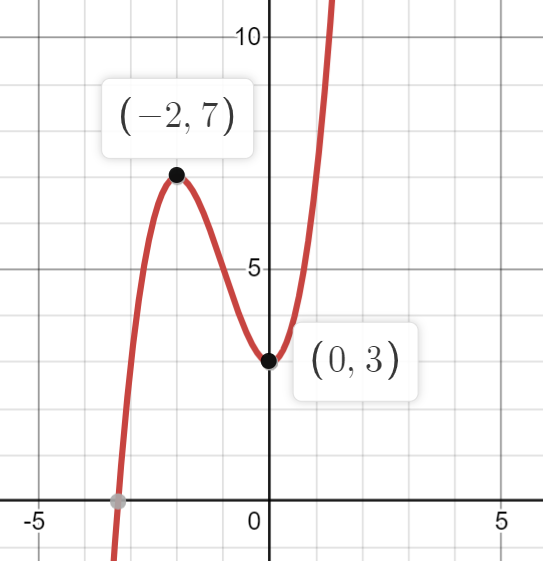
Let's go deeper into each step and sketch this function:
Step 1: Find the domain and look for discontinuities
A useful fact: all polynomial functions have a domain of all real numbers. Since this is a polynomial, the domain is all real numbers.
When looking for discontinuities, check whether the function is rational or has points where is not defined. There are no such points here, so this function is continuous everywhere in its domain.
Step 2: Identify key features such as intercepts and symmetry
First, look for x-intercepts, where .
Set each factor equal to zero and solve for x.
Now set equal to 0.
This gives two x-intercepts: and . Their coordinates are and .
Now look for the y-intercept, where .
The y-intercept is .
Lastly, check for symmetry. A function is symmetric about a line if reflecting across that line gives back the same function. There are two types:
- Even: symmetric across the y-axis. for all in the domain.
- Odd: symmetric about the origin. for all in the domain.
If neither holds, the function has no symmetry. That is the case here, so this function has no symmetry.
So far, we know:
- The function is continuous.
- We can plot , , and .
Step 3: Find critical points
Critical points occur where the first derivative equals zero or is undefined.
The first derivative, using the product rule, is:
Setting this equal to zero and solving for x gives and as the critical points.
Step 4: Determine where the function increases and decreases
Using these critical points, find the intervals where the function increases and decreases.
- If is positive on an interval, is increasing there.
- If is negative on an interval, is decreasing there.
For a deeper explanation, revisit the AP Calculus 5.3 Determining Intervals on Which a Function Is Increasing or Decreasing guide.
Evaluate around each critical point:
| Interval | Verdict | ||
|---|---|---|---|
| is increasing | |||
| is decreasing | |||
| is increasing |
So is increasing on and and decreasing on .
Step 5: Find the extrema of the function
Apply the First Derivative Test to the information above.
- A critical point where decreases on its left and increases on its right is a local minimum.
- A critical point where increases on its left and decreases on its right is a local maximum.
For a refresher, see the AP Calculus 5.4 Using the First Derivative Test to Determine Relative (Local) Extrema guide.
To the left of the function is increasing, and to the right it is decreasing, so is a local maximum.
At the function decreases on its left and increases on its right, so is a local minimum.
Alternative to Steps 4 and 5
Instead of steps 4 and 5, you can use the Second Derivative Test:
- If at a critical point is negative, has a relative maximum there (concave down).
- If at a critical point is positive, has a relative minimum there (concave up).
See the AP Calculus 5.7 Using the Second Derivative Test to Determine Extrema guide.
Step 6: Determine points of inflection and concavity
A function has a possible point of inflection where its second derivative equals zero. To confirm, check whether the function switches from concave up to concave down or vice versa (the second derivative changes sign) across the point.
For more, revisit the AP Calculus 5.6 Determining Concavity of Functions over Their Domains guide.
The second derivative of is:
Find the possible point of inflection by setting it equal to 0.
Now analyze the sign of the second derivative to confirm.
| Concavity | ||
|---|---|---|
| Concave down | ||
| Concave up |
Since the second derivative changes sign and concavity changes, is a point of inflection.
Putting It All Together
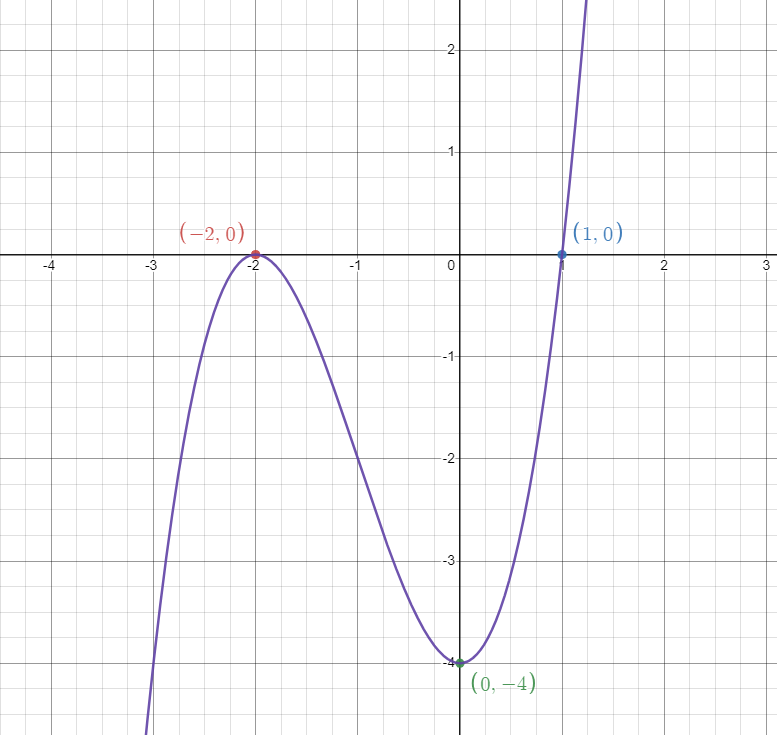
Compiling everything:
- The function is continuous.
- We can plot , , and .
- is increasing on and .
- is decreasing on .
- is a local maximum.
- is a local minimum.
- Concavity changes at from concave down to concave up.
You may not have needed every piece of information, but having it all helps you double-check your sketch.
How to Use This on the AP Calculus Exam
MCQ
Multiple-choice questions often give you the graph of and ask about , or the reverse. Remember these reading rules:
- Where is positive, is increasing; where is negative, is decreasing.
- Where crosses zero and changes sign, has a local extremum.
- Where is increasing, is concave up; where is decreasing, is concave down.
- A point of inflection of lines up with a local max or min of .
Free Response
Free-response questions ask you to justify conclusions about using and . Build your answer on what the derivative shows. For example, " is concave up on because is increasing on that interval." Start by restating the conclusion using the language in the question, then give the derivative-based reason.
Problem Solving
When sketching from scratch, work through the steps in order: domain, intercepts, critical points, increasing/decreasing, extrema, then concavity and inflection. Plotting the key points and labeling behavior between them keeps your sketch organized.
Common Trap
Do not assume automatically means an inflection point. You must show the second derivative actually changes sign there.
Practice: Sketching Graphs
Try sketching this function on your own. What does the graph of look like?
Work through each step before checking the solution.
Sketching Graphs Solution
We'll go through each step briefly. This time, instead of steps 4 and 5, we'll use the alternative.
-
Find the domain and check for discontinuities.
- Since this is a polynomial, the domain is all real numbers and there are no discontinuities.
-
Identify key features such as intercepts and symmetry.
- The x-intercept is and the y-intercept is .
- This function has neither even nor odd symmetry.
-
Find critical points.
- Setting equal to 0 and factoring gives critical points at and .
-
Alternative method: use the Second Derivative Test.
- . Since , the function is concave down here, so by the Second Derivative Test is a maximum.
- . Since , the function is concave up here, so by the Second Derivative Test is a minimum.
-
Determine points of inflection and intervals of concavity.
- is the only possible point of inflection. Checking concavity on each side shows the function is concave down to the left and concave up to the right.
- Since concavity changes at , it is a point of inflection.
-
Putting it all together.
- The y-intercept is .
- is a maximum.
- is a minimum.
- is a point of inflection (concave down to the left, concave up to the right).
Plug these x-values into to get exact y-values. With this information, has the shape you predicted from its key features.
Common Misconceptions
- Misconception: The graph of is the graph of .Actually: Features of a derivative graph describe how behaves, not what itself looks like. The height of is the slope of , not the value of .
- Misconception: always means an extremum.Actually: A critical point is only a local max or min if actually changes sign there. A flat spot can be a stationary inflection point instead.
- Misconception: Every point is an inflection point.Actually: The second derivative must change sign across the point for concavity to change.
- Misconception: It is fine to use vague language like "it" in justifications.Actually: Always name , , or so it is clear which function your reasoning is about.
- Misconception: Increasing means increasing .Actually: When is increasing, is concave up, but could still be decreasing if is negative.
- Misconception: Critical points occur only where is zero.Actually: Cusps, corners, and vertical tangents can be critical points even though is not zero there.
Related AP Calculus Guides
- Unit 5 Overview: Analytical Applications of Differentiation
- 5.1 Using the Mean Value Theorem
- 5.2 Extreme Value Theorem, Global vs Local Extrema, and Critical Points
- 5.3 Determining Intervals on Which a Function is Increasing or Decreasing
- 5.4 Using the First Derivative Test to Determine Relative (Local) Extrema
- 5.11 Solving Optimization Problems
Frequently Asked Questions
How do you sketch a function from its derivative?
Use f prime to find where f is increasing or decreasing, identify critical points, apply the First Derivative Test, then use f double prime to determine concavity and inflection points.
How do you know where a function is increasing or decreasing?
A function is increasing where f prime is positive and decreasing where f prime is negative. Critical points occur where f prime equals zero or is undefined.
How do you identify extrema from a derivative graph?
Use sign changes in f prime. If f prime changes from positive to negative, f has a local maximum. If f prime changes from negative to positive, f has a local minimum.
How do you find concavity when sketching a graph?
Use f double prime. If f double prime is positive, f is concave up. If f double prime is negative, f is concave down.
What is the common mistake in AP Calculus 5.8?
A common mistake is mixing up f, f prime, and f double prime. The height of f prime gives the slope of f, while whether f prime is increasing or decreasing describes concavity of f.
How is AP Calculus 5.8 tested?
AP Calculus 5.8 is tested with graph matching, derivative graph interpretation, and written justifications about increasing, decreasing, extrema, concavity, and inflection points.
See Fiveable more often in Google
Mark Fiveable as a preferred source and Google is more likely to show you our guides in Top Stories, with a "preferred" badge in AI Mode and AI Overviews.