Fiveable

♾️AP Calculus AB/BC Unit 6 Review

QR code for AP Calculus AB/BC practice questions

6.5 Interpreting the Behavior of Accumulation Functions Involving Area

♾️AP Calculus AB/BC
Unit 6 Review

6.5 Interpreting the Behavior of Accumulation Functions Involving Area

Written by the Fiveable Content Team • Last updated September 2025
Verified for the 2026 exam
Verified for the 2026 examWritten by the Fiveable Content Team • Last updated September 2025
♾️AP Calculus AB/BC
Unit & Topic Study Guides
Pep mascot

6.5 Interpreting the Behavior of Accumulation Functions Involving Area

Welcome back to AP Calculus! 🌶️

In this guide, we'll analyze the behavior of accumulation functions using the Fundamental Theorem of Calculus. We'll focus on graphical, numerical, analytical, and verbal representations to gain a comprehensive understanding of integrally-defined functions.

Pep mascot
more resources to help you study

👩‍🏫The Fundamental Theorem Of Calculus

📌 This section only has a summary of this very important theorem. For more necessary details, go to our 6.4 guide here!

The Fundamental Theorem of Calculus links accumulation functions, which are adapted from infinite Riemann sums, to antiderivatives, which “undo” a derivative. This theory states that if

F(n)=anf(t)dtF(n)=\int_{a}^{n}f(t)dt

Then,

F(n)=f(n)F’(n) = f(n)

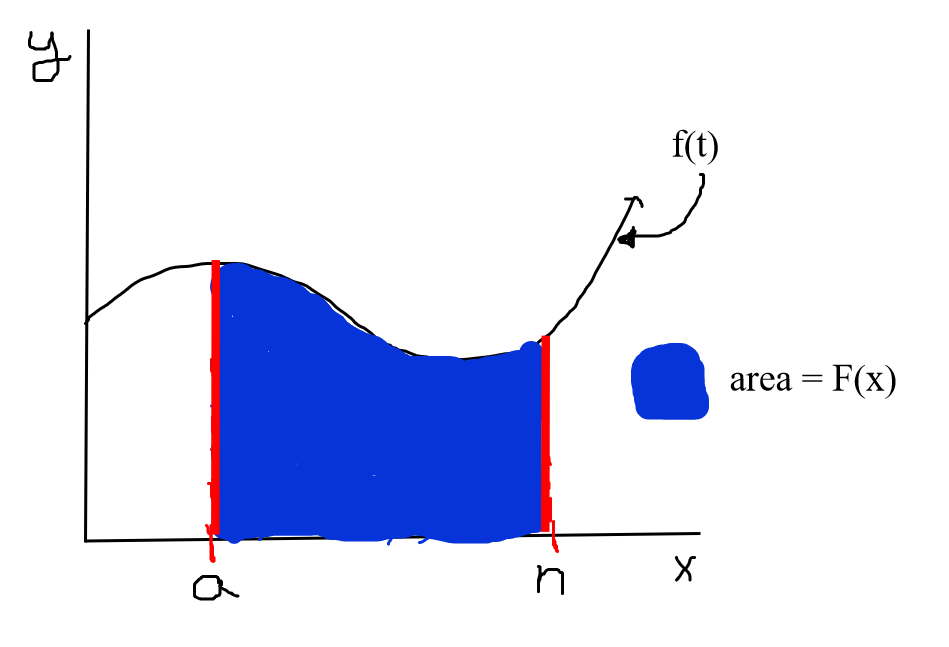
The first equation above states that F(n)F(n) is the accumulation function of f(t)f(t) which equals the area under the curve of f(t)f(t) between the boundaries made by the lines x=ax =a and x=nx = n. Here, aa is some constant number while nn is a variable. Visually, this looks like the following:

Untitled
Drawing of the accumulation function with boundaries aa and nn and the area under the curve f(t)f(t) colored blue and labeled as F(x)F(x)

The second equation says that the derivative of F(n)F(n) is f(n)f(n). This also means that the antiderivative of f(n)f(n) is F(n)F(n), and that F(n)=f(n)F'(n) = f(n).

To put these 2 pieces of information together, the area under a function is equal to the value of its antiderivative (calculated with the same bounds, of course).

💡 Usually, both the accumulation and antiderivative parts of this theorem are written with the variable xx. For example, F(n)=f(n)F’(n) = f(n) is usually written as F(x)F’(x) = f(x)f(x) in lectures or textbooks. Don’t get confused, they are the exact same equation, just using a different letter for the variable. (We used a different letter since telling you that the upper bound of the accumulation function was at x=xx =x would be confusing).

📒 Using the Fundamental Theorem Of Calculus

Just like previous functions, these integrally defined functions can be defined by their various characteristics listed below. Some AP multiple-choice or free-response questions will ask you to analyze these factors given a graph or a function with an integral.

Quick Refresher Chart

If F(x) is…then F’(x)and F’'(x)
Increasing+———
Decreasing-———
Relative Maximum0 and changes from + to -is -
Relative Minimum0 and changes from - to +is +
Concave Up———is +
Concave Down———is -
Inflection Point———Changes Sign

It’s important to note that finding increasing/decreasing ranges uses the first derivative while finding concave up/down ranges uses the second derivative. In addition, a relative minimum or maximum cannot be an inflection point.

When working with analysis integral problems where you must find one of the above items in the table remember that you are working backwards. Instead of finding or drawing the derivative of the given numerical graph or function, use the information as the already-found derivative of your target integral. For example, if you are told that

G(x)=ax6n2dnG(x) =\int_a^x 6n^2dn

Realize that 6x26x^2 is equal to the first derivative and find critical points or the second derivative accordingly.


🤔 Practicing with Accumulation Functions

Almost all AP questions on this topic will fall into 1 of 3 types: graph, table, or equation. These are all equally likely to occur. We will be going over a graph problem!

📈 Graph Questions

Graph questions almost always tell you that a function G(x)=axf(t)dtG(x) =\int_a^x f(t)dt and give you a graph or image of the function f(t)f(t).

The most important thing to remember with this type of problem is that the graph given is not your target function. Instead, the graph is the derivative of your target function. Let’s try an official College Board FRQ from the 2022 exam! (All credits to College Board.)

Untitled
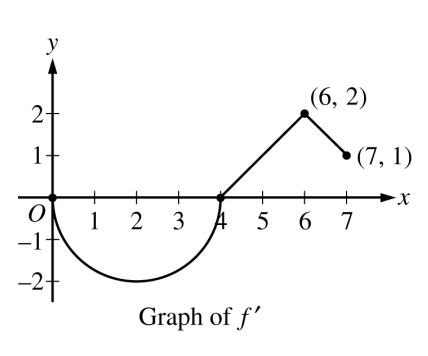
Question 3 from the 2022 AP Calculus AB FRQ Exam. Courtesy of College Board

Let ff be a differentiable function with f(4)=3f(4)=3. On the interval 0x70 \leq x \leq 7, the graph of ff', the derivative of ff, consists of a semicircle and two line segments, as shown in the figure above.

(a) Find f(0)f(0) and f(5)f(5).

(b) Find the x-coordinates of all points of inflection on the graph of ff for 0<x<70<x<7. Justify your answer.

(c) Let gg be the function defined by g(x)=f(x)xg(x)=f(x)-x. On what intervals, if any, is gg decreasing for 0x70 \leq x \leq 7? Show the analysis that leads to your answer.

(d) For the function gg defined in part (c), find the absolute minimum value on the interval 0x70 \leq x \leq 7. Justify your answer.

AP Calc 2022 #3a

Part A of this question asks us to find f(0)f(0) and f(5)f(5). Since we are told that the graph above is the graph of f(x)f'(x), this means that the original equation of…

f(x)=axf(x)dxf(x) = \int_a^x f'(x) dx

Using the Fundamental Theorem of Calculus, we know that this equation is equal to the accumulation function, and is represented on the f(x)f'(x) graph by the area between the curve and the x-axis. This area is the change in f(x)f(x) over the given bounds.

Using mathematical operations, we can set up 2 equations to find f(0)f(0) and f(5)f(5).

The first equation is

f(0)+04f(x)dx=f(4)f(0) + \int_0^4 f'(x) dx = f(4)

which can be simplified to

f(0)=f(4)04f(x)dxf(0) = f(4)- \int_0^4 f'(x) dx

💡 Be careful with how you lay out your integrals! The lower bound is where you start and the upper bound is where you end when computing area. Your formula to find f(x)f(x) given $$$f’(x)$$ should always be arranged to f(low bound) + low bound to high bound integral = f(high bound).

We know that f(4)=3f(4) = 3 from the problem and that 04f(x)dx\int_0^4 f'(x) dx is the area under f(x)f'(x) between x=0x = 0 and x=4x = 4, given the definition of the accumulation function. Our problem tells us that f(x)f'(x) is composed of a semicircle and 2 line segments, and we can see that the area between 0 and 4 is the semicircle area. The area of this semicircle is

π2r2=π222=2π\frac \pi 2*r^2 =\frac \pi2* 2^2 = 2\pi

Remember that since this area is below the x-axis, it is considered negative!

Plugging this into the our equation above gives

f(0)=3(2π)=3+2πf(0) = 3- (-2\pi)=3+2\pi

In the same way, you can set up your equation for f(5)f(5).

f(4)+45f(x)dx=f(5)f(4) + \int_4^5f'(x)dx = f(5)

Again, we know that f(4)=3f(4) = 3. The area of f(x)f'(x) from x=4x=4 and x=5x=5 lies on the first straight line which has a slope of 2064=1\frac {2-0}{6-4} = 1, using the known points of (4,0)(4,0) and (6,2)(6,2). Using this information in a slope equation OR by looking at the graph, we know that when x=5x =5 then y=1y =1. This means that the triangle area between x=4x=4 and x=5x=5 has a height of 1 and a width of 1, with a total area of 12\frac 12. Putting this into our earlier equation, we get

f(5)=3+12=3.5f(5) = 3 + \frac 12=3.5

Remember to write down your integrals AND label your final answers as f(0)f(0) and f(5)f(5) to earn all points on the free-response portion!

AP Calc 2022 #3b

This part asks for the x-coordinates of any points of inflection of the function f(x)f(x). Since we are given the graph of f(x)f’(x), we need to look at the derivative of this graph to find points of inflection (2nd derivative) of the original function f(x)f(x).

Remember that points of inflection occur when the second derivative of a function changes signs. On the graph given to us, this occurs where the slope of the derivative changes signs. This occurs at x=2x = 2, where the slope changes from negative to positive, and x=6x = 6, where the slope changes from positive to negative. Since the slope of a function at a point is the 1st derivative, the slope of the first derivative at a point is the second derivative!

💡 Although there is a critical point for f(x)atx=4f’(x) at x = 4, this isn’t a point of inflection. The slope of the first derivative goes from approaching positive infinity to a positive constant but doesn’t change signs, which is the criteria for a point of inflection.

AP Calc 2022 #3c

Our new equation is defined by

g(x)=f(x)xg(x) =f(x) -x

so the new derivative is

g(x)=f(x)1g'(x) = f'(x) -1

A function is decreasing when its derivative is negative, so g(x)g(x) is decreasing when

0>f(x)10>f'(x)-1

or

1>f(x)1>f'(x)

According to the graph, this occurs between 0<x<50<x<5.

AP Calc 2022 #3d

This part asks for the absolute minimum function of g(x)g(x). A local minimum occurs when g(x)=0g(x) =0 and g(x)g(x) changes from negative to positive. Our candidates are the two endpoints of x=0x=0 and x=7x=7 as well as the local minimum x=5x = 5. Just as a reminder, g(x)=f(x)1g'(x) = f'(x) -1 so g(x)=0g'(x) =0 when f(x)=1f'(x) =1 which only occurs within the function when x=5x = 5.

Testing all 3 candidates for the absolute minimum gives…

xf(x)g(x) = f(x) -x
03 + 2pi3 + 2pi
53.53.5 - 5 = -1.5
77.56.5 -7 =-0.5
f(0)f(0) and f(5)f(5) were both imported from Part A.

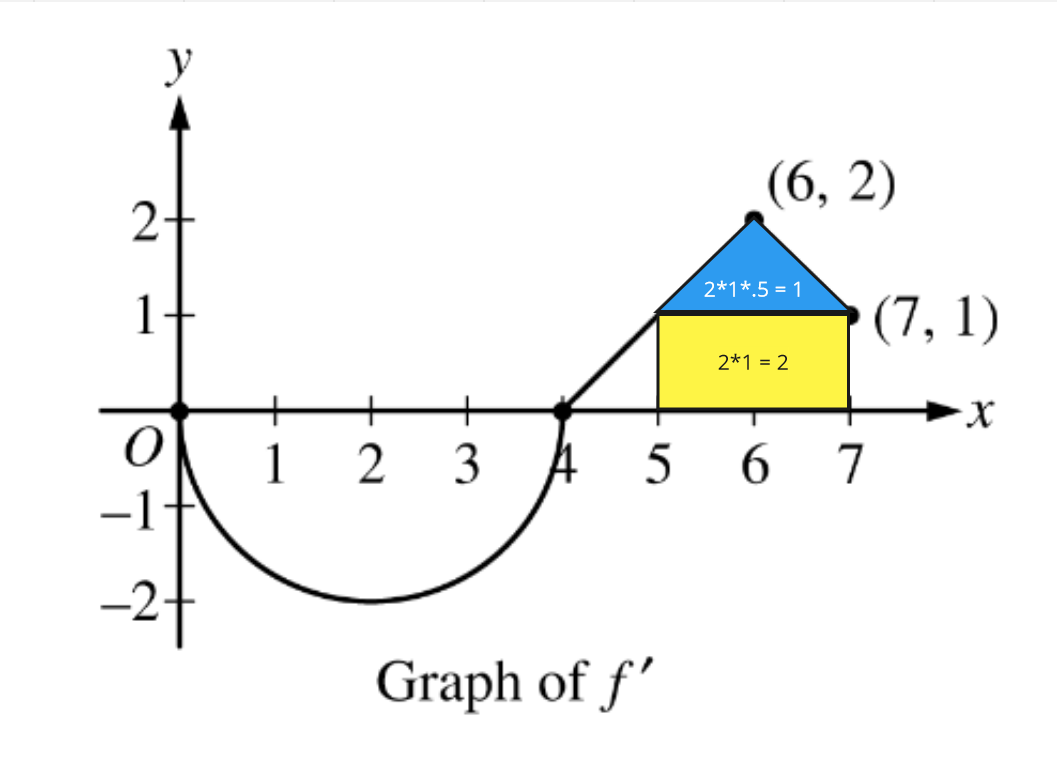
f(7)f(7) was found by adding f(5)+57f(x)dx=3.5+3=6.5f(5) + \int_5^7f'(x)dx =3.5 + 3 = 6.5 through geometry.

Untitled
Integral between x=5x =5 and x=7x =7 broken up into area of a triangle and rectangle. Courtesy of College Board and Julianna Fontanilla

So the absolute minimum of g(x)g(x) is -1.5 which occurs when x=5x=5.


📝 Practice Tips

Here are some tips and tricks when approaching these question types:

  1. 💭 Understand the Relationship: If F(x)=axf(t)dtF(x)=\int_{a}^{x}f(t)dt, this means that F(x)=f(x)F’(x) = f(x) and F(x)=f(x)F’'(x) = f'(x).
  2. 📈 Use Graphical Information: Identify notable points on a graph, such as zeroes, minimums, and maximums. Always relate these back to the original integral equation.
  3. 🧠 Evaluate Extrema: Evaluate function values at critical points (zeroes) to determine relative and absolute extrema of the original integral. Don’t forget to also evaluate endpoints!
  4. Clarify the Question: Make sure you are looking for the zeroes of the correct derivative! It gets very easy to confuse F(x)F(x), F(x)F’(x), and F’’(x)F’’(x). Write Tip 1 somewhere on your paper.

This topic may be difficult, but the most important thing to remember is that area under a curve = the antiderivative. Practice using both concepts with different integral questions to get comfortable with the idea. As always, the best way to improve your understanding is to try lots of practice problems and familiarize yourself with the setup of common AP questions covering this topic. You’ve got this! 👍🏼

Vocabulary

The following words are mentioned explicitly in the College Board Course and Exam Description for this topic.

TermDefinition
accumulation functionFunctions that represent the accumulated total of a quantity over an interval, typically defined as g(x) = ∫[a to x] f(t) dt.
definite integralThe integral of a function over a specific interval [a, b], representing the net signed area between the curve and the x-axis.

Frequently Asked Questions

How do I find g(x) when g(x) equals the integral from a to x of f(t) dt?

If g(x) = ∫_a^x f(t) dt, use the Fundamental Theorem of Calculus (Part 1): - Differentiation: g′(x) = f(x). So g is an antiderivative of f and is continuous/differentiable wherever f is. - Evaluation: if F is any antiderivative of f (F′ = f), then g(x) = F(x) − F(a). In particular g(a) = 0. - Graphically: g(x) equals the net (signed) area under f from a to x. Where f > 0, g increases; where f < 0, g decreases. Where f changes sign you get local extrema of g. - Use in problems: to find g(x) explicitly, find an antiderivative F(x) of f and compute F(x) − F(a). To analyze behavior (increasing/concave/inflection), use f for slope and f′ for concavity of g. This is exactly Topic 6.5 material—see the study guide for examples (https://library.fiveable.me/ap-calculus/unit-6/interpreting-behavior-accumulation-functions-involving-area/study-guide/uVNoabC47nUgOdjr) and lots of practice problems at (https://library.fiveable.me/practice/ap-calculus).

What's the difference between f(x) and the accumulation function g(x) = integral of f(t) dt?

f(x) is the original function (often a rate), while g(x) = ∫_a^x f(t) dt is the accumulation (net area) of f from a to x. Key differences and links (AP CED terms): - Role: f(t) is the integrand / rate of change; g(x) is an accumulation function (signed area, net accumulation) with initial value g(a)=0. - Derivative/Fundamental Theorem: g′(x)=f(x). So g’s slope at x equals f(x). (FUN-5.A) - Second derivative/concavity: g″(x)=f′(x). So where f′>0, g is concave up. - Increasing/decreasing: If f(x)>0 on an interval, g increases there; if f(x)<0, g decreases. Zeros of f are critical points of g (possible extrema). - Units/example: If f is “meters/second,” then g is “meters” traveled. If f(x)=2, g grows at rate 2 so g(x)=2(x−a). - Smoothness: If f is continuous, g is differentiable everywhere. This is exactly what AP asks you to interpret graphically and verbally (see Topic 6.5 study guide for examples and practice) (https://library.fiveable.me/ap-calculus/unit-6/interpreting-behavior-accumulation-functions-involving-area/study-guide/uVNoabC47nUgOdjr). For more review across Unit 6 and thousands of practice problems, check (https://library.fiveable.me/ap-calculus/unit-6) and (https://library.fiveable.me/practice/ap-calculus).

When do I use the Fundamental Theorem of Calculus to find the derivative of an accumulation function?

Use the Fundamental Theorem of Calculus Part 1 whenever your function is defined as an accumulation (definite integral) with a variable limit. Key cases: - g(x) = ∫_a^x f(t) dt. If f is continuous at x, then g′(x) = f(x). (g measures net/signed area; derivative = instantaneous accumulation rate.) - g(x) = ∫_a^{h(x)} f(t) dt. Use the chain rule: g′(x) = f(h(x))·h′(x). - g(x) = ∫_{u(x)}^{v(x)} f(t) dt. Then g′(x) = f(v(x))·v′(x) − f(u(x))·u′(x). Make sure the integrand f is continuous on the interval (this guarantees g is differentiable). Graphically: g increases where f > 0, decreases where f < 0, and g′(x) equals the height of f at x (with chain-rule adjustments if limits aren’t just x). This is exactly what Topic 6.5 / FUN-5.A in the CED tests—practice these forms on the study guide (https://library.fiveable.me/ap-calculus/unit-6/interpreting-behavior-accumulation-functions-involving-area/study-guide/uVNoabC47nUgOdjr) and try more problems at (https://library.fiveable.me/practice/ap-calculus).

I'm confused about why g'(x) = f(x) when g(x) is the integral from a to x of f(t) dt - can someone explain?

Think of g(x) = ∫_a^x f(t) dt as the net area accumulated from a to x. If you increase x by a tiny amount h, the extra area added is approximately the height f(x) times the width h (because over a very small interval f is nearly constant). So g(x + h) − g(x) ≈ f(x)·h. Divide by h and take the limit as h → 0: g′(x) = lim_{h→0} [g(x+h)−g(x)]/h = f(x). This is the Fundamental Theorem of Calculus, Part I: when f is continuous, the accumulation function g(x)=∫_a^x f(t) dt is differentiable and its derivative is the integrand f(x). Intuitively, f(x) is the instantaneous rate at which area (or any accumulated quantity) is changing—exactly what a derivative measures. This is a key AP idea in Topic 6.5 (see the study guide) (https://library.fiveable.me/ap-calculus/unit-6/interpreting-behavior-accumulation-functions-involving-area/study-guide/uVNoabC47nUgOdjr). For more practice on interpreting accumulation and rates, check the Unit 6 resources (https://library.fiveable.me/ap-calculus/unit-6) and practice problems (https://library.fiveable.me/practice/ap-calculus).

How do I interpret the graph of an accumulation function when I'm given the graph of f(x)?

Think of g(x) = ∫_a^x f(t) dt as “net area accumulated from a to x.” Use these quick rules from the FTC and the CED keywords: - g′(x) = f(x). So where f > 0, g is increasing; where f < 0, g is decreasing. - g″(x) = f′(x). So if f is increasing (f′ > 0) then g is concave up; if f is decreasing (f′ < 0) g is concave down. - Local extrema of g occur where f crosses 0 (f changes sign). If f crosses from + to −, g has a local max; from − to +, a local min. - g(x) value equals signed area: add positive areas above the axis and subtract negative areas below. Use that to compute values or compare accumulation amounts. - Remember initial value g(a) sets the baseline; everything is relative to that. On the exam you’ll be asked to read f’s graph and state intervals of increase/decrease, concavity, and compute net accumulation—practice doing that visually. For a focused walk-through, see the Topic 6.5 study guide (https://library.fiveable.me/ap-calculus/unit-6/interpreting-behavior-accumulation-functions-involving-area/study-guide/uVNoabC47nUgOdjr). For extra practice problems, check (https://library.fiveable.me/practice/ap-calculus).

What does it mean when the accumulation function g(x) is increasing or decreasing?

If g(x) = ∫_a^x f(t) dt, the Fundamental Theorem of Calculus says g′(x) = f(x). So: - g is increasing on any interval where f(x) > 0 (the net area is growing; g has positive slope). - g is decreasing where f(x) < 0 (net area is shrinking; g has negative slope). - If f(x) = 0 at a point, g has a horizontal tangent there. Think of g(x) as “net accumulated area from a to x.” Positive signed area adds to g; negative signed area subtracts. Also useful: g″(x) = f′(x), so if f is increasing then g is concave up, and if f is decreasing g is concave down—useful for interpreting shape on the exam. This is exactly the idea tested in Topic 6.5 (FUN-5.A)—see the topic study guide (https://library.fiveable.me/ap-calculus/unit-6/interpreting-behavior-accumulation-functions-involving-area/study-guide/uVNoabC47nUgOdjr) and the Unit 6 overview (https://library.fiveable.me/ap-calculus/unit-6). For more practice problems, check https://library.fiveable.me/practice/ap-calculus.

How do I find where g(x) has a maximum or minimum if g(x) = integral from 2 to x of f(t) dt?

Use the Fundamental Theorem of Calculus: g′(x) = f(x). So to find maxima/minima of g: - Find critical points: solve f(x) = 0 or where f is undefined. Also check endpoints of the domain/interval. - Use sign changes of f to classify: - If f (i.e., g′) changes from positive to negative at c, g has a local maximum at c. - If f changes from negative to positive at c, g has a local minimum at c. - You can also use the second-derivative idea: g′′(x) = f′(x). If g′(c)=0 and f′(c)<0, g has a local max; if f′(c)>0, g has a local min (when f′ exists). - Remember g(2)=∫_2^2 f = 0, so include that endpoint if you’re looking for absolute extrema on a closed interval. Graphically: g rises where the signed area under f is increasing (f>0) and falls where f<0. For more examples and AP-style practice, see the Topic 6.5 study guide (https://library.fiveable.me/ap-calculus/unit-6/interpreting-behavior-accumulation-functions-involving-area/study-guide/uVNoabC47nUgOdjr) and the Unit 6 page (https://library.fiveable.me/ap-calculus/unit-6).

When f(x) is positive, what happens to the accumulation function g(x)?

If g(x) = ∫_a^x f(t) dt and f(x) > 0 on an interval, then g is increasing on that interval. By the Fundamental Theorem of Calculus (Part 1), g′(x) = f(x), so a positive integrand means a positive derivative—g’s slope is positive. Intuitively, g is accumulating positive (signed) area, so for x > a you get g(x) > g(a); larger values of f make g grow faster. (If you move left of a, ∫_a^x f = negative of the positive area from x to a, so g decreases as x decreases.) This reasoning—tying g′ = f, signed area, and net accumulation—is exactly what the AP CED expects for Topic 6.5 (FUN-5.A.3). For more examples and practice, see the Topic 6.5 study guide (https://library.fiveable.me/ap-calculus/unit-6/interpreting-behavior-accumulation-functions-involving-area/study-guide/uVNoabC47nUgOdjr) and practice problems (https://library.fiveable.me/practice/ap-calculus).

I don't understand how to read information about g(x) from the graph of f(t) - help?

Think of g(x) = ∫_a^x f(t) dt as “running total” of signed area under f from a to x. Use these quick rules when reading g from the graph of f: - g′(x) = f(x). So where f is positive, g is increasing; where f is negative, g is decreasing. - The steepness of g at x equals the height of f at x: larger |f(x)| → steeper slope of g. - g has a local max/min where f crosses zero (changes sign). If f goes + → − at x, g has a local max; − → + gives a local min. - g″(x) = f′(x). So g is concave up where f is increasing, concave down where f is decreasing. - Values: g(x) = g(a) + net signed area from a to x. So the numerical area between a and x tells you how much g changed. - Continuity/differentiability: if f is continuous then g is differentiable everywhere (Fundamental Theorem of Calculus, FUN-5.A). If you want practice identifying intervals and extrema from graphs like this (AP-style), check the Topic 6.5 study guide (https://library.fiveable.me/ap-calculus/unit-6/interpreting-behavior-accumulation-functions-involving-area/study-guide/uVNoabC47nUgOdjr) and try problems from the Unit 6 practice set (https://library.fiveable.me/practice/ap-calculus).

What's the relationship between the area under f(t) and the value of the accumulation function?

Think of g(x) = ∫_a^x f(t) dt as the running total (net accumulation) of signed area under f from a to x. By the FTC (part 1), g′(x) = f(x), so: - The value g(x) equals the net area (positive area above the t-axis minus area below) between t = a and t = x. - Where f(t) > 0, g increases (area is being added); where f(t) < 0, g decreases (area is being subtracted). - g has a horizontal tangent (local extremum) when f(x) = 0; whether it’s a max or min depends on the sign change of f. - The rate g is changing at x is exactly f(x); the concavity of g is given by g″(x) = f′(x). On the AP exam you’ll be asked to read graphs/tables of f and use these facts to describe increasing/decreasing intervals, extrema, and amounts of accumulation (definite integrals). For a focused review check the Topic 6.5 study guide (https://library.fiveable.me/ap-calculus/unit-6/interpreting-behavior-accumulation-functions-involving-area/study-guide/uVNoabC47nUgOdjr) and more unit resources (https://library.fiveable.me/ap-calculus/unit-6).

How do I solve problems where they give me f(x) and ask about the behavior of g(x) = integral of f(t) dt?

Think of g(x) = ∫_a^x f(t) dt as “net area so far.” Use the Fundamental Theorem of Calculus (Part 1): g′(x) = f(x). So: - Where f(x) > 0, g is increasing; where f(x) < 0, g is decreasing. - Critical points of g occur where f(x) = 0 (or f is undefined). Check sign changes of f to tell if g has a local max/min. - g″(x) = f′(x), so g is concave up where f′(x) > 0 and concave down where f′(x) < 0. - g(a) is the initial value (often 0); g(x) gives signed net accumulation (areas above positive, below negative). - To get values: evaluate the definite integral (antiderivative or numeric area). For sketching, integrate areas piecewise and keep signs. For AP problems, explicitly state g′ and g″, use sign charts for f and f′, and refer to net signed area when evaluating g. For extra practice and examples, see the Topic 6.5 study guide (https://library.fiveable.me/ap-calculus/unit-6/interpreting-behavior-accumulation-functions-involving-area/study-guide/uVNoabC47nUgOdjr) and Unit 6 resources (https://library.fiveable.me/ap-calculus/unit-6).

Why does g(x) have a critical point wherever f(x) = 0?

Because g(x) = ∫_a^x f(t) dt, the Fundamental Theorem of Calculus (Part 1) gives g′(x) = f(x). A critical point of g is any x where g′(x) = 0 or g′ is undefined. So wherever f(x) = 0 (and f is continuous so g is differentiable there), g′(x)=0 and x is a critical point of g. (This is exactly the FUN-5.A connection between an integrand and its accumulation function.) Whether that critical point is a local max, min, or neither depends on how f changes sign at x: - f: + → − (g′ goes positive → negative) ⇒ local maximum of g. - f: − → + ⇒ local minimum. - If f just touches 0 without changing sign, g has a horizontal inflection (no local extremum). For more on interpreting accumulation functions and signed area, see the Topic 6.5 study guide (https://library.fiveable.me/ap-calculus/unit-6/interpreting-behavior-accumulation-functions-involving-area/study-guide/uVNoabC47nUgOdjr). For extra practice, check the unit resources (https://library.fiveable.me/ap-calculus/unit-6) and thousands of practice problems (https://library.fiveable.me/practice/ap-calculus).

Can someone explain step by step how to find g'(x) and g''(x) when g(x) is an accumulation function?

If g(x) is an accumulation function g(x) = ∫_a^x f(t) dt (with f continuous), use the Fundamental Theorem of Calculus (Part 1): - Step 1—g′(x): g′(x) = f(x). Intuition: the instantaneous rate of change of accumulated area equals the height of the integrand at x (signed area/net accumulation). (CED: FUN-5.A) - Step 2—g″(x): differentiate g′. If f is differentiable, g″(x) = f′(x). So concavity of g comes from f′. If the limit depends on x (variable limits): - If g(x)=∫_a^{h(x)} f(t) dt, then g′(x)=f(h(x))·h′(x) by chain rule. - Then g″(x)=d/dx[f(h(x))·h′(x)] = f′(h(x))·(h′(x))^2 + f(h(x))·h″(x). More generally, for g(x)=∫_{u(x)}^{v(x)} f(t) dt: - g′(x)=f(v(x))v′(x) − f(u(x))u′(x). Want more worked examples and AP-style practice on interpreting accumulation, continuity, and sign? Check the Topic 6.5 study guide (https://library.fiveable.me/ap-calculus/unit-6/interpreting-behavior-accumulation-functions-involving-area/study-guide/uVNoabC47nUgOdjr) and more Unit 6 resources (https://library.fiveable.me/ap-calculus/unit-6). For lots of practice problems, see (https://library.fiveable.me/practice/ap-calculus).

What does the concavity of g(x) tell me about f(x) and f'(x)?

If g(x) = ∫_a^x f(t) dt, the Fundamental Theorem of Calculus gives g′(x) = f(x) and g″(x) = f′(x). So concavity of g tells you about f and f′ directly: - If g is concave up on an interval, then g″(x) > 0 there → f′(x) > 0 → f is increasing on that interval. Since g′ = f, g′ is increasing. - If g is concave down, then g″(x) < 0 → f′(x) < 0 → f is decreasing (so g′ is decreasing). - Combined with signs of f: g is increasing where f(x) > 0 and decreasing where f(x) < 0. In APCalc language: concavity of the accumulation function g gives the sign of the integrand’s derivative (f′) and whether the integrand f is increasing or decreasing. For more practice and examples, see the Topic 6.5 study guide (https://library.fiveable.me/ap-calculus/unit-6/interpreting-behavior-accumulation-functions-involving-area/study-guide/uVNoabC47nUgOdjr) and extra problems (https://library.fiveable.me/practice/ap-calculus).

How do I use the graph of f(t) to sketch the graph of its accumulation function g(x)?

Think of g(x) = ∫_a^x f(t) dt as a running total whose instantaneous rate of change is f. That gives you three quick rules to sketch g from the graph of f: - Slope rule: g′(x) = f(x). At each x, the slope of g equals the height of f there. If f(x) is large positive, g is steeply increasing; if f(x) is negative, g is decreasing. - Extrema: g has a local max or min where f crosses zero (changes sign). If f goes + to −, g has a local max; − to + gives a local min. - Concavity: g′′(x) = f′(x). Where f is increasing, g is concave up; where f is decreasing, g is concave down. Practical sketch steps: start at g(a) (usually 0), move right using slope = f(x), flatten where f = 0, steepen where f is large, and change concavity where f has turning points. Use signed areas under f to place relative vertical changes or exact values when integrals/areas are computable. These ideas are exactly what the CED calls for (FUN-5.A). For more examples and practice problems, see the Topic 6.5 study guide (https://library.fiveable.me/ap-calculus/unit-6/interpreting-behavior-accumulation-functions-involving-area/study-guide/uVNoabC47nUgOdjr) and the unit practice page (https://library.fiveable.me/practice/ap-calculus).