8.11 Volume with Washer Method: Revolving Around the x- or y-Axis

♾️AP Calculus AB/BC Unit 8 Review
8.11 Volume with Washer Method: Revolving Around the x- or y-Axis
♾️ AP Calculus AB/BC
8.1
Finding the Average Value of a Function on an Interval
8.2
Connecting Position, Velocity, and Acceleration of Functions Using Integrals
8.3
Using Accumulation Functions and Definite Integrals in Applied Contexts
8.4
Finding the Area Between Curves Expressed as Functions of x
8.5
Finding the Area Between Curves Expressed as Functions of y
8.6
Finding the Area Between Curves That Intersect at More Than Two Points
8.7
Volumes with Cross Sections: Squares and Rectangles
8.8
Volumes with Cross Sections: Triangles and Semicircles
8.9
Volume with Disc Method: Revolving Around the x- or y-Axis
8.10
Volume with Disc Method: Revolving Around Other Axes
8.11
Volume with Washer Method: Revolving Around the x- or y-Axis
8.12
Volume with Washer Method: Revolving Around Other Axes
8.13
The Arc Length of a Smooth, Planar Curve and Distance Traveled
The washer method finds the volume of a solid of revolution when there is a gap between the region and the axis, so each slice is a ring instead of a full disc. Square the outer radius, subtract the squared inner radius, multiply by , and integrate: . For AP Calculus, the setup matters as much as the arithmetic.
Why This Matters for the AP Calculus Exam
Volume of revolution shows up often in AP Calculus, both in multiple-choice and in free-response questions where you set up an integral. You usually have to choose the right procedure (disc vs. washer), find intersection points for your bounds, and write a correct integral using clear notation. Many free-response volume problems do not even ask you to evaluate the integral by hand, so a correct, well-written setup like is exactly the kind of work that matters. A graphing calculator can find intersections and evaluate the integral, so your job is recognizing the structure.
Key Takeaways
- Use the washer method when the region you revolve has a gap between it and the axis, leaving a ring-shaped cross section.
- The area of a washer is , where is the outer (farther) radius and is the inner (nearer) radius, both measured from the axis of rotation.
- Square each radius first, then subtract. Squaring the difference is a common and costly error.
- Find bounds by setting the two functions equal and solving for the intersection points, or use your calculator.
- The function farther from the axis is the outer radius. The top function is not automatically the outer one; it depends on where the axis is.
- Your final volume must be positive. A negative answer usually means you swapped the radii.
The Washer Method
A washer is a circle with a smaller circle cut out of the middle, so its cross section looks like a ring.
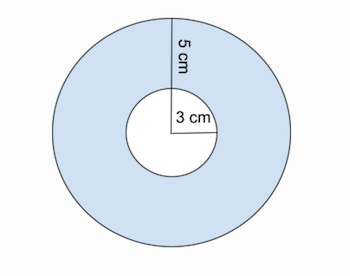
You use washer cross sections when you revolve a region bounded by more than one function around an axis, and there is space between the region and that axis. The area of one washer is:
where is the larger (outer) radius and is the smaller (inner) radius. Replacing the circle area in the disc method with this washer area gives the washer integral:
Here is the function farther from the -axis (outer radius) and is the function nearer the -axis (inner radius). The lower bound is , and the upper bound is .
Over your interval, should be farther from the axis of rotation than .
You must square each function before subtracting. For example, a washer with outer radius 4 and inner radius 2 has area:
not .
📌 Order of operations matters: square, then subtract.
When you revolve around the -axis, the radii are vertical distances, so you usually integrate with respect to . When you revolve around the -axis, the radii are horizontal distances, so you write the curves as functions of and integrate with respect to .
Solving with the Washer Equation
The general washer equation works for any washer problem:
You are always given at least two functions and told the axis of rotation. Usually you still have to find the bounds and decide which function is (outer) and which is (inner).
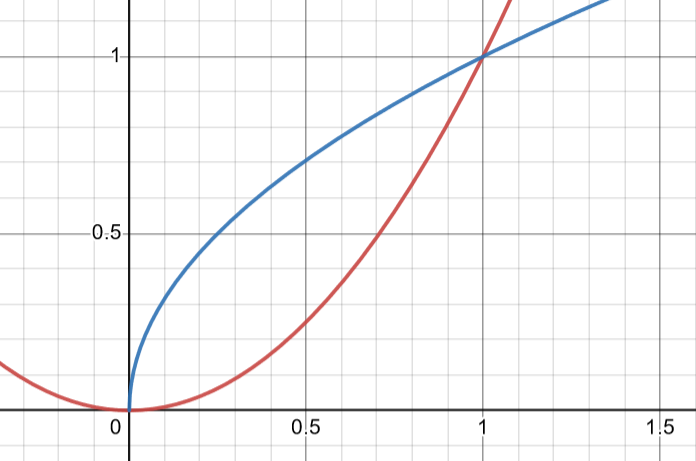
Suppose you want the volume of the solid formed when the region bounded by and is revolved around the -axis.
Find the bounds. The bounds occur where the two functions intersect. Set them equal:
This gives and , so and . You can also use a graphing calculator to find intersections.
Decide which function is outer. Over the interval from 0 to 1, is farther from the -axis than , so and .
Graphing the functions and the axis of rotation is worth the time. It shows you the region, helps you estimate the bounds, and tells you which function is farther from the axis. It also keeps you from assuming the top function is always the outer radius.
For a -axis rotation, the same idea applies with horizontal radii. Write each boundary as or , then integrate with respect to :
Summing Up the Washer Method
With , , , and , the integral is:
Simplify:
Using the power rule:
Evaluate:
Your final answer should be positive, since volume is always positive. A negative result usually means you mixed up which function is and which is .
How to Use This on the AP Calculus Exam
Free Response
A typical setup gives you two curves and an axis. Your steps:
- Confirm whether the rotation is around the -axis or -axis.
- Find and , the bounds, usually from where the curves intersect.
- Identify the outer radius (farther from the axis) and inner radius (nearer the axis).
A correct expression with clear notation is the heart of these problems, so write the integral cleanly even if a calculator does the arithmetic.
Problem Solving
Try this one before reading the solution.
Find the integral that represents the volume of the solid formed by revolving the region bounded by and about the -axis.
Identify:
- and (bounds)
- and (farther and nearer functions)
Solution
Start by sketching the functions and the axis of rotation.
For the bounds, set the two functions equal:
Then solve:
So the bounds are and .
On , the line is farther from the -axis than the parabola . That means the outer radius is and the inner radius is .
The integral is:
You could simplify this to:
The setup is the important AP skill: find the intersections, identify the farther function as the outer radius, square each radius separately, and subtract.
Common Trap
Do not assume the top curve is the outer radius. The outer radius is whichever curve is farther from the axis of rotation, and that can flip depending on where the axis sits.
Common Misconceptions
- Misconception: You should square the difference instead of subtracting the squares.Actually: is not . Always square each radius separately, then subtract.
- Misconception: The top function is the outer radius.Actually: The outer radius is the curve farther from the axis. If the axis is above or below the region in an unexpected place, the roles can switch.
- Misconception: Shifted-axis formulas should be used here.Actually: If the axis is not the -axis or -axis, use the 8.12 method and measure each radius from the shifted line.
- Misconception: Washers should be used even when there is no gap.Actually: If the region touches the axis with no hole, the inner radius is 0 and the washer collapses to a disc. Washers are for ring-shaped cross sections.
- Misconception: The pi or the bounds can be dropped.Actually: A correct setup needs , the squared radii, and the correct limits of integration.
- Misconception: Volume can be negative.Actually: Volume is always positive, so a negative result signals that you swapped the outer and inner radii.
Prerequisites and Review
If you need a refresher, review the disc method in 8.9 Volume with Disc Method: Revolving Around the x- or y-Axis and the disc method with other axes in 8.10 Volume with Disc Method: Revolving Around Other Axes. The washer method is the disc method with a hole subtracted out.
Related AP Calculus Guides
- Unit 8 Overview: Applications of Integration
- 8.1 Finding the Average Value of a Function on an Interval
- 8.7 Volumes with Cross Sections: Squares and Rectangles
- 8.2 Connecting Position, Velocity, and Acceleration of Functions Using Integrals
- 8.4 Finding the Area Between Curves Expressed as Functions of x
- 8.3 Using Accumulation Functions and Definite Integrals in Applied Contexts
Practice Questions for 8.11
1 of 10
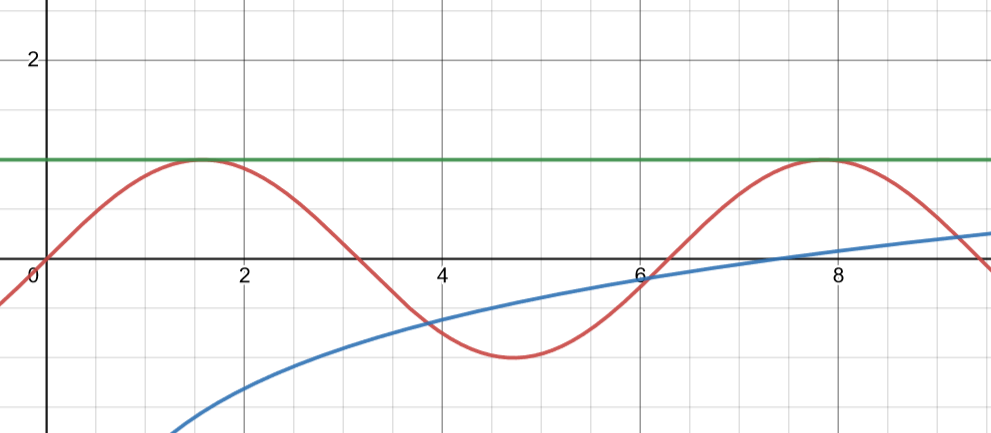
The graph of the function is shown above.
Let be the region bounded by the graph of and the horizontal line . Which of the following expressions gives the volume of the solid generated when is revolved about the -axis?
A.
B.
C.
D.
Vocabulary
The following words are mentioned explicitly in the AP® course framework for this topic.Term | Definition |
|---|---|
cross section | Two-dimensional slices of a three-dimensional solid, perpendicular to an axis, used to build up the volume through integration. |
definite integral | The integral of a function over a specific interval [a, b], representing the net signed area between the curve and the x-axis. |
ring shaped | Cross sections that have the shape of a washer or annulus, with an outer radius and an inner radius, used in volume calculations. |
solids of revolution | Three-dimensional solids formed by rotating a two-dimensional region around an axis. |
washer method | A technique for finding the volume of a solid of revolution by integrating the areas of ring-shaped (washer-shaped) cross sections perpendicular to the axis of rotation. |
Frequently Asked Questions
What is the washer method in AP Calculus?
The washer method finds the volume of a solid of revolution when cross sections are rings instead of full discs. You subtract the inner circular area from the outer circular area and integrate.
What is the washer method formula?
The washer method formula is V = pi integral from a to b of [R(x)^2 - r(x)^2] dx, where R is the outer radius and r is the inner radius. If integrating with respect to y, use R(y) and r(y).
How do I choose the outer and inner radius?
Measure both radii from the axis of rotation. The outer radius is the distance to the curve farther from the axis, and the inner radius is the distance to the curve closer to the axis.
What is the difference between the disc and washer methods?
The disc method uses full circular cross sections with no hole. The washer method uses ring-shaped cross sections, so you subtract the inner radius squared from the outer radius squared.
Why do I square before subtracting in the washer method?
Each washer area is the area of a large circle minus the area of a small circle. That means pi R squared minus pi r squared, not pi times (R - r) squared.
How is the washer method tested on AP Calculus?
AP Calculus questions may ask you to set up a volume integral, choose bounds from intersections, identify radii from an axis of rotation, or use a calculator to evaluate the final integral.
See Fiveable more often in Google
Mark Fiveable as a preferred source and Google is more likely to show you our guides in Top Stories, with a "preferred" badge in AI Mode and AI Overviews.